


All parties involved in Taiwan-US relations share responsibility for the current impasse on US arms sales to Taiwan, Lin Yu-fang (林郁方), chairman of the Legislative Yuan’s Diplomacy and National Defense Committee, said in Washington on Thursday.
Lin, who is heading a delegation for talks with US officials, congressmen and think tanks, cast blame on his own Chinese Nationalist Party (KMT), as well as the Democratic Progressive Party (DPP) and the US government in the arms sales standoff that has led to the current “freeze” in the arms sales process.
At a press conference for Taiwan reporters at the end of his trip to Washington, Lin said there had been many “misunderstandings” on the issue between the two countries, and that his main purpose in coming to Washington was to try to overcome those misunderstandings.
Lin said he was pessimistic about the US Congress’ ability to approve the US$11 billion arms package being held up by the administration of US President George W. Bush this year.
As a result, the decision will have to go to the new president that US voters elect in November, and “everything will have to start over again,” he said in remarks translated for the Taipei Times.
Lin hit out at the DPP for spreading negative information about the KMT in Washington.
He said the DPP had told Washington that the KMT was “anti-arms sales” and never wanted to buy advanced F-16C/D fighters, and that the KMT only cares about China and doesn’t care about the US.
As for the KMT, Lin conceded that the party, which has control of the Legislative Yuan, was also responsible for delaying approval of the budget for the arms that Taiwan sought to buy from the US.
As for the US’ responsibility, Lin said that although the Legislative Yuan approved funds for the design of the diesel-electric subs, the US tried to charge Taiwan an exorbitant sum of more than US$1.1 billion per vessel and did not send Taiwan a so-called “PNA” giving price and availability until years after Taiwanese lawmakers approved the funding.
In addition, the US has never used the budget allocation to begin the design process that Taiwan approved, he said.
US specialists familiar with the issue feel that Taiwan may never get the subs because China has drawn a red line at the supply of the subs, in view of the threat Beijing feels they might pose to China.
On other items, Lin said the Bush administration was also to blame for delaying sending PNA’s, which inhibited the Legislative Yuan’s action on the sales.
Nevertheless, Lin said he was optimistic about prospects for the eventual US sales of items other than the subs and the F16s.
Lin called the arms sales issue the “touchstone” of overall Taiwan and US relations.
The issue is not only about procurement, but about the whole Taiwan-US relationship, he said.
The lawmaker said he found US attitudes toward Taiwan very complex and conflicting.
Using the analogy of a family with a marriage-age daughter, he said that while the family is anxious for the girl to marry, when she does find a man, they are very nervous and unsure about her marriage and afraid of her leaving them.
In the same way, Lin said he found in his talks with US officials and academics that while they favored advances toward China by the government of President Ma Ying-jeou (馬英九), they also had concerns over whether he was going too far at the expense of US-Taiwan relations.
Lin said he doubted China would try to use the arms issue as a bargaining chip in US-China relations, for instance taking revenge on Taiwanese businesses in China for US arms sales. Beijing knows, he asserted, that if it tried to manipulate the arms issue for its own purposes, that would engender a backlash in Taiwan and that the Taiwanese would feel that “the price of engagement with China is too high.”
That is not what the Chinese government wants, he said.
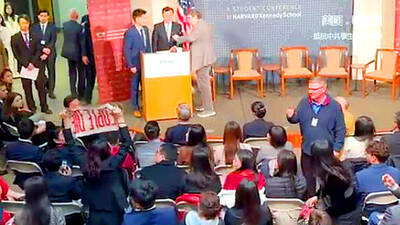
A group of Taiwanese-American and Tibetan-American students at Harvard University on Saturday disrupted Chinese Ambassador to the US Xie Feng’s (謝鋒) speech at the school, accusing him of being responsible for numerous human rights violations. Four students — two Taiwanese Americans and two from Tibet — held up banners inside a conference hall where Xie was delivering a speech at the opening ceremony of the Harvard Kennedy School China Conference 2024. In a video clip provided by the Coalition of Students Resisting the CCP (Chinese Communist Party), Taiwanese-American Cosette Wu (吳亭樺) and Tibetan-American Tsering Yangchen are seen holding banners that together read:

UNAWARE: Many people sit for long hours every day and eat unhealthy foods, putting them at greater risk of developing one of the ‘three highs,’ an expert said More than 30 percent of adults aged 40 or older who underwent a government-funded health exam were unaware they had at least one of the “three highs” — high blood pressure, high blood lipids or high blood sugar, the Health Promotion Administration (HPA) said yesterday. Among adults aged 40 or older who said they did not have any of the “three highs” before taking the health exam, more than 30 percent were found to have at least one of them, Adult Preventive Health Examination Service data from 2022 showed. People with long-term medical conditions such as hypertension or diabetes usually do not
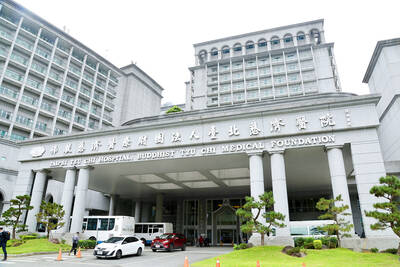
POLICE INVESTIGATING: A man said he quit his job as a nurse at Taipei Tzu Chi Hospital as he had been ‘disgusted’ by the behavior of his colleagues A man yesterday morning wrote online that he had witnessed nurses taking photographs and touching anesthetized patients inappropriately in Taipei Tzu Chi Hospital’s operating theaters. The man surnamed Huang (黃) wrote on the Professional Technology Temple bulletin board that during his six-month stint as a nurse at the hospital, he had seen nurses taking pictures of patients, including of their private parts, after they were anesthetized. Some nurses had also touched patients inappropriately and children were among those photographed, he said. Huang said this “disgusted” him “so much” that “he felt the need to reveal these unethical acts in the operating theater
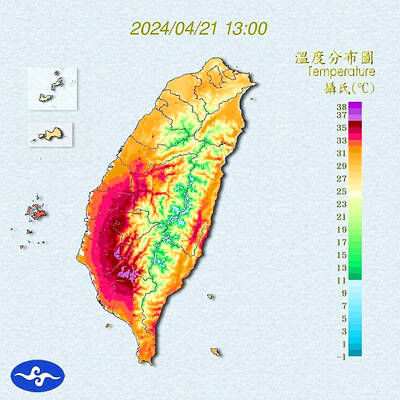
Heat advisories were in effect for nine administrative regions yesterday afternoon as warm southwesterly winds pushed temperatures above 38°C in parts of southern Taiwan, the Central Weather Administration (CWA) said. As of 3:30pm yesterday, Tainan’s Yujing District (玉井) had recorded the day’s highest temperature of 39.7°C, though the measurement will not be included in Taiwan’s official heat records since Yujing is an automatic rather than manually operated weather station, the CWA said. Highs recorded in other areas were 38.7°C in Kaohsiung’s Neimen District (內門), 38.2°C in Chiayi City and 38.1°C in Pingtung’s Sandimen Township (三地門), CWA data showed. The spell of scorching


 RSS
RSS