


Twenty million tonnes of agricultural waste is produced in Taiwan each year, but with a little technical dress-up the waste can be converted into high-quality fertilizers and increase agricultural production by 15 percent to 20 percent, the Council of Agriculture (COA) said earlier this week.
The COA's Taichung district agricultural research and extension station developed four fertilizers last year and patented the technologies and recipes. It has transferred the fruits of its research to 13 businesses for commercial application, station director-general Chen Jung-wu (
Agricultural waste, including animal feces, rice stalks, sugar cane pulp and wood chips, contain fertilizing components such as nitrogen, potassium and phosphorous, he said.
"After fermentation, the 20 million tonnes of waste can be turned into 10 million tonnes of fertilizer, which is enough to nourish a million hectares of farm land," he said.
To increase the potency of the fertilizers, microorganisms are mixed into the waste, project researcher Tsai Yi-feng said. Different microorganisms are used for different kinds of waste.
"Microorganisms produce enzymes that can break down compounds in the waste and expose nutrients for the crops to absorb, making the end product [fertilizers] not only less smelly, but also more effective," Tsai said, "We have tested the compatibility of microorganisms with each type of waste and obtained several good recipes, four of which have been patented."
Every gram of the fertilizer product contains a billion active microorganisms. In addition, since most of the enzymes were found in the soil, they work very well because their survival in the soil is assured, he said.
The fertilizers have been used to grow persimmons, grapes, strawberries, pineapples, roses and potatoes, and had gained a 15 percent to 20 percent production increase in the crops, Chen said.

Former president Ma Ying-jeou’s (馬英九) mention of Taiwan’s official name during a meeting with Chinese President Xi Jinping (習近平) on Wednesday was likely a deliberate political play, academics said. “As I see it, it was intentional,” National Chengchi University Graduate Institute of East Asian Studies professor Wang Hsin-hsien (王信賢) said of Ma’s initial use of the “Republic of China” (ROC) to refer to the wider concept of “the Chinese nation.” Ma quickly corrected himself, and his office later described his use of the two similar-sounding yet politically distinct terms as “purely a gaffe.” Given Ma was reading from a script, the supposed slipup
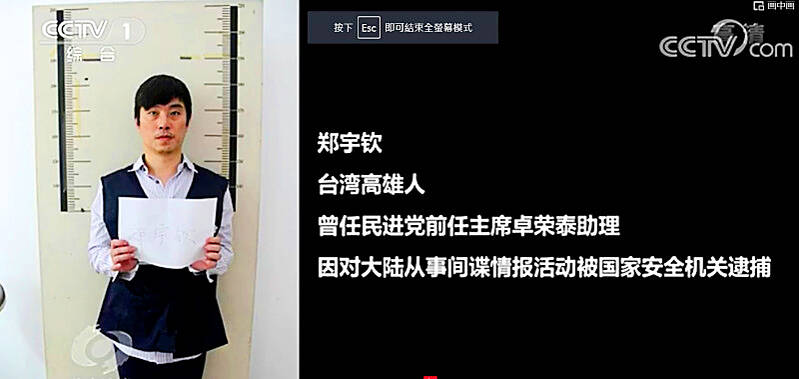
Former Czech Republic-based Taiwanese researcher Cheng Yu-chin (鄭宇欽) has been sentenced to seven years in prison on espionage-related charges, China’s Ministry of State Security announced yesterday. China said Cheng was a spy for Taiwan who “masqueraded as a professor” and that he was previously an assistant to former Cabinet secretary-general Cho Jung-tai (卓榮泰). President-elect William Lai (賴清德) on Wednesday last week announced Cho would be his premier when Lai is inaugurated next month. Today is China’s “National Security Education Day.” The Chinese ministry yesterday released a video online showing arrests over the past 10 years of people alleged to be
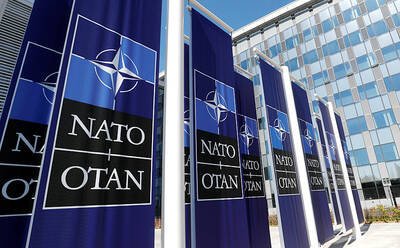
THE HAWAII FACTOR: While a 1965 opinion said an attack on Hawaii would not trigger Article 5, the text of the treaty suggests the state is covered, the report says NATO could be drawn into a conflict in the Taiwan Strait if Chinese forces attacked the US mainland or Hawaii, a NATO Defense College report published on Monday says. The report, written by James Lee, an assistant research fellow at Academia Sinica’s Institute of European and American Studies, states that under certain conditions a Taiwan contingency could trigger Article 5 of NATO, under which an attack against any member of the alliance is considered an attack against all members, necessitating a response. Article 6 of the North Atlantic Treaty specifies that an armed attack in the territory of any member in Europe,
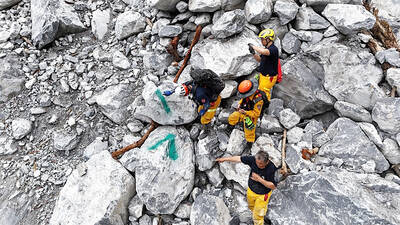
The bodies of two individuals were recovered and three additional bodies were discovered on the Shakadang Trail (砂卡礑) in Taroko National Park, eight days after the devastating earthquake in Hualien County, search-and-rescue personnel said. The rescuers reported that they retrieved the bodies of a man and a girl, suspected to be the father and daughter from the Yu (游) family, 500m from the entrance of the trail on Wednesday. The rescue team added that despite the discovery of the two bodies on Friday last week, they had been unable to retrieve them until Wednesday due to the heavy equipment needed to lift


 RSS
RSS