


A promising new vaccine that employs a two-punch strategy to combat the HIV virus received preliminary laboratory recognition and is ready for further development before it can be used on humans, a joint project between Academia Sinica and the US' Scripps Research Institute said yesterday.
The study, led by Academia Sinica President Wong Chi-huey (
Past attempts to combat HIV -- the virus responsible for AIDS -- by increasing patient immunity have failed clinically, Wong said, but the new vaccine tackles the problem in a different way with synthetic chemicals called "glycodendrons."
Glycodendrons have a two-fold function, Wong said. They inhibit the HIV from entering the body through its traditional route and trigger an immune antibody response to a specific carbohydrate structure on the HIV surface to stop the infection from spreading.
innovative
The innovative vaccine capitalizes on two recent findings in HIV research, Wong said.
"First, it was discovered that after entering human bodies through sexual contact, HIV evades immune detection and reaches its targets -- immune T-cells in the lymphoid system -- by latching onto the human immunity system fighters, dendritic cells," he said
The location for HIV attachment was a receptor protein known as DC-SIGN, found on the cells' surface, he said.
Second is an extremely rare antibody called 2G12 found in some Austrians that kept them healthy after HIV infection, Liang Pi-hui (梁碧惠), one of the group's researchers, told the Taipei Times.
prevention
"When HIV enters the body, 2G12 triggers infection prevention mechanisms when the antibody binds with a dense sugar cluster found on the HIV surface," she said.
"When we built a dendron structure that mimicked 2G12, so that this antibody response could be triggered in lab rats, we found that the structure also bound with the DC-SIGN, preventing the HIV from latching onto it," she said.
The next stage of experiments would involve testing the vaccine on different strains of HIV and evaluating potential preventive strategies, she said.

Former president Ma Ying-jeou’s (馬英九) mention of Taiwan’s official name during a meeting with Chinese President Xi Jinping (習近平) on Wednesday was likely a deliberate political play, academics said. “As I see it, it was intentional,” National Chengchi University Graduate Institute of East Asian Studies professor Wang Hsin-hsien (王信賢) said of Ma’s initial use of the “Republic of China” (ROC) to refer to the wider concept of “the Chinese nation.” Ma quickly corrected himself, and his office later described his use of the two similar-sounding yet politically distinct terms as “purely a gaffe.” Given Ma was reading from a script, the supposed slipup
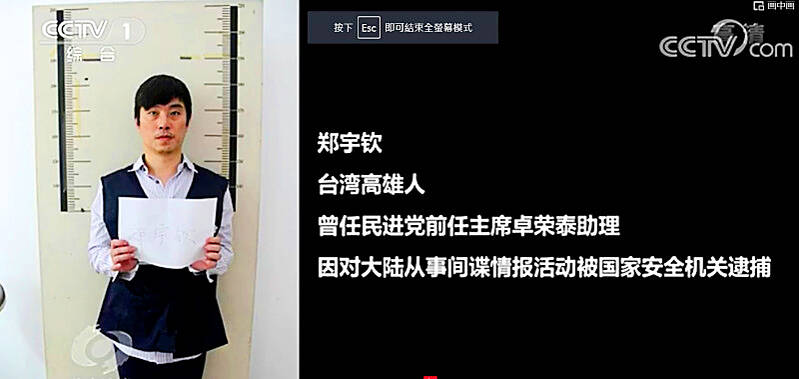
Former Czech Republic-based Taiwanese researcher Cheng Yu-chin (鄭宇欽) has been sentenced to seven years in prison on espionage-related charges, China’s Ministry of State Security announced yesterday. China said Cheng was a spy for Taiwan who “masqueraded as a professor” and that he was previously an assistant to former Cabinet secretary-general Cho Jung-tai (卓榮泰). President-elect William Lai (賴清德) on Wednesday last week announced Cho would be his premier when Lai is inaugurated next month. Today is China’s “National Security Education Day.” The Chinese ministry yesterday released a video online showing arrests over the past 10 years of people alleged to be

THE HAWAII FACTOR: While a 1965 opinion said an attack on Hawaii would not trigger Article 5, the text of the treaty suggests the state is covered, the report says NATO could be drawn into a conflict in the Taiwan Strait if Chinese forces attacked the US mainland or Hawaii, a NATO Defense College report published on Monday says. The report, written by James Lee, an assistant research fellow at Academia Sinica’s Institute of European and American Studies, states that under certain conditions a Taiwan contingency could trigger Article 5 of NATO, under which an attack against any member of the alliance is considered an attack against all members, necessitating a response. Article 6 of the North Atlantic Treaty specifies that an armed attack in the territory of any member in Europe,
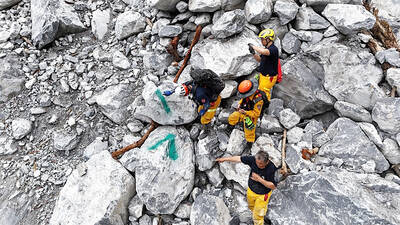
The bodies of two individuals were recovered and three additional bodies were discovered on the Shakadang Trail (砂卡礑) in Taroko National Park, eight days after the devastating earthquake in Hualien County, search-and-rescue personnel said. The rescuers reported that they retrieved the bodies of a man and a girl, suspected to be the father and daughter from the Yu (游) family, 500m from the entrance of the trail on Wednesday. The rescue team added that despite the discovery of the two bodies on Friday last week, they had been unable to retrieve them until Wednesday due to the heavy equipment needed to lift


 RSS
RSS