


The Ministry of Education honored nine organizations and 17 individuals for helping to preserve and promote their mother tongues during an award ceremony on International Mother Language Day yesterday.
"The mother tongue is an important part of cultural heritage," program host Wang Chi-wen (
However, according to UNESCO estimates, 50 percent of the 6,000 languages in the world today will become extinct by 2050, she said.
The ceremony yesterday, therefore, was to honor those who work hard to preserve Taiwan's diverse languages and cultures, Wang said.
For Hsu Teng-chih (
Although born into a Hakka family, Hsu could only speak Hoklo (also known as Taiwanese) as her family lived in a Hoklo-speaking neighborhood, she said.
"I started learning Hakka at six when we moved to Tungshih [
Tungshih is in Taichung County with a large Hakka population.
However, when Hsu started going to the local elementary school, she found herself isolated by her classmates, because she spoke Sisien (
"Out of peer pressure, I started to speak Hakka like they did, and stopped speaking the Hakka spoken by my family. After a period of time, I forgot how to speak my family's Hakka," she said.
After retiring from her 36-year career as an elementary school teacher, Hsu decided to relearn the family's language.
Hsu authored a number of textbooks teaching Dapu Hakka and taught Hakka lessons during her spare time at several elementary schools.
For Cheng Shih-chung (鄭詩宗), a dermatologist at Kaohsiung Medical University Hospital, better communication between physicians and patients was his goal in promoting education in his mother tongue.
A native Hoklo speaker, Cheng was often surprised at the inability of medical students to communicate with Hoklo-speaking patients.
"One time, when a student was supposed to tell a patient that she had yizang yan [
The student made the mistake because yizang, the Mandarin term for pancreas, is similar in pronunciation to yizhang (姨丈), the Mandarin word for "maternal aunt's husband," and the student thought it might be pronounced the same way in Hoklo, Cheng said.
In another instance, while a student meant to tell a patient that she had heart and liver problems, the student said, in Hoklo, that the patient was sim koan bo-ho, which literally translates as "evil-hearted" in Hoklo, Cheng said.
In order to prevent such confusion, Cheng began to offer medical Hoklo and medical Hakka courses at the Kaohsiung Medical University.
"Besides promoting better communication, it's important to be able to speak to a patient in his or her native tongue because it's also a way to gain the trust of that patient," Cheng said.
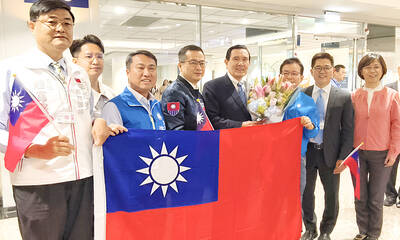
Former president Ma Ying-jeou’s (馬英九) mention of Taiwan’s official name during a meeting with Chinese President Xi Jinping (習近平) on Wednesday was likely a deliberate political play, academics said. “As I see it, it was intentional,” National Chengchi University Graduate Institute of East Asian Studies professor Wang Hsin-hsien (王信賢) said of Ma’s initial use of the “Republic of China” (ROC) to refer to the wider concept of “the Chinese nation.” Ma quickly corrected himself, and his office later described his use of the two similar-sounding yet politically distinct terms as “purely a gaffe.” Given Ma was reading from a script, the supposed slipup
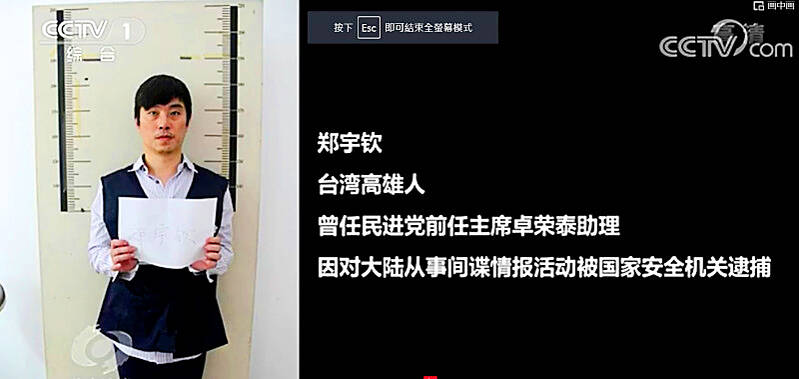
Former Czech Republic-based Taiwanese researcher Cheng Yu-chin (鄭宇欽) has been sentenced to seven years in prison on espionage-related charges, China’s Ministry of State Security announced yesterday. China said Cheng was a spy for Taiwan who “masqueraded as a professor” and that he was previously an assistant to former Cabinet secretary-general Cho Jung-tai (卓榮泰). President-elect William Lai (賴清德) on Wednesday last week announced Cho would be his premier when Lai is inaugurated next month. Today is China’s “National Security Education Day.” The Chinese ministry yesterday released a video online showing arrests over the past 10 years of people alleged to be
THE HAWAII FACTOR: While a 1965 opinion said an attack on Hawaii would not trigger Article 5, the text of the treaty suggests the state is covered, the report says NATO could be drawn into a conflict in the Taiwan Strait if Chinese forces attacked the US mainland or Hawaii, a NATO Defense College report published on Monday says. The report, written by James Lee, an assistant research fellow at Academia Sinica’s Institute of European and American Studies, states that under certain conditions a Taiwan contingency could trigger Article 5 of NATO, under which an attack against any member of the alliance is considered an attack against all members, necessitating a response. Article 6 of the North Atlantic Treaty specifies that an armed attack in the territory of any member in Europe,
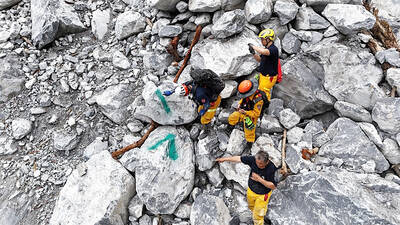
The bodies of two individuals were recovered and three additional bodies were discovered on the Shakadang Trail (砂卡礑) in Taroko National Park, eight days after the devastating earthquake in Hualien County, search-and-rescue personnel said. The rescuers reported that they retrieved the bodies of a man and a girl, suspected to be the father and daughter from the Yu (游) family, 500m from the entrance of the trail on Wednesday. The rescue team added that despite the discovery of the two bodies on Friday last week, they had been unable to retrieve them until Wednesday due to the heavy equipment needed to lift


 RSS
RSS