


Taiwan's promise not to deport any Malawian students is good news for Michael, but it is not enough to stop him worrying what will happen.
The 25-year-old computer science student, who agreed to only speak using an alias, said not knowing what is going to happen in the future is a big source of his frustration.
"The students were the last ones to be told of the severance [of diplomatic ties]. All I know is that they [the Malawian government] have strongly advised us to transfer to China, but have given us the option to either stay or to leave," he said.
Earlier this month, the southeast African country pulled the plug on its relations with Taiwan when it announced it dumped Taipei in order to recognize Beijing. Reports suggested the new allegiance came with a price tag of US$6 billion, an amount that Taiwan was unable and unwilling to match.
On the evening when the Ministry of Foreign Affairs (MOFA) announced the news, ministry spokeswoman Phoebe Yeh (
Yeh said that when Costa Rica severed ties with Taiwan last June, Taiwan also extended the same courtesy to Costa Rican students.
The notable difference, however, was that upon hearing the news that MOFA would not retract the scholarships nor evict the students, the Costa Ricans publicly thanked the Taiwanese government.
A handful of students even marched to the Presidential Office in the pouring rain, holding up "I am sorry" signs and the Republic of China flag to show their disdain for their country's "betrayal" of Taiwan.
Malawian students, on the other hand, have not expressed their views on the abrupt break-up. In fact, out of the two dozen Malawian students studying in Taiwan, only one has agreed to talk to the press.
"Maybe it is just the difference in personality. We are grateful to Taiwan for allowing us to stay, but Malawians just don't speak about our feelings too much," Michael said.
Michael is one of just three recipients of the "Taiwan Scholarship," which is run by MOFA and the Ministry of Education. Recipients have their tuition paid in full and also receive a monthly stipend.
Last week, the Chinese ambassador to Uganda said in addition to taking over infrastructure projects that Taiwan had started in Malawi, Beijing was planning to uproot and relocate all 26 Malawian students currently studying in Taiwan.
"Of course many Malawian students want to stay, but some also think going to Beijing is not a bad idea," Michael said.
He said students who are close to graduation or have established a tight social network feel it would be a waste of time to move to Beijing, especially when it was uncertain whether Chinese universities would recognize the credits they earned in Taiwan.
Another reason why students are reluctant to transfer, he said, was because they would face six months of forced respite before they were able to enroll in the next semester in September.
However, some students think leaving Taiwan would be the wise move in the run long because "who knows if the Taiwanese government will continue to be friendly to Malawian students," especially with a new legislature being convened and the upcoming presidential election in March.
"The political situation in Taiwan is so unpredictable. At this time, MOFA say we are allowed to stay. But we fear that it might change with the new administration," Michael said.
Yeh reassured the students that scholarships given to foreign students would not be affected, even if the opposition wins the March presidential race.
"We believe that students should not be collateral damage for the actions of their country," she said.
National Chengchi University agreed with Yeh, saying students' academic pursuits should be independent of politics.
Ho Yun-ting (何雲婷), one of the staff at the university's Center of International Education and Exchanges, said the two Malawian students currently enrolled in the university were welcome and even encouraged to stay.
"We view the Malawian students just like every other foreign student. We encourage all foreign students to stay at the school and we will not stop our scholarships programs just because the two countries no longer have formal ties," she said.
Ho said the two students from Malawi have not made a decision between staying and transferring to Beijing. All students must register for the next semester by Feb. 21 to avoid paying a late fee, she said.
For many Malawians, the severance of diplomatic ties with Taiwan means the loss of faithful friends and possible blows to their businesses. Some readers of the Malawian Nyasa Times said official ties with Beijing would mean the opening of the floodgates for cheaply made Chinese products that would inundate the country and kill off local businesses.
Michael, however, said he could see the reasons behind Lilongwe's motivation to break up.
"The Chinese Nationalist Party (KMT) might take over the running of the country after this May. What will happen to Malawi if the KMT decides to unite with Beijing? Maybe Beijing would alienate Malawi because we refused to shake their hands when they extended a welcome," Michael said.
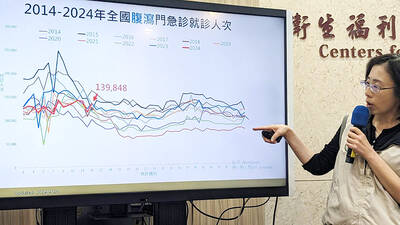
FLU SEASON: Twenty-six severe cases were reported from Tuesday last week to Monday, including a seven-year-old girl diagnosed with influenza-associated encephalopathy Nearly 140,000 people sought medical assistance for diarrhea last week, the Centers for Disease Control (CDC) said on Tuesday. From April 7 to Saturday last week, 139,848 people sought medical help for diarrhea-related illness, a 15.7 percent increase from last week’s 120,868 reports, CDC Epidemic Intelligence Center Deputy Director Lee Chia-lin (李佳琳) said. The number of people who reported diarrhea-related illness last week was the fourth highest in the same time period over the past decade, Lee said. Over the past four weeks, 203 mass illness cases had been reported, nearly four times higher than the 54 cases documented in the same period
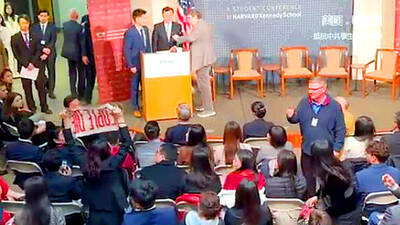
A group of Taiwanese-American and Tibetan-American students at Harvard University on Saturday disrupted Chinese Ambassador to the US Xie Feng’s (謝鋒) speech at the school, accusing him of being responsible for numerous human rights violations. Four students — two Taiwanese Americans and two from Tibet — held up banners inside a conference hall where Xie was delivering a speech at the opening ceremony of the Harvard Kennedy School China Conference 2024. In a video clip provided by the Coalition of Students Resisting the CCP (Chinese Communist Party), Taiwanese-American Cosette Wu (吳亭樺) and Tibetan-American Tsering Yangchen are seen holding banners that together read:
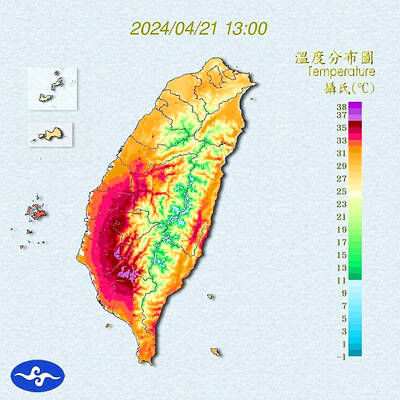
Heat advisories were in effect for nine administrative regions yesterday afternoon as warm southwesterly winds pushed temperatures above 38°C in parts of southern Taiwan, the Central Weather Administration (CWA) said. As of 3:30pm yesterday, Tainan’s Yujing District (玉井) had recorded the day’s highest temperature of 39.7°C, though the measurement will not be included in Taiwan’s official heat records since Yujing is an automatic rather than manually operated weather station, the CWA said. Highs recorded in other areas were 38.7°C in Kaohsiung’s Neimen District (內門), 38.2°C in Chiayi City and 38.1°C in Pingtung’s Sandimen Township (三地門), CWA data showed. The spell of scorching

UNAWARE: Many people sit for long hours every day and eat unhealthy foods, putting them at greater risk of developing one of the ‘three highs,’ an expert said More than 30 percent of adults aged 40 or older who underwent a government-funded health exam were unaware they had at least one of the “three highs” — high blood pressure, high blood lipids or high blood sugar, the Health Promotion Administration (HPA) said yesterday. Among adults aged 40 or older who said they did not have any of the “three highs” before taking the health exam, more than 30 percent were found to have at least one of them, Adult Preventive Health Examination Service data from 2022 showed. People with long-term medical conditions such as hypertension or diabetes usually do not


 RSS
RSS