


Advocates of social welfare programs have urged the Sports Affairs Council (SAC) to establish a law to regulate the issuance of sports lotteries.
The SAC has said a license for the lotteries is scheduled to be issued on May 2. Taipei Fubon Bank (台北富邦銀行) won the bid to run the sports lotteries.
Last month, the Cabinet approved an amendment to the Statute Governing Public Welfare Lotteries (
The amendment, however, was vetoed at the legislative Finance Committee. Legislators who opposed the amendment said the statute only authorizes the government to use lottery earnings to pay for the National Pension System (國民年金), National Health Insurance (全民健保) and other social welfare programs.
Yeh Ta-hua (
Yeh, a member of the government's Supervisory Committee of Public Welfare Lotteries, said that since 1999 the accumulated earnings from the sale of the Public Welfare Lottery had topped NT$128.8 billion (US$3.9 billion). However, because of inadequate supervision, local governments now cut their annual budgets for welfare programs and use the profits from the lottery to cover the operational expenses of the programs instead, she said.
"Not much is left to actually pay for social welfare," Yeh said.
She also said that public welfare lotteries and sports lotteries operate under different rules and target different buyers.
The fact that Fubon Bank set such stringent standards for retailers has also denied physically challenged people the right to operate small business selling lottery tickets, she said.
Eva Teng (
Even though 20 percent of the profit was to be allocated to social welfare programs, she said that the new sports lotteries were likely to generate a "crowding-out" effect. The new sports lotteries would mean the revenue gained from the public welfare lotteries would now decrease, she said.
Chang Fen-fen (張芬芬), director of the SAC's general planning department, said yesterday the council had considered drafting a new law to regulate the issuance of sports lotteries.
"But given the time that the legal procedures would take, we decided we wouldn't be able to make it [on schedule]," she said.
Chang said the council expected the lotteries to commence in May and did not have any plan to propose a new law.
Regarding the standards set for retailers, Chang said earlier this month that the government could only ask the bank to employ more handicapped persons.
In related news, the council is relocating its main office to Tsoying (左營), Kaohsiung City, on Thursday.
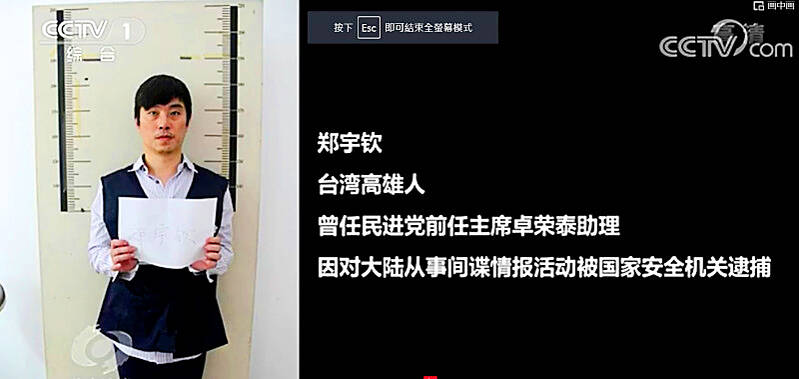
Former Czech Republic-based Taiwanese researcher Cheng Yu-chin (鄭宇欽) has been sentenced to seven years in prison on espionage-related charges, China’s Ministry of State Security announced yesterday. China said Cheng was a spy for Taiwan who “masqueraded as a professor” and that he was previously an assistant to former Cabinet secretary-general Cho Jung-tai (卓榮泰). President-elect William Lai (賴清德) on Wednesday last week announced Cho would be his premier when Lai is inaugurated next month. Today is China’s “National Security Education Day.” The Chinese ministry yesterday released a video online showing arrests over the past 10 years of people alleged to be

THE HAWAII FACTOR: While a 1965 opinion said an attack on Hawaii would not trigger Article 5, the text of the treaty suggests the state is covered, the report says NATO could be drawn into a conflict in the Taiwan Strait if Chinese forces attacked the US mainland or Hawaii, a NATO Defense College report published on Monday says. The report, written by James Lee, an assistant research fellow at Academia Sinica’s Institute of European and American Studies, states that under certain conditions a Taiwan contingency could trigger Article 5 of NATO, under which an attack against any member of the alliance is considered an attack against all members, necessitating a response. Article 6 of the North Atlantic Treaty specifies that an armed attack in the territory of any member in Europe,
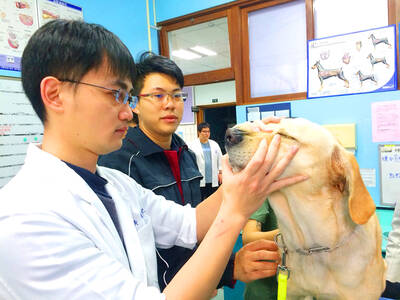
LIKE FAMILY: People now treat dogs and cats as family members. They receive the same medical treatments and tests as humans do, a veterinary association official said The number of pet dogs and cats in Taiwan has officially outnumbered the number of human newborns last year, data from the Ministry of Agriculture’s pet registration information system showed. As of last year, Taiwan had 94,544 registered pet dogs and 137,652 pet cats, the data showed. By contrast, 135,571 babies were born last year. Demand for medical care for pet animals has also risen. As of Feb. 29, there were 5,773 veterinarians in Taiwan, 3,993 of whom were for pet animals, statistics from the Animal and Plant Health Inspection Agency showed. In 2022, the nation had 3,077 pediatricians. As of last

XINJIANG: Officials are conducting a report into amending an existing law or to enact a special law to prohibit goods using forced labor Taiwan is mulling an amendment prohibiting the importation of goods using forced labor, similar to the Uyghur Forced Labor Prevention Act (UFLPA) passed by the US Congress in 2021 that imposed limits on goods produced using forced labor in China’s Xinjiang region. A government official who wished to remain anonymous said yesterday that as the US customs law explicitly prohibits the importation of goods made using forced labor, in 2021 it passed the specialized UFLPA to limit the importation of cotton and other goods from China’s Xinjiang Uyghur region. Taiwan does not have the legal basis to prohibit the importation of goods


 RSS
RSS