


Democratic Progressive Party (DPP) presidential candidate Frank Hsieh (謝長廷) yesterday urged his Chinese Nationalist Party (KMT) rival, Ma Ying-jeou (馬英九), to accept his invitation to hold a debate, saying Ma had been skirting questions of concern for the nation's economic development.
"I issued the invitation three months, or 105 days, ago. We would have had a debate this week if Ma had agreed," Hsieh said at a press conference called to raise questions about Ma's economic platform.
Hsieh first asked Ma to clarify his position on the issue of cross-strait charter flights.
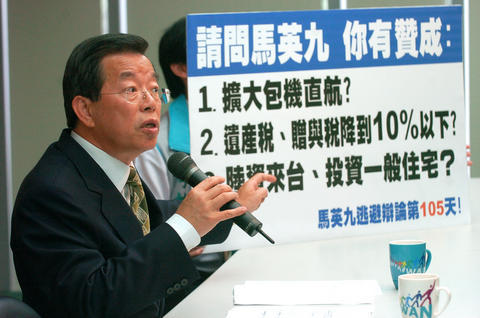
PHOTO: WANG MIN-WEI, TAIPEI TIMES
Hsieh said that from the time he served as premier (2005 to 2006), he has been consistent in advocating a plan to expand cross-strait charter flight services on festival holidays, to include flights on regular weekends and to increase the number of airports used for the service.
"Ma has been inconsistent on this. Initially, he suggested cross-strait direct transportation on the basis of regular charter flights, and gradually what Ma has said has become the same as my proposal," Hsieh said.
"Ma had said that China must first remove its missiles targeting Taiwan before the opening of cross-strait direct transportation. If so, does that mean Ma would refuse to talk to China on the issue if China turns down his request?" Hsieh said.
Hsieh also demanded that Ma reveal his position on Hsieh's proposal to lower the inheritance tax to 10 percent from the current 50 percent.
Ma has said that the tax reform idea, which was proposed with some complementary measures meant to benefit salaried workers, would favor only rich people, but he never said whether he approves or disapproves of the proposal, Hsieh said.
Hsieh also asked Ma to debate the issues of conditionally opening the real estate market to Chinese capital and of building low-priced housing for young people on state-owned land.
Ma and Hsieh both agreed that Chinese capital should be allowed to enter the local real estate market, but Hsieh said such capital should be restrained from speculation in land or real estate.
"Chinese capital can buy a house for business use, but not for investment. Otherwise, house prices would skyrocket and young people wouldn't be able to afford homes," Hsieh said.
Hsieh also asked Ma to explain why he considered his low-priced housing idea "outdated."
In response to Hsieh's challenge, Ma yesterday dared Hsieh to open cross-strait charter flights for the presidential election to allow Taiwanese businesspeople in China return to cast their ballots.
"I would like to ask Mr Hsieh whether or not he will open Election Day charter flights on March 22 so that businesspeople in China can return to vote," Ma said yesterday after attending an economic development forum held by six business associations at the Taipei International Conference Center.
"Providing Election Day charter flight services would show Hsieh's determination to push for direct flights," he said.
As the associations holding the forum called for direct flights and relaxed investment regulations, Ma promised daily cross-strait flights within months if elected.
He promised weekend charter flights after taking office, eventually followed by regular direct flights.
Opening direct links and easing regulations on investment would encourage Taiwanese businesspeople in China to invest more at home, Ma said.
Promising to improve the investment environment in Taiwan by normalizing cross-strait economic relations, Ma also said he would allow 3,000 Chinese tourists to visit Taiwan each day, which he said would revive the economy.
Describing his economic policies as more "pragmatic" than Hsieh's, Ma accused the government of ignoring the state of the economy.
He also dismissed concerns that it would be bad for the KMT to have control of both the legislative and executive branches.
"Electing a president with the same political affiliation as the majority party means that the government and the legislature are of one mind and will ease public worries," he said.
If the DPP wins the presidential election, Ma warned, the confrontations between the two branches will only grow. Ma pledged to oversee the performance of party legislators and ensure the KMT exercises its majority responsibly if he is elected president.
"As a majority party, we will have no excuse if the legislature performs poorly. We will take full responsibility," Ma said.
"I will be a president for all Taiwanese if elected. I will serve as a symbol of cooperation rather than a source of political confrontation," he said.
Business leaders at the forum expressed satisfaction with Ma's economic proposals, although some said that the manner in which they are executed would determine the success of such policies.
"The key is implementation, which won't be easy in terms of [making breakthroughs in] cross-strait negotiations and regional political play," said Theodore Huang (黃茂雄), chairman of the Chinese National Association of Industry and Commerce (工商協進會). "But at least they understand the importance of these [economic] issues."
Huang was referring to the obstacles confronting Taiwan after KMT vice presidential candidate Vincent Siew (
Siew said the KMT, once in power, would resume talks with China and increase the nation's economic clout in the region "under the condition that China approves."
Asked which presidential candidate would best represent economic interests in cross-strait negotiations with China, General Chamber of Commerce (全國商業總會) chairman Chang Ping-chao (張平沼) declined to respond as the business associations are scheduled to hold a forum with Hsieh.
"Dignity and reciprocity" is the bottom line that either Ma or Hsieh would need to adopt when negotiating with China, Chang said.
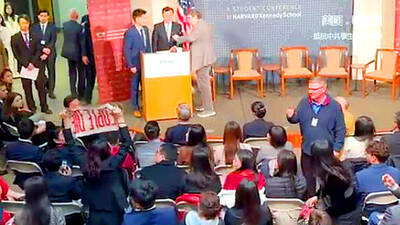
A group of Taiwanese-American and Tibetan-American students at Harvard University on Saturday disrupted Chinese Ambassador to the US Xie Feng’s (謝鋒) speech at the school, accusing him of being responsible for numerous human rights violations. Four students — two Taiwanese Americans and two from Tibet — held up banners inside a conference hall where Xie was delivering a speech at the opening ceremony of the Harvard Kennedy School China Conference 2024. In a video clip provided by the Coalition of Students Resisting the CCP (Chinese Communist Party), Taiwanese-American Cosette Wu (吳亭樺) and Tibetan-American Tsering Yangchen are seen holding banners that together read:

UNAWARE: Many people sit for long hours every day and eat unhealthy foods, putting them at greater risk of developing one of the ‘three highs,’ an expert said More than 30 percent of adults aged 40 or older who underwent a government-funded health exam were unaware they had at least one of the “three highs” — high blood pressure, high blood lipids or high blood sugar, the Health Promotion Administration (HPA) said yesterday. Among adults aged 40 or older who said they did not have any of the “three highs” before taking the health exam, more than 30 percent were found to have at least one of them, Adult Preventive Health Examination Service data from 2022 showed. People with long-term medical conditions such as hypertension or diabetes usually do not
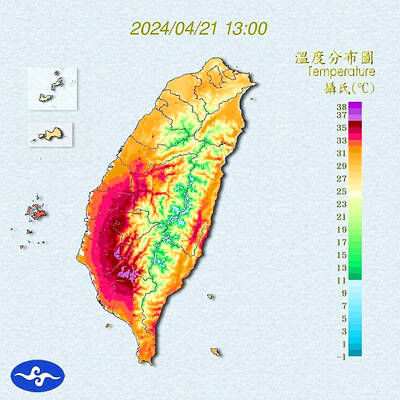
Heat advisories were in effect for nine administrative regions yesterday afternoon as warm southwesterly winds pushed temperatures above 38°C in parts of southern Taiwan, the Central Weather Administration (CWA) said. As of 3:30pm yesterday, Tainan’s Yujing District (玉井) had recorded the day’s highest temperature of 39.7°C, though the measurement will not be included in Taiwan’s official heat records since Yujing is an automatic rather than manually operated weather station, the CWA said. Highs recorded in other areas were 38.7°C in Kaohsiung’s Neimen District (內門), 38.2°C in Chiayi City and 38.1°C in Pingtung’s Sandimen Township (三地門), CWA data showed. The spell of scorching
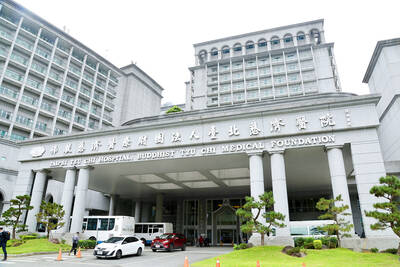
POLICE INVESTIGATING: A man said he quit his job as a nurse at Taipei Tzu Chi Hospital as he had been ‘disgusted’ by the behavior of his colleagues A man yesterday morning wrote online that he had witnessed nurses taking photographs and touching anesthetized patients inappropriately in Taipei Tzu Chi Hospital’s operating theaters. The man surnamed Huang (黃) wrote on the Professional Technology Temple bulletin board that during his six-month stint as a nurse at the hospital, he had seen nurses taking pictures of patients, including of their private parts, after they were anesthetized. Some nurses had also touched patients inappropriately and children were among those photographed, he said. Huang said this “disgusted” him “so much” that “he felt the need to reveal these unethical acts in the operating theater


 RSS
RSS