


Several English villages have sprung up around the nation over the last few years to provide students with situations where they can communicate in English.
These usually involve simulation of real-life situations in which teachers and students interact in English through role-playing.
However, there may remain a gap between the simulated scenarios and the authenticity of communication in everyday life.
The Kaohsiung City Government Education Bureau recently proposed a policy to bridge that gap by applying the concept of English villages to daily life in communities.
Cheng Ying-yao (鄭英耀), director- general of the bureau, said its "English-friendly stores" project is meant to offer pupils different real-life situations to practice speaking English.
Huang Yi-chiao (
All of the stores are located in the vicinity of 18 schools and they all have a certain number of employees who serve as "English-friendly ambassadors" in the stores, she said.
The number of "ambassadors" varies according to the size of the stores, she said.
The 23 locations were chosen after the schools evaluated the environments of the businesses, Huang said.
"Basically, the stores must have clerks who speak English," she told the Taipei Times during a telephone interview yesterday.
Students can talk to the employees in English as they shop there, and by doing so, students will receive discounts as positive reinforcement for their efforts, she said.
Teachers can also take their classes to the stores on field trips and offer students rewards if they are willing to communicate with the clerks in English, she said.
However, she admitted that the bureau did not have a mechanism to screen the English proficiency of the clerks in advance.
"But the point is to encourage students to speak English," she said. "[We hope to help students understand that] they have to speak even if what they say is wrong or grammatically incorrect."
"We hope the project can offer teenagers and students an interesting language learning environment," Cheng said.
Calling it "a great project," Cheng said the plan represents a starting point for the city's connection to the international arena.
"This sets a good example of cooperation between education departments and industry. It is very meaningful," he said.
Nevertheless, some English teachers have reservations about the feasibility of the project.
Hugo Tseng (
"I think Taiwan still lacks an overall environment [for students to communicate in English]. Although the project is well-intentioned, I doubt whether it will prove fruitful," Tseng said.
"Those [people] who do speak English in daily life [in Taiwan] would certainly suffer from some psychological pressure because they may be treated differently in our society," he said.
Tseng said the results of the project may be compromised as both the clerks' and students' general English ability may be limited, meaning that students may not gain much meaningful input from the communication.
Gary Chi (
"If the clerk is not proficient, the students won't benefit much, which in turn [would] weaken their willingness to take part," he said in English.
Chi said it would be preferable that the "English-friendly ambassadors" have English proficiency above intermediate level, adding that if a similar project were tried in Taipei, he would personally check the English ability of the clerks before encouraging his students to participate.
Chi told the Taipei Times that the project also lacks an important mechanism to evaluate students' performance during their interaction with the clerks.
"Students have the opportunity to practice, but they may not have the chance to know how they're performing," he said.
Angel Hsieh (
She also wondered how many students would actually take advantage of the project to sharpen their English ability.
"It is the same case as the stores cooperating with universities. There are many stores of this kind, but how many university students would actually shop there?" she said.
Tseng expressed similar views, saying that it is possible for the project to conclude without concrete results because of "insufficient student participation."
"Contexts that are deliberately created like this may not last long," he said.
Chi further questioned the general effectiveness of the project, saying that it would only benefit students with advanced language skills or those with high motivation.
While the project focuses on providing students with real-life contexts, Tseng said it is more important to offer students incentives to speak English.
"If students have strong initiative, the approaches they take to learn to speak English or whether they have an environment to learn to speak English would become minor problems," Tseng said.

Former president Ma Ying-jeou’s (馬英九) mention of Taiwan’s official name during a meeting with Chinese President Xi Jinping (習近平) on Wednesday was likely a deliberate political play, academics said. “As I see it, it was intentional,” National Chengchi University Graduate Institute of East Asian Studies professor Wang Hsin-hsien (王信賢) said of Ma’s initial use of the “Republic of China” (ROC) to refer to the wider concept of “the Chinese nation.” Ma quickly corrected himself, and his office later described his use of the two similar-sounding yet politically distinct terms as “purely a gaffe.” Given Ma was reading from a script, the supposed slipup
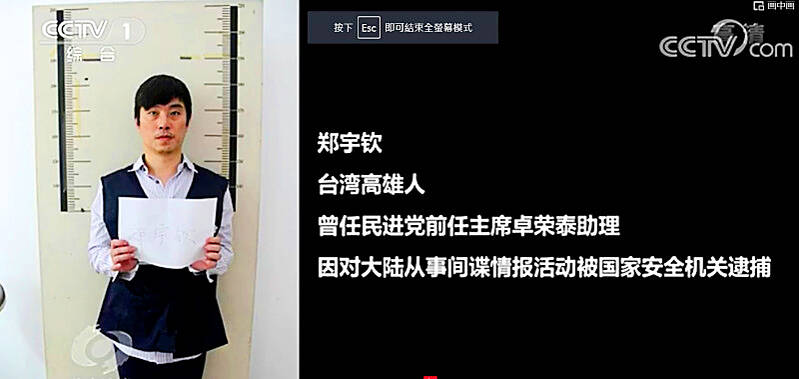
Former Czech Republic-based Taiwanese researcher Cheng Yu-chin (鄭宇欽) has been sentenced to seven years in prison on espionage-related charges, China’s Ministry of State Security announced yesterday. China said Cheng was a spy for Taiwan who “masqueraded as a professor” and that he was previously an assistant to former Cabinet secretary-general Cho Jung-tai (卓榮泰). President-elect William Lai (賴清德) on Wednesday last week announced Cho would be his premier when Lai is inaugurated next month. Today is China’s “National Security Education Day.” The Chinese ministry yesterday released a video online showing arrests over the past 10 years of people alleged to be

THE HAWAII FACTOR: While a 1965 opinion said an attack on Hawaii would not trigger Article 5, the text of the treaty suggests the state is covered, the report says NATO could be drawn into a conflict in the Taiwan Strait if Chinese forces attacked the US mainland or Hawaii, a NATO Defense College report published on Monday says. The report, written by James Lee, an assistant research fellow at Academia Sinica’s Institute of European and American Studies, states that under certain conditions a Taiwan contingency could trigger Article 5 of NATO, under which an attack against any member of the alliance is considered an attack against all members, necessitating a response. Article 6 of the North Atlantic Treaty specifies that an armed attack in the territory of any member in Europe,
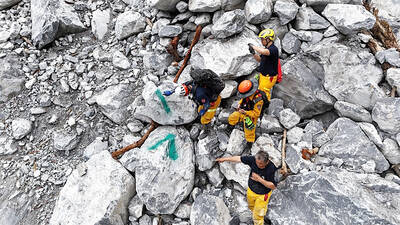
The bodies of two individuals were recovered and three additional bodies were discovered on the Shakadang Trail (砂卡礑) in Taroko National Park, eight days after the devastating earthquake in Hualien County, search-and-rescue personnel said. The rescuers reported that they retrieved the bodies of a man and a girl, suspected to be the father and daughter from the Yu (游) family, 500m from the entrance of the trail on Wednesday. The rescue team added that despite the discovery of the two bodies on Friday last week, they had been unable to retrieve them until Wednesday due to the heavy equipment needed to lift


 RSS
RSS