


Some 30 advocates for the rights of Hansen's Disease sufferers staged a silent sit-in in front of the legislature yesterday, urging lawmakers to pass the Hansen's Disease compensation bill today -- the final day the enactment can be discussed before the legislature goes into recess tomorrow.
Today "is the last chance for the bill to be put to a vote in the legislature," Taiwanese Association for Human Rights secretary-general Lin Shu-ya (
Lin said that as of yesterday, the Taiwan Solidarity Union (TSU) was the only caucus that had yet to endorse the bill after cross-party talks, adding that the bill could be stalled as a result.
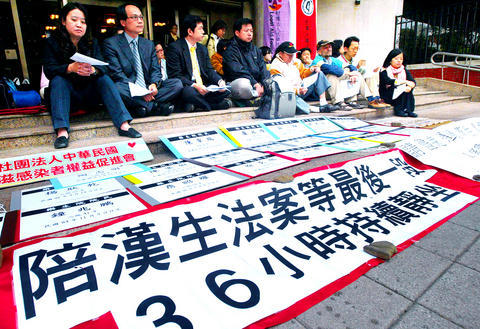
PHOTO: CNA
Lin said the bill would guarantee that residents of Losheng Sanatorium can continue to reside at Losheng and grant them the right to seek government action against discrimination of those suffering from Hansen's, which is also known as leprosy.
The bill would also require the government to apologize for past discrimination of Hansen's patients and would entitle those who were quarantined or otherwise mistreated by the government to compensation, Lin said.
The Losheng sanatorium in Sinjhuang (
A controversy over the compound's future arose after the Taipei City and Taipei County governments began demolishing it to make way for the Sinjhuang MRT line. Activists have blocked construction for cultural and historical reasons, as well as for the benefit of the facility's residents.
The controversy has also highlighted the struggle for compensation for formerly quarantined patients.
As a result, six versions of a bill were proposed concerning the rights of Hansen's sufferers. They proposed different measures for compensation, lifelong health care and rehabilitation.
The final draft law would require the government to designate the sanatorium as a national historical site.
Legislators across party lines held the a final negotiation session on Tuesday, during which the TSU insisted on introducing a clause prohibiting the government from forcefully removing the patients from the facility.
The bill ranked 74th on the legislative agenda for this week and cannot be put to a vote until all legislative caucuses have endorsed it.
If it fails to pass the third reading today, it must go through the whole legislative procedure again, including committee reviews and cross-party negotiations, which could delay the bill's passage for months.
"How long will these people -- many of whom are now in their 80s -- have to wait before the bill is passed? It would be meaningless for us to pass it after they pass away," said lawyer Cheng Wen-lung (
In response, the TSU yesterday said the party would insist on passing the bill in a form that preserves "one hundred percent of the bill's original spirit."
"This matter concerns transitional justice -- and justice should not be discounted," said Su Wei-shuo (

Former president Ma Ying-jeou’s (馬英九) mention of Taiwan’s official name during a meeting with Chinese President Xi Jinping (習近平) on Wednesday was likely a deliberate political play, academics said. “As I see it, it was intentional,” National Chengchi University Graduate Institute of East Asian Studies professor Wang Hsin-hsien (王信賢) said of Ma’s initial use of the “Republic of China” (ROC) to refer to the wider concept of “the Chinese nation.” Ma quickly corrected himself, and his office later described his use of the two similar-sounding yet politically distinct terms as “purely a gaffe.” Given Ma was reading from a script, the supposed slipup
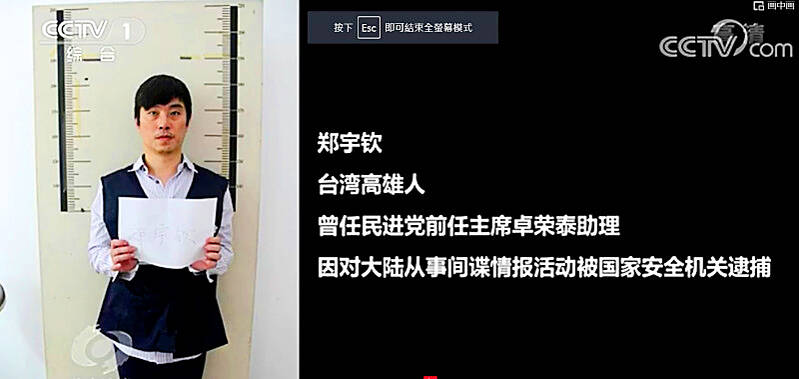
Former Czech Republic-based Taiwanese researcher Cheng Yu-chin (鄭宇欽) has been sentenced to seven years in prison on espionage-related charges, China’s Ministry of State Security announced yesterday. China said Cheng was a spy for Taiwan who “masqueraded as a professor” and that he was previously an assistant to former Cabinet secretary-general Cho Jung-tai (卓榮泰). President-elect William Lai (賴清德) on Wednesday last week announced Cho would be his premier when Lai is inaugurated next month. Today is China’s “National Security Education Day.” The Chinese ministry yesterday released a video online showing arrests over the past 10 years of people alleged to be

THE HAWAII FACTOR: While a 1965 opinion said an attack on Hawaii would not trigger Article 5, the text of the treaty suggests the state is covered, the report says NATO could be drawn into a conflict in the Taiwan Strait if Chinese forces attacked the US mainland or Hawaii, a NATO Defense College report published on Monday says. The report, written by James Lee, an assistant research fellow at Academia Sinica’s Institute of European and American Studies, states that under certain conditions a Taiwan contingency could trigger Article 5 of NATO, under which an attack against any member of the alliance is considered an attack against all members, necessitating a response. Article 6 of the North Atlantic Treaty specifies that an armed attack in the territory of any member in Europe,
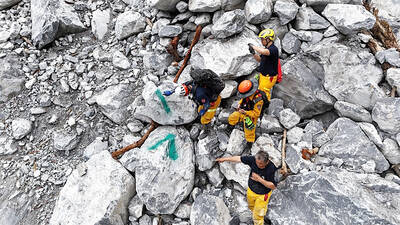
The bodies of two individuals were recovered and three additional bodies were discovered on the Shakadang Trail (砂卡礑) in Taroko National Park, eight days after the devastating earthquake in Hualien County, search-and-rescue personnel said. The rescuers reported that they retrieved the bodies of a man and a girl, suspected to be the father and daughter from the Yu (游) family, 500m from the entrance of the trail on Wednesday. The rescue team added that despite the discovery of the two bodies on Friday last week, they had been unable to retrieve them until Wednesday due to the heavy equipment needed to lift


 RSS
RSS