


China's oppression of Taiwan and its determination to build cross-strait links as a strategy to annex Taiwan are the main reasons negotiations on several fronts have not progressed, Premier Chang Chun-hsiung (
"Taiwan is ready to let in Chinese tourists and expand cross-strait charter services and has all supplementary measures for the opening in place, but cross-strait negotiations were unfortunately halted by China," Chang said.
He made the remarks at a forum hosted by the Straits Exchange Foundation to mark the 20th anniversary of the opening of cross-strait interaction.
In 2004, the government proposed around 20 items for negotiation. A year later, it listed cargo and passenger charter flights, as well as the opening of Taiwan to Chinese tourists, high on its agenda for negotiations with Beijing.
Negotiations on tourism and charter flights came to a halt earlier this year following several rounds of talks.
"We have extended olive branches to China, but it insists on its `one-China' policy. Moreover, it is building up strength to oppress Taiwan politically, diplomatically and militarily ... which is the biggest obstacle to cross-strait relations," Chang said.
Straits Exchange Foundation Chairman Hung Chi-chang (
"We are fully aware that China's eventual goal in conducting exchanges is to annex Taiwan, and that's something it needs to change," Hung said.
During a forum session on political relations with China, Lin Cheng-yi (林正義), a researcher in European and US studies at the Academia Sinica, said China had thrown away two chances to improve relations in the past two decades.
In 1991, former president Lee Teng-hui (
Instead, a dispute erupted over what was said at the talks after the KMT, in 2000, began claiming an agreement had been reached -- the "1992 consensus" -- that both sides of the strait should be permitted to have their own interpretations of "one China."
Beijing had a chance again in 2000, when President Chen Shui-bian (陳水扁), in a show of goodwill, suggested Taiwan and China should increase economic and cultural ties, create a framework for perpetual peace and work for functional integration in a federation modeled on the EU.
But China remained silent, Lee said.
The forum also discussed future prospects for economic ties across the strait.
Chen Tain-jy (
But Huang Tien-lin (
"The nation's total investment [in China] is equal to half of its GDP, but its economic growth rate and GDP growth rate lag behind South Korea, whose investment in China is just 2.7 percent of its GDP," Huang said.
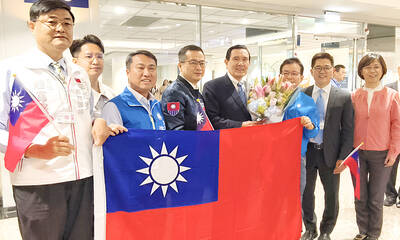
Former president Ma Ying-jeou’s (馬英九) mention of Taiwan’s official name during a meeting with Chinese President Xi Jinping (習近平) on Wednesday was likely a deliberate political play, academics said. “As I see it, it was intentional,” National Chengchi University Graduate Institute of East Asian Studies professor Wang Hsin-hsien (王信賢) said of Ma’s initial use of the “Republic of China” (ROC) to refer to the wider concept of “the Chinese nation.” Ma quickly corrected himself, and his office later described his use of the two similar-sounding yet politically distinct terms as “purely a gaffe.” Given Ma was reading from a script, the supposed slipup
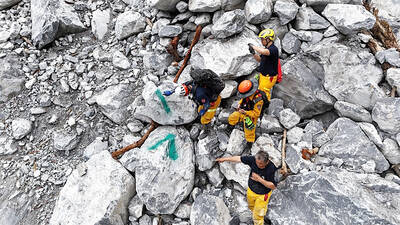
The bodies of two individuals were recovered and three additional bodies were discovered on the Shakadang Trail (砂卡礑) in Taroko National Park, eight days after the devastating earthquake in Hualien County, search-and-rescue personnel said. The rescuers reported that they retrieved the bodies of a man and a girl, suspected to be the father and daughter from the Yu (游) family, 500m from the entrance of the trail on Wednesday. The rescue team added that despite the discovery of the two bodies on Friday last week, they had been unable to retrieve them until Wednesday due to the heavy equipment needed to lift
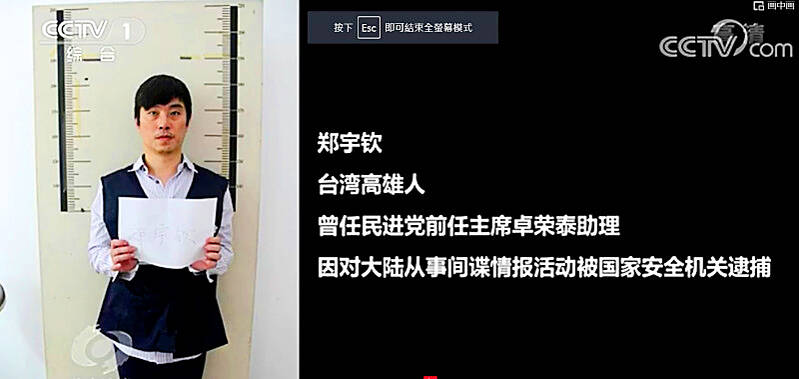
Former Czech Republic-based Taiwanese researcher Cheng Yu-chin (鄭宇欽) has been sentenced to seven years in prison on espionage-related charges, China’s Ministry of State Security announced yesterday. China said Cheng was a spy for Taiwan who “masqueraded as a professor” and that he was previously an assistant to former Cabinet secretary-general Cho Jung-tai (卓榮泰). President-elect William Lai (賴清德) on Wednesday last week announced Cho would be his premier when Lai is inaugurated next month. Today is China’s “National Security Education Day.” The Chinese ministry yesterday released a video online showing arrests over the past 10 years of people alleged to be
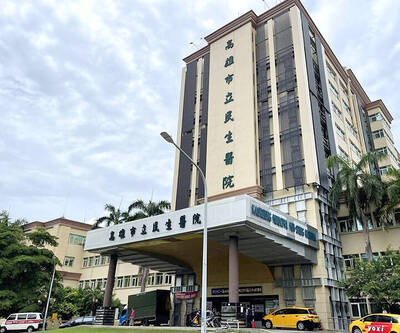
MIX-UP: Kaohsiung Municipal Min-Sheng Hospital director Yen Chia-chi was suspended from his duties after surgeons operated on the wrong patient last week The Kaohsiung Department of Health yesterday fined Kaohsiung Municipal Min-Sheng Hospital NT$500,0000 for misidentifying two patients and consequently causing one of them to undergo the wrong surgery last week. The hospital’s director Yen Chia-chi (顏家祺) was suspended from his duties. The surgeon who was scheduled to operate on the patient was given a major demerit and is subject to subsequent disciplinary actions. Demerits were given to the anesthesiologist, the nurse in the operation room, the nurse in the ward and the worker who helped transfer the patient from the ward to the operation room for having failed to verify the patient’s identity. Meanwhile, the


 RSS
RSS