


President Chen Shui-bian (
Chen said the referendum proposed by the Democratic Progressive Party would go ahead as planned as it had collected more than 2.7 million signatures in support of the poll. The president said he expected the referendum would be held in conjunction with the presidential election on March 22.
"We fear that if the US government continues to exert pressure on this issue, it may hurt the feelings of our people and this will only be detrimental to US-Taiwan relations," Chen said.
Chen made the remarks while receiving US Representative Eni Faleomavaega at the Presidential Office. Faleomavaega is the chairman of the House of Representatives Foreign Affairs Subcommittee on Asia, the Pacific and the Global Environment.
Chen said he had learned that Beijing had asked US President George W. Bush and US Secretary of State Condoleezza Rice to publicly oppose Taiwan's referendum.
"I think the Chinese government has learned a lesson from the past and realized that the most effective way to pressure Taiwan is via Washington," he said.
Chen said Beijing planned to designate an air defense identification zone within the Taiwan Strait to prevent the US and Japan from gathering military intelligence on China. The president said China was also planning to inaugurate a new air route on the Chinese side of the median of the Taiwan Strait.
"We consider China's plans an attempt to alter the `status quo' in the Taiwan Strait," he said. "They will pose a great threat to peace and stability in the strait and damage the `status quo.' We hope the US and Japan will jointly tackle this serious issue."
Chen also took the opportunity to thank American Institute in Taiwan (AIT) Director Stephen Young for his support during a speech Young delivered at the Foundation on International and Cross-Strait Studies Conference on Monday.
Chen said he had felt particularly proud when Young said that Taiwan served as a model for democratization in the region and around the world, but perhaps most importantly, just across the strait in the People's Republic of China (PRC).
Chen said he was also happy to hear from Young that the US government would not interfere in Taiwan's domestic affairs and that Washington looks forward to working closely with whoever the people of Taiwan elect as their next president.
However, the president said that whereas Beijing used to claim Taiwan as part of China, they have come up with a new theory in which Taiwan is claimed as part of the PRC.
"We find it totally unacceptable," Chen said. "Even the [Chinese Nationalist Party] KMT and its presidential candidate, Ma Ying-jeou [馬英九], do not dare openly say Taiwan is a part of the PRC."
In response, AIT spokesman Thomas Hodges said yesterday that the US had already made its position on the Taiwanese government's referendum on entering the UN under the name "Taiwan" clear.
"We don't have much more to say and can just refer you back to the previous statements," he said when asked to comment on Chen's remarks.
He was referring to Young's comments on Monday and on Nov. 9, and a statement made by US Deputy Assistant Secretary of State for East Asian Affairs Thomas Christensen at the US-Taiwan Business Council Defense Industry Conference on Sept. 11.
Meanwhile, China told visiting former US president Jimmy Carter it hopes the US will thwart the referendum plan.
"The Taiwan issue concerns China's territorial integrity and sovereignty," the official People's Daily quoted Xi Jinping (
"[We] hope the US side will join the Chinese side to resolutely oppose and effectively stop Chen Shui-bian from pushing forward the `UN admission referendum' and other `Taiwan independence' splittist activities," Xi said.
In related news, British Foreign Secretary David Miliband said on Wednesday Britain opposes the referendum, adding that any "reckless maneuvers" were to be "deplored."
Britain's policy towards Taiwan had not changed in the past 35 years, Miliband said after talks in London with his Chinese counterpart, Yang Jiechi (
"We do not support the proposed referendum in Taiwan for it to gain membership of the United Nations under the name of `Taiwan,'" Miliband said.
Additional reporting by Shih Hsiu-chuan
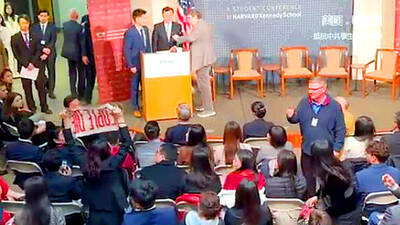
A group of Taiwanese-American and Tibetan-American students at Harvard University on Saturday disrupted Chinese Ambassador to the US Xie Feng’s (謝鋒) speech at the school, accusing him of being responsible for numerous human rights violations. Four students — two Taiwanese Americans and two from Tibet — held up banners inside a conference hall where Xie was delivering a speech at the opening ceremony of the Harvard Kennedy School China Conference 2024. In a video clip provided by the Coalition of Students Resisting the CCP (Chinese Communist Party), Taiwanese-American Cosette Wu (吳亭樺) and Tibetan-American Tsering Yangchen are seen holding banners that together read:

UNAWARE: Many people sit for long hours every day and eat unhealthy foods, putting them at greater risk of developing one of the ‘three highs,’ an expert said More than 30 percent of adults aged 40 or older who underwent a government-funded health exam were unaware they had at least one of the “three highs” — high blood pressure, high blood lipids or high blood sugar, the Health Promotion Administration (HPA) said yesterday. Among adults aged 40 or older who said they did not have any of the “three highs” before taking the health exam, more than 30 percent were found to have at least one of them, Adult Preventive Health Examination Service data from 2022 showed. People with long-term medical conditions such as hypertension or diabetes usually do not
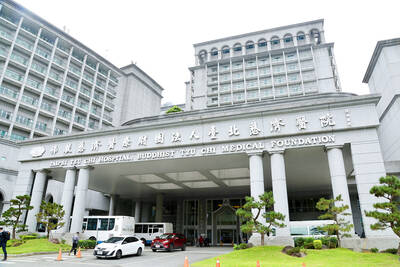
POLICE INVESTIGATING: A man said he quit his job as a nurse at Taipei Tzu Chi Hospital as he had been ‘disgusted’ by the behavior of his colleagues A man yesterday morning wrote online that he had witnessed nurses taking photographs and touching anesthetized patients inappropriately in Taipei Tzu Chi Hospital’s operating theaters. The man surnamed Huang (黃) wrote on the Professional Technology Temple bulletin board that during his six-month stint as a nurse at the hospital, he had seen nurses taking pictures of patients, including of their private parts, after they were anesthetized. Some nurses had also touched patients inappropriately and children were among those photographed, he said. Huang said this “disgusted” him “so much” that “he felt the need to reveal these unethical acts in the operating theater
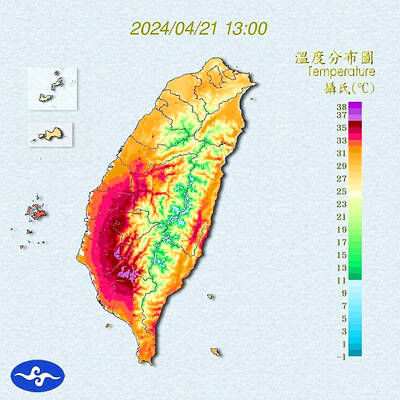
Heat advisories were in effect for nine administrative regions yesterday afternoon as warm southwesterly winds pushed temperatures above 38°C in parts of southern Taiwan, the Central Weather Administration (CWA) said. As of 3:30pm yesterday, Tainan’s Yujing District (玉井) had recorded the day’s highest temperature of 39.7°C, though the measurement will not be included in Taiwan’s official heat records since Yujing is an automatic rather than manually operated weather station, the CWA said. Highs recorded in other areas were 38.7°C in Kaohsiung’s Neimen District (內門), 38.2°C in Chiayi City and 38.1°C in Pingtung’s Sandimen Township (三地門), CWA data showed. The spell of scorching


 RSS
RSS