


Strengthening economic ties with China will not solve Taiwan's economic issues -- what Taiwan needs is new economic development strategies, a top economist said yesterday.
Chen Poh-chih (
"Many of our low-skilled laborers are unemployed because a lot of low-skilled jobs have been moved to developing countries like China," Chen said.
"Some politicians, however, are suggesting that to solve the economic problem we're facing now we should strengthen economic ties with China -- they've even proposed the idea of a cross-strait common market," Chen said.
"That just doesn't make any sense," he said.
Chen explained that an essential component of a common market is the free movement of labor.
"I could only see the situation worsening if [a common market] becomes a reality," he said.
He then said that the only advantage of increasing investment in China is to bring down the costs of production.
But that would mean more domestic unemployment and lowered wages, Chen said.
"Lowering the production cost may be good for businesses owners, but would be a disaster for workers," he said.
Sung Chee Tek (
"When the big corporations make their money in China, Hong Kong laborers don't benefit from it," Sung said.
"When the business owners return to invest in real estate in Hong Kong and boost the real estate market, ordinary Hong Kong citizens suffer from the inflation of housing prices," he said.
Chen also said that the economic benefit for businesses is only temporary, because once other companies are doing the same thing, "they have to compete by cutting the sales prices, and thus the profit margin shrinks," Chen warned.
Hence, Chen suggested that Taiwan should seek an economic breakthrough by creating locally oriented specialty industries.
"A great majority of the 160,000 Singaporeans who visited Taiwan last year said in a survey that what they liked the most in Taiwan were tourist farms -- and that has potential," he said.
Chen also believed that Taiwan should stress cooperation with more developed countries.
"We have our economic achievement today because we worked closely with developed countries such as the US and Japan," Chen said. "We learned skills and technologies from them, and we acquired some of their jobs, too."
Meanwhile, the vice president of National Chengchi University, Lin Bih-jaw (
"We might need to wait for the completion of certain events -- Taiwan's 2008 presidential election, the Beijing 2008 Olympics and the new US government -- to see the development of a new cross-strait relationship," Lin said at a forum on the review of and prospects for the long-term effects of opening cross-strait exchange.
The forum was held by the Institute for National Policy Research.
Since the government took the initiative in 1987 to lift the ban on Mainlanders returning to their homes and families in China for visits and reunions, it has been China, not Taiwan, that has steered the development of cross-strait relations, Lin said.
"We have to ask why US-Taiwan relations have experienced sporadic episodes of tension and why the US would find Taiwan unpredictable in terms of maintaining cross-strait stability, instead of blaming China for its reluctance to talk to Taiwan," Lin said.
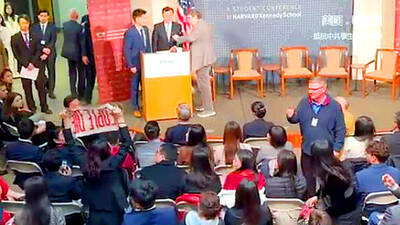
A group of Taiwanese-American and Tibetan-American students at Harvard University on Saturday disrupted Chinese Ambassador to the US Xie Feng’s (謝鋒) speech at the school, accusing him of being responsible for numerous human rights violations. Four students — two Taiwanese Americans and two from Tibet — held up banners inside a conference hall where Xie was delivering a speech at the opening ceremony of the Harvard Kennedy School China Conference 2024. In a video clip provided by the Coalition of Students Resisting the CCP (Chinese Communist Party), Taiwanese-American Cosette Wu (吳亭樺) and Tibetan-American Tsering Yangchen are seen holding banners that together read:

UNAWARE: Many people sit for long hours every day and eat unhealthy foods, putting them at greater risk of developing one of the ‘three highs,’ an expert said More than 30 percent of adults aged 40 or older who underwent a government-funded health exam were unaware they had at least one of the “three highs” — high blood pressure, high blood lipids or high blood sugar, the Health Promotion Administration (HPA) said yesterday. Among adults aged 40 or older who said they did not have any of the “three highs” before taking the health exam, more than 30 percent were found to have at least one of them, Adult Preventive Health Examination Service data from 2022 showed. People with long-term medical conditions such as hypertension or diabetes usually do not
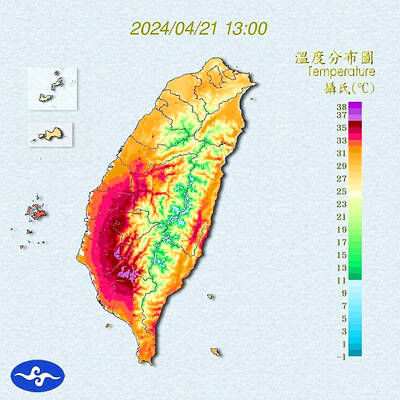
Heat advisories were in effect for nine administrative regions yesterday afternoon as warm southwesterly winds pushed temperatures above 38°C in parts of southern Taiwan, the Central Weather Administration (CWA) said. As of 3:30pm yesterday, Tainan’s Yujing District (玉井) had recorded the day’s highest temperature of 39.7°C, though the measurement will not be included in Taiwan’s official heat records since Yujing is an automatic rather than manually operated weather station, the CWA said. Highs recorded in other areas were 38.7°C in Kaohsiung’s Neimen District (內門), 38.2°C in Chiayi City and 38.1°C in Pingtung’s Sandimen Township (三地門), CWA data showed. The spell of scorching
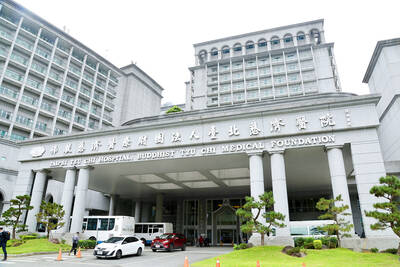
POLICE INVESTIGATING: A man said he quit his job as a nurse at Taipei Tzu Chi Hospital as he had been ‘disgusted’ by the behavior of his colleagues A man yesterday morning wrote online that he had witnessed nurses taking photographs and touching anesthetized patients inappropriately in Taipei Tzu Chi Hospital’s operating theaters. The man surnamed Huang (黃) wrote on the Professional Technology Temple bulletin board that during his six-month stint as a nurse at the hospital, he had seen nurses taking pictures of patients, including of their private parts, after they were anesthetized. Some nurses had also touched patients inappropriately and children were among those photographed, he said. Huang said this “disgusted” him “so much” that “he felt the need to reveal these unethical acts in the operating theater


 RSS
RSS