


Not many things will hold Cheng Yun-chien (鄭雲謙) back from achieving his dream of obtaining a doctorate in the US.
Cheng is so fixed on his "American Dream" that even if Taiwanese universities are ranked higher than the US schools he is interested in he would still choose to leave.
However, people with dreams similar to Cheng's are becoming more of a rarity in Taiwan, academics say.
National Taiwan University (NTU) President Lee Si-chen (李嗣涔) said yesterday the improvements made to the Taiwanese education system are a double-edged sword.
On one hand, Taiwanese students are receiving a higher quality education, but on the other hand, it is also deterring students from furthering their education in another country -- an indispensable experience in one's academic career, he said.
"Thirty or 40 years ago, 80 percent to 90 percent of NTU graduates went to a foreign country to further their studies, but now the number has now dwindled to only 10 percent to 15 percent. The number is worrisome because it indicates that even Taiwan's finest students are no longer willing to go abroad," he said.
Lee said while it was true that students are receiving adequate education and research opportunities in Taiwan, the academic circle still urges students to spend time overseas to gain experiences that they cannot get in a classroom in Taiwan.
NTU political science professor Hung Yong-tai (
Hung's comments resonant with many Taiwanese.
Even Cheng, who is extremely determined to go to either Duke University or the University of Washington, said if he did not win a scholarship he would not go, or he would reapply until he won a scholarship because he does not want to have to depend on his family.
Even if Taiwanese universities receive a better ranking he would not change his mind about going abroad, he said.
"The ranking is a factor but not significant enough to convince me to stay in Taiwan. I want to go and study abroad so I can experience what it is like to live in another country," Cheng said.
The Times of London's Higher Education supplement on the top 200 universities in the world this year had NTU ranked 102nd. It was the only Taiwanese university that made the list.
The school has been making steady progress, from 114th place in 2005 and 108th place last year.
The Higher Education Evaluation and Accreditation Council of Taiwan also released their own ratings, which had NTU at 185th place, while National Cheng Kung University, National Tsing Hua University and National Chiao Tung University placed 360th, 429th and 471st respectively out of the 500 universities that were evaluated.
The evaluation was based on the number and the quality of scientific papers published by each university.
Universities have protested against the ranking system, saying the evaluation process is subjective and does not take the school's overall quality of education into consideration.
Although the government has been pushing get at least one Taiwanese university into the top 100 list, some Taiwanese students say even if Taiwanese schools did receive better marks, they would still opt to study abroad.
Farah Shih (施芙琪), a sophomore at NTU majoring in industrial management, shared Cheng's views, saying, in addition to experiencing life in another country, having a foreign diploma would be a big plus when hunting for a job.
Shih said even if NTU had a higher placement, she does not think it would attract more foreign students to study in Taiwan because most foreign students coming to Taiwan do so to study Mandarin and not for academic research.
Both Cheng and Shih said the Times' ranking of NTU is more or less what they expected.
Lin Hsiu-hua (林琇華), the mother of a high school freshman, said she has always wanted her son to go to a university in th US regardless of the quality of Taiwanese universities because she thinks he will have a better chance of finding a job in the US and eventually "getting a green card."
She said she wants her son to see the world and not be trapped on this small island.
"It does not even matter to me if he does not go to a famous school in the US, as long as he gets there," she said.
However, another mother, Wu Bao-gui (吳寶貴), said if Taiwanese universities could improve their quality, then she would prefer her children to stay in Taiwan because the tuition would be cheaper.
"Many people spend so much of their time adjusting to a foreign country. If Taiwan can provide quality education, then why not stay here? As long you are skilled in your field, you will find a good job no matter where you got your degree," Wu said.

Former president Ma Ying-jeou’s (馬英九) mention of Taiwan’s official name during a meeting with Chinese President Xi Jinping (習近平) on Wednesday was likely a deliberate political play, academics said. “As I see it, it was intentional,” National Chengchi University Graduate Institute of East Asian Studies professor Wang Hsin-hsien (王信賢) said of Ma’s initial use of the “Republic of China” (ROC) to refer to the wider concept of “the Chinese nation.” Ma quickly corrected himself, and his office later described his use of the two similar-sounding yet politically distinct terms as “purely a gaffe.” Given Ma was reading from a script, the supposed slipup
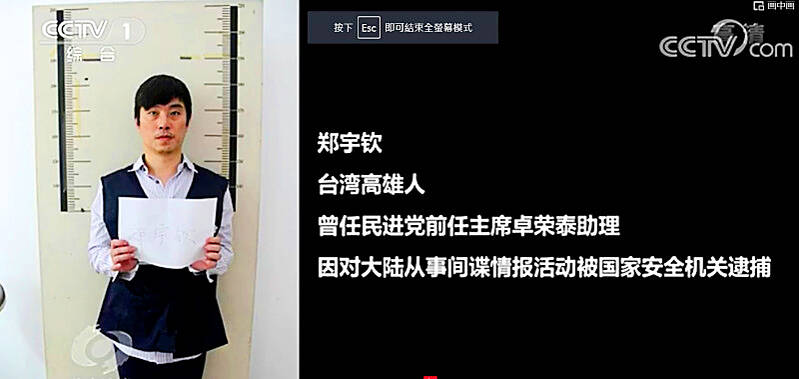
Former Czech Republic-based Taiwanese researcher Cheng Yu-chin (鄭宇欽) has been sentenced to seven years in prison on espionage-related charges, China’s Ministry of State Security announced yesterday. China said Cheng was a spy for Taiwan who “masqueraded as a professor” and that he was previously an assistant to former Cabinet secretary-general Cho Jung-tai (卓榮泰). President-elect William Lai (賴清德) on Wednesday last week announced Cho would be his premier when Lai is inaugurated next month. Today is China’s “National Security Education Day.” The Chinese ministry yesterday released a video online showing arrests over the past 10 years of people alleged to be
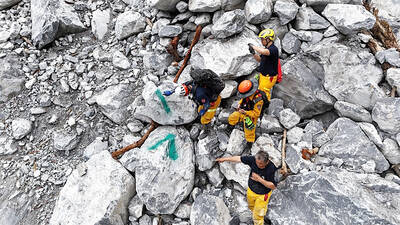
The bodies of two individuals were recovered and three additional bodies were discovered on the Shakadang Trail (砂卡礑) in Taroko National Park, eight days after the devastating earthquake in Hualien County, search-and-rescue personnel said. The rescuers reported that they retrieved the bodies of a man and a girl, suspected to be the father and daughter from the Yu (游) family, 500m from the entrance of the trail on Wednesday. The rescue team added that despite the discovery of the two bodies on Friday last week, they had been unable to retrieve them until Wednesday due to the heavy equipment needed to lift
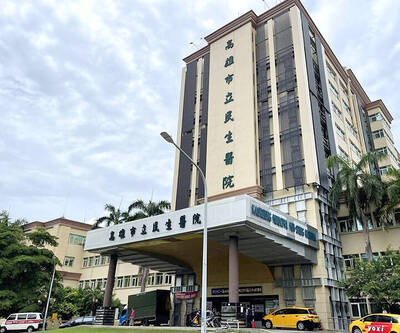
MIX-UP: Kaohsiung Municipal Min-Sheng Hospital director Yen Chia-chi was suspended from his duties after surgeons operated on the wrong patient last week The Kaohsiung Department of Health yesterday fined Kaohsiung Municipal Min-Sheng Hospital NT$500,0000 for misidentifying two patients and consequently causing one of them to undergo the wrong surgery last week. The hospital’s director Yen Chia-chi (顏家祺) was suspended from his duties. The surgeon who was scheduled to operate on the patient was given a major demerit and is subject to subsequent disciplinary actions. Demerits were given to the anesthesiologist, the nurse in the operation room, the nurse in the ward and the worker who helped transfer the patient from the ward to the operation room for having failed to verify the patient’s identity. Meanwhile, the


 RSS
RSS