


Democratic Progressive Party (DPP) presidential candidate Frank Hsieh (
Following a meeting with Taiwan Semiconductor Manufacturing Co (
While insisting that control over technology exports to China in the high-tech, defense and agricultural sectors was necessary, Hsieh said he believed that a review of the mechanism governing export control was needed.
"Businesses and experts cognizant of the international trend in these areas should participate [in the review]," Hsieh said.
DPP caucus whip Ker Chien-ming (柯建銘) also took part in the one-hour closed-door meeting.
Ker quoted Chang as saying that "the mechanism is problematic if its decisions are made only by national security officials and businesses are excluded."
Ker said Chang cited Intel as an example: The US company is investing US$2.5 billion to build a 12-inch (300mm) wafer plant deploying 90-nanometer process technology to produce central processing unit chips in Dalian, China.
In comparison, Taiwanese semiconductor chipmakers are only allowed to set up 8-inch (200mm) wafer fabs using 0.18-micron process technology in China, Ker said.
"Other than the national security element, economic development should also be taken into consideration [in determining cross-strait economic policy]," Hsieh said.
But Hsieh added that he and Chang agreed that continuous technology innovation and the ability to provide value-added products were critical to the nation's long-term economic development.
Further liberalization of investment in China will only have a short-term impact, Hsieh said.
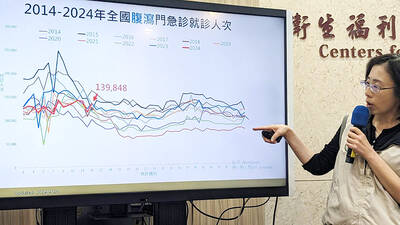
FLU SEASON: Twenty-six severe cases were reported from Tuesday last week to Monday, including a seven-year-old girl diagnosed with influenza-associated encephalopathy Nearly 140,000 people sought medical assistance for diarrhea last week, the Centers for Disease Control (CDC) said on Tuesday. From April 7 to Saturday last week, 139,848 people sought medical help for diarrhea-related illness, a 15.7 percent increase from last week’s 120,868 reports, CDC Epidemic Intelligence Center Deputy Director Lee Chia-lin (李佳琳) said. The number of people who reported diarrhea-related illness last week was the fourth highest in the same time period over the past decade, Lee said. Over the past four weeks, 203 mass illness cases had been reported, nearly four times higher than the 54 cases documented in the same period

A group of Taiwanese-American and Tibetan-American students at Harvard University on Saturday disrupted Chinese Ambassador to the US Xie Feng’s (謝鋒) speech at the school, accusing him of being responsible for numerous human rights violations. Four students — two Taiwanese Americans and two from Tibet — held up banners inside a conference hall where Xie was delivering a speech at the opening ceremony of the Harvard Kennedy School China Conference 2024. In a video clip provided by the Coalition of Students Resisting the CCP (Chinese Communist Party), Taiwanese-American Cosette Wu (吳亭樺) and Tibetan-American Tsering Yangchen are seen holding banners that together read:
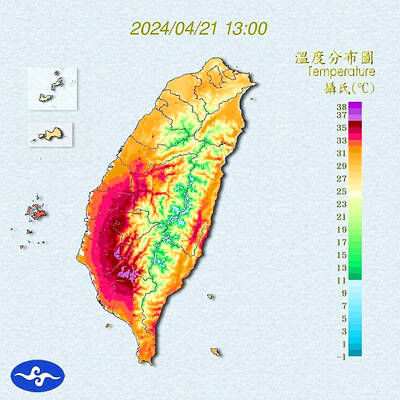
Heat advisories were in effect for nine administrative regions yesterday afternoon as warm southwesterly winds pushed temperatures above 38°C in parts of southern Taiwan, the Central Weather Administration (CWA) said. As of 3:30pm yesterday, Tainan’s Yujing District (玉井) had recorded the day’s highest temperature of 39.7°C, though the measurement will not be included in Taiwan’s official heat records since Yujing is an automatic rather than manually operated weather station, the CWA said. Highs recorded in other areas were 38.7°C in Kaohsiung’s Neimen District (內門), 38.2°C in Chiayi City and 38.1°C in Pingtung’s Sandimen Township (三地門), CWA data showed. The spell of scorching

UNAWARE: Many people sit for long hours every day and eat unhealthy foods, putting them at greater risk of developing one of the ‘three highs,’ an expert said More than 30 percent of adults aged 40 or older who underwent a government-funded health exam were unaware they had at least one of the “three highs” — high blood pressure, high blood lipids or high blood sugar, the Health Promotion Administration (HPA) said yesterday. Among adults aged 40 or older who said they did not have any of the “three highs” before taking the health exam, more than 30 percent were found to have at least one of them, Adult Preventive Health Examination Service data from 2022 showed. People with long-term medical conditions such as hypertension or diabetes usually do not


 RSS
RSS