


Representatives from several government agencies yesterday voiced their opposition to a referendum petition by the Chinese Nationalist Party (KMT) to allow direct cross-strait air and sea transportation "right away."
A public hearing on the referendum petition was held by the Cabinet's Referendum Review Committee at the Central Election Commission (CEC) yesterday.
The KMT submitted the petition, along with the required 130,000 signatures, last month. Once the review committee approves the petition, the petitioner has to submit another 820,000 signatures within six months before the referendum can be held.
"With direct cross-strait transportation, Taiwan would be more accessible to tourists from China, and these tourists can contribute significantly to our economic prosperity," KMT policy committee convener Tseng Yung-chuan (曾永權) told the public hearing.
"It could save transportation costs for Taiwanese businesses that have invested in China ... and would make it easier to persuade multinational corporations to set up regional headquarters in Taiwan," Tseng said.
Tseng added that only through economic cooperation with China could Taiwan enhance its competitiveness in the global market.
However, the Mainland Affairs Council said that while direct cross-strait links were a long-term policy objective, it opposed opening direct links "right away," as stated in the KMT referendum proposal.
"Direct cross-strait links is certainly our long-term policy objective, but the issue is very complicated and needs careful planning," said Lee Li-cheng (
Ministry of National Defense representative Peng Ming-yang (
"As China has shown in its policy statements, passage of the `Anti-Secession' Law and military activity, we should be more cautious in deciding the direct links issue," Peng said.
Meanwhile, a group of Democratic Progressive Party (DPP) lawmakers visited CEC Chairman Chang Cheng-hsiung (
"Many states in the US put referendums and elections on the same ballot," DPP Legislator Chai Trong-rong (
DPP Legislator Hsu Kuo-yung (徐國勇) said the one-ballot proposal was environmentally friendly and would "cut administrative costs and better ensure that voters' choices remain confidential."
Chang said he would leave discussion of the issue with the CEC, but added that it would be "difficult to do in reality."
"We've always had separate ballots in the past. It would be difficult for people to get accustomed to a new voting system," Chang said.
"Besides, our electoral laws require that valid and invalid ballots must be packed and kept separately -- it's impossible to do so if everything is printed on one sheet," he said.
When asked how referendum voter turnout would be calculated if the election and the plebiscite were printed on the same ballot, Chang said it wouldn't be a problem, as "we can put a `nonvoter' option on the slip."

THE HAWAII FACTOR: While a 1965 opinion said an attack on Hawaii would not trigger Article 5, the text of the treaty suggests the state is covered, the report says NATO could be drawn into a conflict in the Taiwan Strait if Chinese forces attacked the US mainland or Hawaii, a NATO Defense College report published on Monday says. The report, written by James Lee, an assistant research fellow at Academia Sinica’s Institute of European and American Studies, states that under certain conditions a Taiwan contingency could trigger Article 5 of NATO, under which an attack against any member of the alliance is considered an attack against all members, necessitating a response. Article 6 of the North Atlantic Treaty specifies that an armed attack in the territory of any member in Europe,
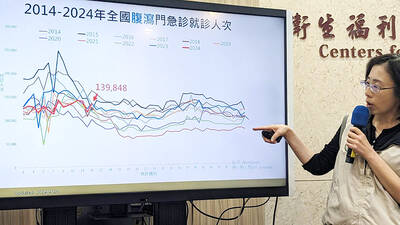
FLU SEASON: Twenty-six severe cases were reported from Tuesday last week to Monday, including a seven-year-old girl diagnosed with influenza-associated encephalopathy Nearly 140,000 people sought medical assistance for diarrhea last week, the Centers for Disease Control (CDC) said on Tuesday. From April 7 to Saturday last week, 139,848 people sought medical help for diarrhea-related illness, a 15.7 percent increase from last week’s 120,868 reports, CDC Epidemic Intelligence Center Deputy Director Lee Chia-lin (李佳琳) said. The number of people who reported diarrhea-related illness last week was the fourth highest in the same time period over the past decade, Lee said. Over the past four weeks, 203 mass illness cases had been reported, nearly four times higher than the 54 cases documented in the same period
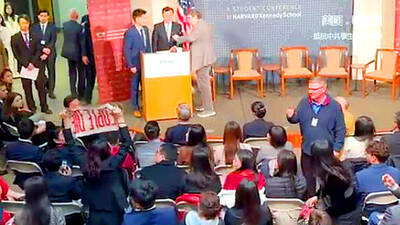
A group of Taiwanese-American and Tibetan-American students at Harvard University on Saturday disrupted Chinese Ambassador to the US Xie Feng’s (謝鋒) speech at the school, accusing him of being responsible for numerous human rights violations. Four students — two Taiwanese Americans and two from Tibet — held up banners inside a conference hall where Xie was delivering a speech at the opening ceremony of the Harvard Kennedy School China Conference 2024. In a video clip provided by the Coalition of Students Resisting the CCP (Chinese Communist Party), Taiwanese-American Cosette Wu (吳亭樺) and Tibetan-American Tsering Yangchen are seen holding banners that together read:
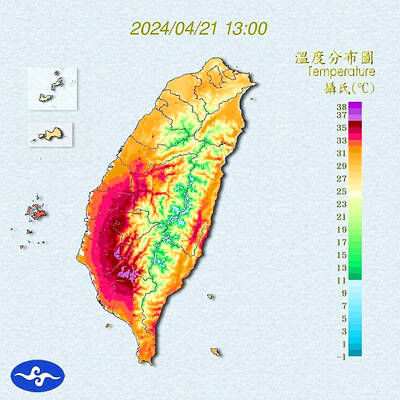
Heat advisories were in effect for nine administrative regions yesterday afternoon as warm southwesterly winds pushed temperatures above 38°C in parts of southern Taiwan, the Central Weather Administration (CWA) said. As of 3:30pm yesterday, Tainan’s Yujing District (玉井) had recorded the day’s highest temperature of 39.7°C, though the measurement will not be included in Taiwan’s official heat records since Yujing is an automatic rather than manually operated weather station, the CWA said. Highs recorded in other areas were 38.7°C in Kaohsiung’s Neimen District (內門), 38.2°C in Chiayi City and 38.1°C in Pingtung’s Sandimen Township (三地門), CWA data showed. The spell of scorching


 RSS
RSS