


Local medical research is essential to ensure the safe and effective use of pharmaceuticals, doctors and researchers said at the Formosa Medical Association's annual conference in Taipei yesterday.
In a discussion focusing on how ethnic differences could impact on treatment response, Wu Jer-yuarn (鄔哲源), director of Academia Sinica's National Genotyping Center, said that advances in genetics give researchers tools to investigate the disparities that clinicians have long observed.
"Most large-scale medical studies are conducted in the US or Europe, but tiny genetic differences can have an enormous effect on how pharmaceutical compounds are tolerated and metabolized by the body," Wu said.
Wu called for more local research into drug safety, rather than just efficacy trials.
One of the speakers gave a dramatic example of a drug that is considered relatively safe in the US and Europe, but that can have disastrous effects in Taiwan.
Stevens-Johnson syndrome (SJS) is supposed to be a rare condition, occurring in just two or three individuals per million. But at Chang Gung Memorial Hospital, the incidence of patients diagnosed with the life-threatening skin condition was much too high.
"Instead of seeing four or five cases a year, we are seeing 40 or 50," said Chung Wen-hung (鐘文宏), a researcher at Chang Gung Memorial Hospital's department of dermatology. "Sometimes we see two or three in a single week."
In SJS patients, an individual's hypersensitivity to certain drugs causes the body to attack itself, causing first a rash, then painful blistering and inflammations all over the body, and eventually causing toxic epidermal necrolysis if allowed to progress.
Local doctors long suspected that anticonvulsants, especially the epilepsy drug Carbamazepine, were more prone to causing SJS than overseas research suggests. But it was not until Chung's group conducted their own research into SJS using Taiwanese patients that they discovered the extent to which this is true, and why.
Chung's research showed that there was a high correlation between hypersensitivity to Carbamazepine and a single allele, human leukocyte antigen B1502.
Eight percent of the Taiwanese population carries the allele.
The death rate for SJS is around 10 percent, climbing to between 40 percent and 50 percent if it develops into toxic epidermal necrolysis.
"I have seen and studied a living tragedy," Chung said.
The research made doctors nationwide aware of the potential dangers of prescribing Carbamazepine, Chung said.
The research team is now working on developing a test to determine whether a patient possesses the B1502 allele.
While recent advances in pharmacogenomics are helping to explain how different ethnic groups respond differently to treatments, future research should enable doctors to move beyond ethnic differences in treatment altogether, said Chang Hua-mei (張畫眉), director of technology development at Vita Genomics Inc.
"We are on our way to truly personalized medicine," Chang said at the conference.
"In the future, instead of abandoning a drug if it causes an adverse reaction in an unacceptably high percentage of the population, we will have the technology to find out which individuals can or cannot safely use the drug," Chang said.
The discussion, which is part of Taiwan Medical Week, was one of 25 featured sessions and eight educational seminars at the conference, which concludes tomorrow.

THE HAWAII FACTOR: While a 1965 opinion said an attack on Hawaii would not trigger Article 5, the text of the treaty suggests the state is covered, the report says NATO could be drawn into a conflict in the Taiwan Strait if Chinese forces attacked the US mainland or Hawaii, a NATO Defense College report published on Monday says. The report, written by James Lee, an assistant research fellow at Academia Sinica’s Institute of European and American Studies, states that under certain conditions a Taiwan contingency could trigger Article 5 of NATO, under which an attack against any member of the alliance is considered an attack against all members, necessitating a response. Article 6 of the North Atlantic Treaty specifies that an armed attack in the territory of any member in Europe,
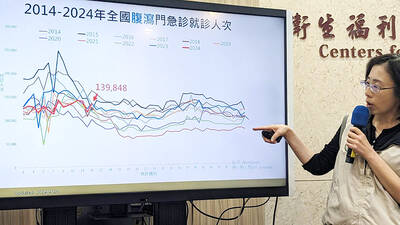
FLU SEASON: Twenty-six severe cases were reported from Tuesday last week to Monday, including a seven-year-old girl diagnosed with influenza-associated encephalopathy Nearly 140,000 people sought medical assistance for diarrhea last week, the Centers for Disease Control (CDC) said on Tuesday. From April 7 to Saturday last week, 139,848 people sought medical help for diarrhea-related illness, a 15.7 percent increase from last week’s 120,868 reports, CDC Epidemic Intelligence Center Deputy Director Lee Chia-lin (李佳琳) said. The number of people who reported diarrhea-related illness last week was the fourth highest in the same time period over the past decade, Lee said. Over the past four weeks, 203 mass illness cases had been reported, nearly four times higher than the 54 cases documented in the same period
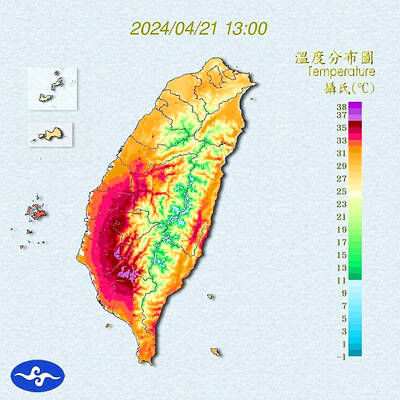
Heat advisories were in effect for nine administrative regions yesterday afternoon as warm southwesterly winds pushed temperatures above 38°C in parts of southern Taiwan, the Central Weather Administration (CWA) said. As of 3:30pm yesterday, Tainan’s Yujing District (玉井) had recorded the day’s highest temperature of 39.7°C, though the measurement will not be included in Taiwan’s official heat records since Yujing is an automatic rather than manually operated weather station, the CWA said. Highs recorded in other areas were 38.7°C in Kaohsiung’s Neimen District (內門), 38.2°C in Chiayi City and 38.1°C in Pingtung’s Sandimen Township (三地門), CWA data showed. The spell of scorching
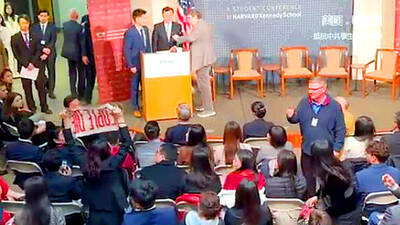
A group of Taiwanese-American and Tibetan-American students at Harvard University on Saturday disrupted Chinese Ambassador to the US Xie Feng’s (謝鋒) speech at the school, accusing him of being responsible for numerous human rights violations. Four students — two Taiwanese Americans and two from Tibet — held up banners inside a conference hall where Xie was delivering a speech at the opening ceremony of the Harvard Kennedy School China Conference 2024. In a video clip provided by the Coalition of Students Resisting the CCP (Chinese Communist Party), Taiwanese-American Cosette Wu (吳亭樺) and Tibetan-American Tsering Yangchen are seen holding banners that together read:


 RSS
RSS