


The government should immediately evaluate the mental health of all security guards serving in crucial posts where the president and vice president live and work, a Democratic Progressive Party (DPP) legislator said, following the suspected suicide of a military guard at President Chen Shui-bian's (
Captain Lu Tseng-hsiang (
The officer was rushed to National Taiwan University Hospital at 8:35am, but despite several hours of emergency treatment, he was declared dead at 12:20pm.
Bureau officials said in a news release that Lu may have been suffering from depression as a result of a failed relationship.
DPP Legislator Sandy Yen (莊和子) said armed security guards who are mentally unstable and who obtained their jobs with the help of lobbyists, or who are not suited for the job, should be "retrained."
Yen said that the bureau, the Coast Guard Administration and other security agencies should establish criteria to prevent further suicide attempts or shootings.
Yen listed seven points that, she claimed, would help the agencies draw up guidelines to help monitor staff. They were: determining physical strength during drills; observing movements and sounds while guards sleep; inspecting the amount of food guards eat; listening to their tone of voice when they make phone calls; examine their luggage when they leave their barracks; and examining their expression upon their return.
DPP Legislator Lin Chin-hsing (
He called for higher-ranking security authorities to pay closer attention to the personal lives of key personnel to reduce the likelihood of suicide by bodyguards who have access to weapons.
Hsu Li-meng (許立孟), deputy commander of the National Security Bureau's Special Service Center, said yesterday the bureau would not consider disciplinary measures until after military prosecutors have finalized their investigation and legal proceedings have been completed.
He also dismissed rumors that the scene of the suicide had been compromised before the arrival of investigators.
"Security personnel called the 119 emergency line immediately after the incident and the scene remained intact," he said.
Hsu further rebutted speculation that Lu committed suicide because of a heavy workload -- standing guard for four shifts during the day and two at night -- and that he might have been bullied by senior security guards.
While Lu was young, he was by no means a rookie, Hsu said.
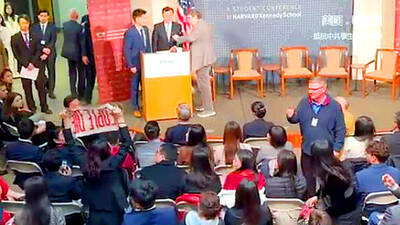
A group of Taiwanese-American and Tibetan-American students at Harvard University on Saturday disrupted Chinese Ambassador to the US Xie Feng’s (謝鋒) speech at the school, accusing him of being responsible for numerous human rights violations. Four students — two Taiwanese Americans and two from Tibet — held up banners inside a conference hall where Xie was delivering a speech at the opening ceremony of the Harvard Kennedy School China Conference 2024. In a video clip provided by the Coalition of Students Resisting the CCP (Chinese Communist Party), Taiwanese-American Cosette Wu (吳亭樺) and Tibetan-American Tsering Yangchen are seen holding banners that together read:

UNAWARE: Many people sit for long hours every day and eat unhealthy foods, putting them at greater risk of developing one of the ‘three highs,’ an expert said More than 30 percent of adults aged 40 or older who underwent a government-funded health exam were unaware they had at least one of the “three highs” — high blood pressure, high blood lipids or high blood sugar, the Health Promotion Administration (HPA) said yesterday. Among adults aged 40 or older who said they did not have any of the “three highs” before taking the health exam, more than 30 percent were found to have at least one of them, Adult Preventive Health Examination Service data from 2022 showed. People with long-term medical conditions such as hypertension or diabetes usually do not
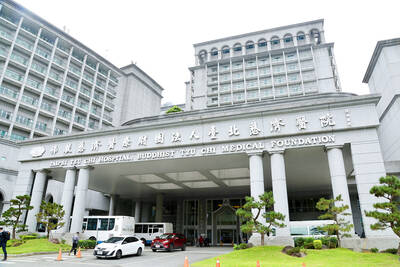
POLICE INVESTIGATING: A man said he quit his job as a nurse at Taipei Tzu Chi Hospital as he had been ‘disgusted’ by the behavior of his colleagues A man yesterday morning wrote online that he had witnessed nurses taking photographs and touching anesthetized patients inappropriately in Taipei Tzu Chi Hospital’s operating theaters. The man surnamed Huang (黃) wrote on the Professional Technology Temple bulletin board that during his six-month stint as a nurse at the hospital, he had seen nurses taking pictures of patients, including of their private parts, after they were anesthetized. Some nurses had also touched patients inappropriately and children were among those photographed, he said. Huang said this “disgusted” him “so much” that “he felt the need to reveal these unethical acts in the operating theater
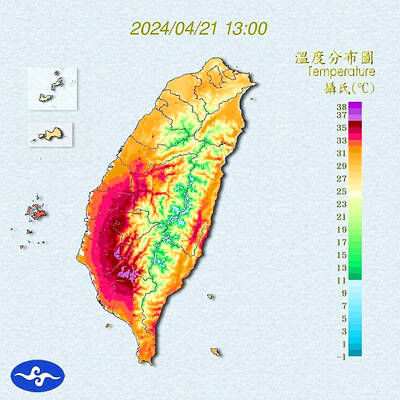
Heat advisories were in effect for nine administrative regions yesterday afternoon as warm southwesterly winds pushed temperatures above 38°C in parts of southern Taiwan, the Central Weather Administration (CWA) said. As of 3:30pm yesterday, Tainan’s Yujing District (玉井) had recorded the day’s highest temperature of 39.7°C, though the measurement will not be included in Taiwan’s official heat records since Yujing is an automatic rather than manually operated weather station, the CWA said. Highs recorded in other areas were 38.7°C in Kaohsiung’s Neimen District (內門), 38.2°C in Chiayi City and 38.1°C in Pingtung’s Sandimen Township (三地門), CWA data showed. The spell of scorching


 RSS
RSS