


An academic yesterday said the government should embark on "island diplomacy" by promoting "sister city" ties between the nation's cities and nearby countries' island-cities.
"Instead of looking west like we usually do, Taiwan should seriously consider expanding its diplomatic web to the east, north and south of the country," said National Taiwan Normal University political science professor Chen Ting-hui (陳廷輝).
Many islands around Taiwan are eager to form closer relations with Taiwan because they share similar beliefs, customs and even languages, he said.
More than 100 people from the Japanese island of Yonagunicho flew to Hualien City early this month to celebrate the quarter-century-long friendship between the eastern city and the island.
The trip also highlighted the islanders' will to be self-reliant from Tokyo and their interest in forging closer ties with Taiwan despite an absence of official relations between the two countries, Chen said.
For centuries, Japanese islanders, such as those on Yonagunicho, have been keen to establish tighter economic ties with Taiwan, even to the point of attempting to declare independence from Tokyo, he said.
For example, Ilan County's Suao Township (
Chen said that some residents of the Philippines' Batan Islands can communicate with people on Orchid Island (蘭嶼) because they speak very similar languages.
During the pre-World War II era, Taiwan and the Japanese islands enjoyed close communications and people were allowed to freely travel, seeking business or education opportunities and medical attention.
Many people have close friends and extended families in both places.
Some Taiwanese farmers even went to Ishigaki to teach locals how to plant and process sugarcane.
Many "Okinawa Villages" were also established along the coastal cities of Taiwan, Chen said.
After World War II, the US kept a tight lid on Japan's foreign dealings and thus cut off communication between the islands and Taiwan. The isolation, coupled with the diminishing budget from the central government, has put a huge strain on the islands' economic growth.
Chen said the total island population plummeted from over 20,000 during its peak days to 1,600 today.
One-seventh of the residents are senior citizens, he said.
"These islands feel a closer kinship to Taiwan, which is only 110km away versus Tokyo, which is 2,200km away. For many islanders, Taiwan is the country they want to be part of, both on a geographical and emotional level," the professor said.
In 2005, the islanders started an independent movement to secede from Japan.
They wanted to become a self-governing body so they could develop official ties with Taiwan without the attendant political hassles.
Although the movement was quickly quashed by Tokyo, the islanders are still eager to develop closer ties with their Taiwanese counterparts.
One example is Chiyoki Tasato, who has been stationed in Hualien in recent months as a representative of Yonagunicho.
"I want to build bridges between Yonaguni and Taiwan to generate new ties," Tasato was quoted as saying in the Daily Yomiuri, an online Japanese news outlet.
"I feel an affinity as we are the same kind of people -- residents of remote regions. Many things, from food to weeds, are similar [between Yonagunijima and Taiwan]," he said.
"I want to bring things back to the way they were 60 years ago when people could visit each other freely. I also want to show the central government the future of my island, which, with the help of Taiwan, will become self-reliant," Tasato said.
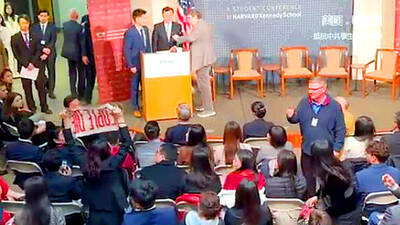
A group of Taiwanese-American and Tibetan-American students at Harvard University on Saturday disrupted Chinese Ambassador to the US Xie Feng’s (謝鋒) speech at the school, accusing him of being responsible for numerous human rights violations. Four students — two Taiwanese Americans and two from Tibet — held up banners inside a conference hall where Xie was delivering a speech at the opening ceremony of the Harvard Kennedy School China Conference 2024. In a video clip provided by the Coalition of Students Resisting the CCP (Chinese Communist Party), Taiwanese-American Cosette Wu (吳亭樺) and Tibetan-American Tsering Yangchen are seen holding banners that together read:

UNAWARE: Many people sit for long hours every day and eat unhealthy foods, putting them at greater risk of developing one of the ‘three highs,’ an expert said More than 30 percent of adults aged 40 or older who underwent a government-funded health exam were unaware they had at least one of the “three highs” — high blood pressure, high blood lipids or high blood sugar, the Health Promotion Administration (HPA) said yesterday. Among adults aged 40 or older who said they did not have any of the “three highs” before taking the health exam, more than 30 percent were found to have at least one of them, Adult Preventive Health Examination Service data from 2022 showed. People with long-term medical conditions such as hypertension or diabetes usually do not
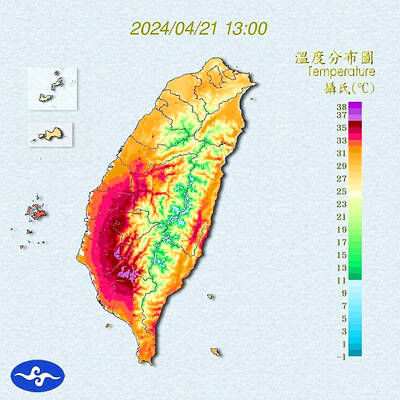
Heat advisories were in effect for nine administrative regions yesterday afternoon as warm southwesterly winds pushed temperatures above 38°C in parts of southern Taiwan, the Central Weather Administration (CWA) said. As of 3:30pm yesterday, Tainan’s Yujing District (玉井) had recorded the day’s highest temperature of 39.7°C, though the measurement will not be included in Taiwan’s official heat records since Yujing is an automatic rather than manually operated weather station, the CWA said. Highs recorded in other areas were 38.7°C in Kaohsiung’s Neimen District (內門), 38.2°C in Chiayi City and 38.1°C in Pingtung’s Sandimen Township (三地門), CWA data showed. The spell of scorching
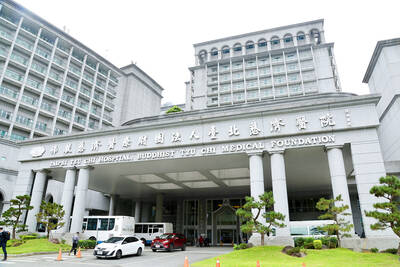
POLICE INVESTIGATING: A man said he quit his job as a nurse at Taipei Tzu Chi Hospital as he had been ‘disgusted’ by the behavior of his colleagues A man yesterday morning wrote online that he had witnessed nurses taking photographs and touching anesthetized patients inappropriately in Taipei Tzu Chi Hospital’s operating theaters. The man surnamed Huang (黃) wrote on the Professional Technology Temple bulletin board that during his six-month stint as a nurse at the hospital, he had seen nurses taking pictures of patients, including of their private parts, after they were anesthetized. Some nurses had also touched patients inappropriately and children were among those photographed, he said. Huang said this “disgusted” him “so much” that “he felt the need to reveal these unethical acts in the operating theater


 RSS
RSS