


Descendents of "Princess Bannen" of the Rukai tribe yesterday called the popular myth about the princess an unauthorized rewriting of a true story in the tribe's history.
Dozens of Rukai tribesmen joined the protest at a press conference held at the legislature yesterday.
In recent years, the myth of Princess Bannen has not only been used in a computer game, but also turned into a pop song.
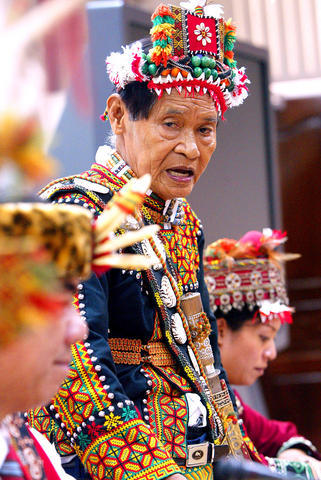
PHOTO: CNA
One of the popularized versions of the Princess Bannen story recounts how a beautiful Rukai princess named Bannen fell in love with Prince Hundred-Pacer Snake and wanted to marry him.
Bannen's parents were angry since they didn't want their daughter to marry a snake. However, they couldn't directly refuse the marriage for fear of angering their ancestral spirits, because Rukai people believed themselves to be descendents of the hundred-pacer snake.
Therefore, Bannen's parents listed several difficult tasks for the prince to complete before granting their permission for the marriage.
The prince completed them all successfully. On the wedding day, Bannen followed the hundred-pacer snake into the sacred Talopalin Lake and was never seen again.
For the Rukai tribesmen and Bannen's descendents, the love story element is completely an outside creation.
"The real name of Princess Bannen was Limuasa. The real story was that Limuasa fell in love with a man from another tribe -- which was unacceptable for the Rukai at the time," said Dale Vag, an Amis man who married a descendent of Limuasa.
"The story happened about 260 years ago, and for the Rukais at the time, marriage with someone from another tribe was shameful," said Lakuduvia Muni, a 13th-generation descendent from Limuasa's family.
To agree to the marriage, Limuasa's parents posed several challenges to the man.
After he had completed all the challenges, permission to marry was granted, Muni said.
As agreed, the man married Limuasa. But since Limuasa felt guilty toward her parents, the couple committed suicide a few days later by the Talopalin Lake, Muni said.
"No one consulted us when they rewrote the story, which was disrespectful," Muni said. "I'd like to ask the government to help preserve tribal culture -- which includes our right to tell the story."
At a separate venue, Council of Indigenous Peoples Minister Icyang Parod said he supported Muni's request.
He also said that the council has drafted a bill specifically aimed at protecting traditional and original Aboriginal stories and music.
The bill is currently in the legislative backlog, Icyang added.

A group of Taiwanese-American and Tibetan-American students at Harvard University on Saturday disrupted Chinese Ambassador to the US Xie Feng’s (謝鋒) speech at the school, accusing him of being responsible for numerous human rights violations. Four students — two Taiwanese Americans and two from Tibet — held up banners inside a conference hall where Xie was delivering a speech at the opening ceremony of the Harvard Kennedy School China Conference 2024. In a video clip provided by the Coalition of Students Resisting the CCP (Chinese Communist Party), Taiwanese-American Cosette Wu (吳亭樺) and Tibetan-American Tsering Yangchen are seen holding banners that together read:

UNAWARE: Many people sit for long hours every day and eat unhealthy foods, putting them at greater risk of developing one of the ‘three highs,’ an expert said More than 30 percent of adults aged 40 or older who underwent a government-funded health exam were unaware they had at least one of the “three highs” — high blood pressure, high blood lipids or high blood sugar, the Health Promotion Administration (HPA) said yesterday. Among adults aged 40 or older who said they did not have any of the “three highs” before taking the health exam, more than 30 percent were found to have at least one of them, Adult Preventive Health Examination Service data from 2022 showed. People with long-term medical conditions such as hypertension or diabetes usually do not
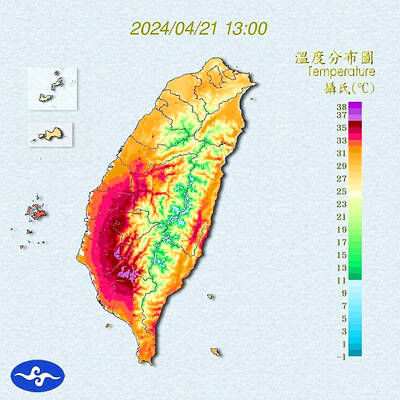
Heat advisories were in effect for nine administrative regions yesterday afternoon as warm southwesterly winds pushed temperatures above 38°C in parts of southern Taiwan, the Central Weather Administration (CWA) said. As of 3:30pm yesterday, Tainan’s Yujing District (玉井) had recorded the day’s highest temperature of 39.7°C, though the measurement will not be included in Taiwan’s official heat records since Yujing is an automatic rather than manually operated weather station, the CWA said. Highs recorded in other areas were 38.7°C in Kaohsiung’s Neimen District (內門), 38.2°C in Chiayi City and 38.1°C in Pingtung’s Sandimen Township (三地門), CWA data showed. The spell of scorching

POLICE INVESTIGATING: A man said he quit his job as a nurse at Taipei Tzu Chi Hospital as he had been ‘disgusted’ by the behavior of his colleagues A man yesterday morning wrote online that he had witnessed nurses taking photographs and touching anesthetized patients inappropriately in Taipei Tzu Chi Hospital’s operating theaters. The man surnamed Huang (黃) wrote on the Professional Technology Temple bulletin board that during his six-month stint as a nurse at the hospital, he had seen nurses taking pictures of patients, including of their private parts, after they were anesthetized. Some nurses had also touched patients inappropriately and children were among those photographed, he said. Huang said this “disgusted” him “so much” that “he felt the need to reveal these unethical acts in the operating theater


 RSS
RSS