


The Kaohsiung District Court judges' decision on Friday to annul Kaohsiung Mayor Chen Chu's (
The court in charge of the lawsuit consisted of three judges. While Preceding Judge Huang Hung-chin (
Huang's action was considered rare in common courtroom practice, said judicial experts.
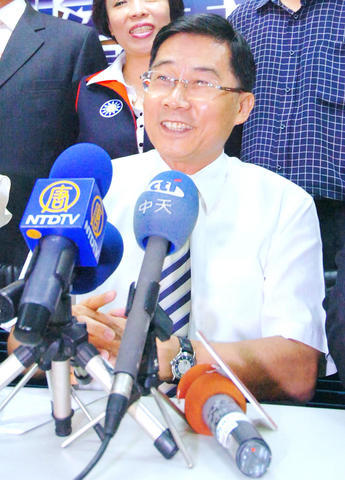
PHOTO: HUANG CHIH-YUAN, TAIPEI TIMES
Former Tainan judge and currently Kaohsiung prosecutor Chang Hsueh-ming (
"His point of view would have been considered as the judges of Taiwan High Court listened to the case," he said. "I expect an intense crossfire during the second trial."
Preceding Judge Huang said in the ruling that Chen lost the suit mainly because she violated the Election and Recall Law (
The ruling said the Chen camp's press conference on the eve of the election accusing Chinese Nationalist Party (KMT) candidate Huang Chun-ying's (黃俊英) camp of vote-buying violated the Election and Recall Law, which stipulates that election candidates must stop campaign activities at 10pm on the eve of elections.
The ruling said the vote-buying allegation made by Chen's camp at the press conference had spread via TV and radio reports. Chen's camp also spread it by sending text massages to Kaohsiung voters, which impacted Huang's chances in the election, the ruling said.
Huang Hung-chin said that the purpose of banning campaign activities on the eve of elections is to avoid any surprise attack on campaign rivals and so to ensure procedural justice and a fair competition.
The ruling said that the press conference held by Chen's camp left Huang Chun-ying's camp no time to explain or clarify the matter before the vote, putting Huang in an unfair position in the race.
"The tactic ... was enough to influence the election result," the district court ruled in its verdict.
The vote-buying allegation made by Chen's camp turned out to be valid and Kaohsiung prosecutors have indicted Ku Hsin-ming (
Tsai was suspected by prosecutors of supplying the funds.
Last Friday's ruling said that while the evidence showed that the two men had engaged in vote-buying, there was nothing to prove Huang's involvement in this, as Chen's team had said in its press conference.
However, Ku outlined questions challenging the ruling.
First, he said, if Huang's camp could not prove that Chen's claim that "Huang was paying `walking fees' (
Second, Ku said that since the Chen camp's negative campaign tactic at most violated the regulations relating to the period for campaigning, voters' voting rights were by no means affected by such an infraction.
Consequently, he said, Chen had not broken any fundamental election-related principles which would justify the annulment ruling.
Ku said the evidence showed it was Chen's campaign team -- not Chen herself -- who led the accusation campaign, and that therefore Chen was not the main defendant in the case and should not be responsible for the incident.
He said it is common for candidates to make revelations about or attack their rivals during election campaigns and that these should be protected under freedom of speech.
He further argued that such accusations should be assessed by the voters themselves, the media and government authorities in charge of holding elections.
Lin Ching-tsung (林慶宗), a prosecutor with the high court's Kaohsiung office, said he was surprised by the ruling, but said the Democratic Progressive Party (DPP) should not have criticized the verdict, because the criticism might leave a bad impression on the judges who will be taking over the case following Chen Chu's appeal.
President Chen Shui-bian (
He said he was confident Chen Chu would complete her term as mayor and believed Kaohsiung residents felt the same.
KMT presidential candidate Ma Ying-jeou (馬英九), meanwhile, said yesterday he hoped the Taiwan High Court would uphold the ruling.
Although the court's ruling provoked mixed responses, Ma said he believed the verdict would be helpful in wiping out "dirty tricks" in future elections.
DPP presidential candidate Frank Hsieh (
ADDITIONAL REPORTING BY CNA
THE HAWAII FACTOR: While a 1965 opinion said an attack on Hawaii would not trigger Article 5, the text of the treaty suggests the state is covered, the report says NATO could be drawn into a conflict in the Taiwan Strait if Chinese forces attacked the US mainland or Hawaii, a NATO Defense College report published on Monday says. The report, written by James Lee, an assistant research fellow at Academia Sinica’s Institute of European and American Studies, states that under certain conditions a Taiwan contingency could trigger Article 5 of NATO, under which an attack against any member of the alliance is considered an attack against all members, necessitating a response. Article 6 of the North Atlantic Treaty specifies that an armed attack in the territory of any member in Europe,
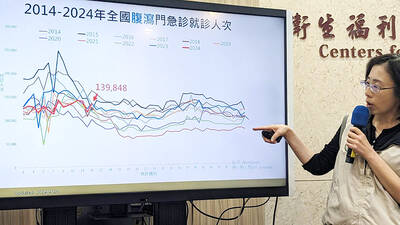
FLU SEASON: Twenty-six severe cases were reported from Tuesday last week to Monday, including a seven-year-old girl diagnosed with influenza-associated encephalopathy Nearly 140,000 people sought medical assistance for diarrhea last week, the Centers for Disease Control (CDC) said on Tuesday. From April 7 to Saturday last week, 139,848 people sought medical help for diarrhea-related illness, a 15.7 percent increase from last week’s 120,868 reports, CDC Epidemic Intelligence Center Deputy Director Lee Chia-lin (李佳琳) said. The number of people who reported diarrhea-related illness last week was the fourth highest in the same time period over the past decade, Lee said. Over the past four weeks, 203 mass illness cases had been reported, nearly four times higher than the 54 cases documented in the same period
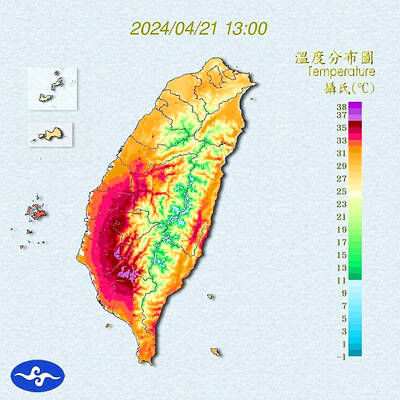
Heat advisories were in effect for nine administrative regions yesterday afternoon as warm southwesterly winds pushed temperatures above 38°C in parts of southern Taiwan, the Central Weather Administration (CWA) said. As of 3:30pm yesterday, Tainan’s Yujing District (玉井) had recorded the day’s highest temperature of 39.7°C, though the measurement will not be included in Taiwan’s official heat records since Yujing is an automatic rather than manually operated weather station, the CWA said. Highs recorded in other areas were 38.7°C in Kaohsiung’s Neimen District (內門), 38.2°C in Chiayi City and 38.1°C in Pingtung’s Sandimen Township (三地門), CWA data showed. The spell of scorching
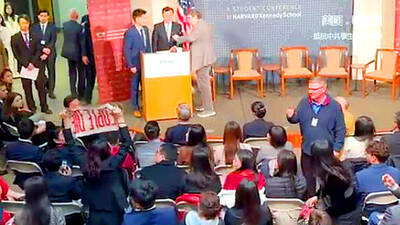
A group of Taiwanese-American and Tibetan-American students at Harvard University on Saturday disrupted Chinese Ambassador to the US Xie Feng’s (謝鋒) speech at the school, accusing him of being responsible for numerous human rights violations. Four students — two Taiwanese Americans and two from Tibet — held up banners inside a conference hall where Xie was delivering a speech at the opening ceremony of the Harvard Kennedy School China Conference 2024. In a video clip provided by the Coalition of Students Resisting the CCP (Chinese Communist Party), Taiwanese-American Cosette Wu (吳亭樺) and Tibetan-American Tsering Yangchen are seen holding banners that together read:


 RSS
RSS