


As Washington struggles to end nuclear programs in North Korea and Iran, startling details have emerged from declassified US government documents regarding its success in halting Taiwan's budding nuclear project in the 1970s.
The recently declassified documents show the administrations of former US presidents Gerald Ford and Jimmy Carter placed heavy pressure on Taiwan to end its quest for sophisticated equipment that Washington feared would be used in the manufacture of a nuclear bomb.
The pressure paid off -- though not without setbacks -- and the Taiwanese government abandoned its plans, according to the documents, which were obtained under Freedom of Information Act guidelines by a private group of researchers affiliated with the George Washington University in Washington.
William Burr, who coordinated the Taiwan project for the university's privately funded National Security Archive, said the documents provide a compelling insight into how the US government approached what it believed to be the danger of a nuclear-armed Taiwan.
"Nothing of this level of detail on the US interest in changing the course of the Taiwan nuclear program has ever appeared before," he said in an interview.
Taiwanese leaders repeatedly denied that the country was trying to build a nuclear weapon, according to the documents, although they also show that from as early as November 1972, the CIA thought otherwise.
"We believe Taipei's present intention is to develop the capacity to fabricate and test a nuclear device," the agency concluded in a Special National Intelligence Estimate. "This capacity could be attained by 1976."
The CIA said it was not sure why Taiwan began its alleged nuclear quest, but speculated that it was related to anxiety over the budding US relationship with China.
In the early 1970s the communist leadership in China was unyielding about bringing Taiwan under its sway -- an attitude it maintains to this day.
In February 1972, then US president Richard Nixon visited China, breaking the ice on more than two decades of hostility between Washington and Beijing, and raising fears in Taipei that the island's long-running defense pact with the US might be on the rocks.
"Some in Taiwan may be questioning how long they can count on all-out US support," the agency said. "In this perspective, a nuclear weapons option may be seen by [Taiwan] as one of the few feasible deterrents to communist attack."
The documents show that US concerns deepened in 1973 when the State Department learned that Taiwan had contacted French and Belgian companies to obtain a nuclear reprocessing plant -- a step it saw as a clear intention to build a bomb.
Washington sent a special team to Taiwan to meet with government officials and nuclear experts, and warn them that acquiring such a plant would undermine Taiwan-US cooperation. Taiwan continued to disavow any interest in producing a nuclear device, but some on the team were skeptical, the documents show.
The documents indicate team leaders cautioned then Taiwanese foreign minister James Shen (
Three years later, in 1976, the documents show that US ambassador to Taipei Leonard Unger met with then premier Chiang Ching-kuo (蔣經國) to express concerns that Washington had "conclusive evidence" that a key Taiwanese nuclear facility was trying to acquire reprocessing technology.
The meeting resulted in the Taiwanese Cabinet declaring publicly that the island "had no intention whatsoever to use its human and natural resources for the development of nuclear weapons," or to obtain technology to reprocess spent fuel.
The documents show that Carter administration officials continued the US policy of leaning hard on Taiwan, making it clear that nuclear nonproliferation was a top priority for the new president.
In April 1977, according to the documents, the Taiwanese began to show clear signs they were taking the US pressure seriously.
In a top secret memorandum to Carter, former national security adviser Zbigniew Brzezinski said that a heavy water reactor project and hot laboratory at the Taiwanese Institute of Nuclear Research had been closed down, removing a major US worry about the Taiwanese nuclear program.
"The American effort to crack down on this project clearly yielded its desired results," Brzezinski wrote.
Still, the documents show, the US remained concerned that elements in the Taiwanese leadership -- including the military -- were dedicated to leaving the nuclear weapons option open.
Unger kept pressing Chiang -- who at that time became Taiwan's president -- to be more forthright on the nuclear issue.
In September 1978, Chiang showed an unusual fit of pique, the documents show, complaining to Unger in a face-to-face meeting that the US was dealing with it "in a fashion which few other countries would tolerate."
The US switched diplomatic recognition from Taipei to Beijing in 1979, but Washington continued to monitor Taiwan's nuclear program, the documents show, using a variety of means.
In the absence of any new evidence, Burr believes that the US pressure paid off, and that Taiwan has definitively renounced any nuclear weapons ambitions it might once have had.
However, he said, that doesn't mean that Washington will have similar success with North Korea, which last year tested a nuclear device, or Iran, which the US maintains is working hard at building a nuclear bomb. Iran denies the US charges, maintaining that its long-standing nuclear program is aimed only at generating electricity.
"Taiwan was a US ally heavily dependent on American goodwill," Burr said. "But with North Korea and Iran, there is no security relationship and very little leverage."
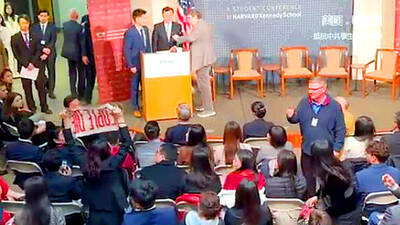
A group of Taiwanese-American and Tibetan-American students at Harvard University on Saturday disrupted Chinese Ambassador to the US Xie Feng’s (謝鋒) speech at the school, accusing him of being responsible for numerous human rights violations. Four students — two Taiwanese Americans and two from Tibet — held up banners inside a conference hall where Xie was delivering a speech at the opening ceremony of the Harvard Kennedy School China Conference 2024. In a video clip provided by the Coalition of Students Resisting the CCP (Chinese Communist Party), Taiwanese-American Cosette Wu (吳亭樺) and Tibetan-American Tsering Yangchen are seen holding banners that together read:

UNAWARE: Many people sit for long hours every day and eat unhealthy foods, putting them at greater risk of developing one of the ‘three highs,’ an expert said More than 30 percent of adults aged 40 or older who underwent a government-funded health exam were unaware they had at least one of the “three highs” — high blood pressure, high blood lipids or high blood sugar, the Health Promotion Administration (HPA) said yesterday. Among adults aged 40 or older who said they did not have any of the “three highs” before taking the health exam, more than 30 percent were found to have at least one of them, Adult Preventive Health Examination Service data from 2022 showed. People with long-term medical conditions such as hypertension or diabetes usually do not
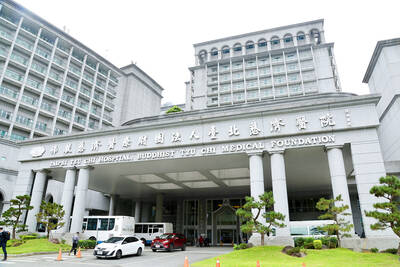
POLICE INVESTIGATING: A man said he quit his job as a nurse at Taipei Tzu Chi Hospital as he had been ‘disgusted’ by the behavior of his colleagues A man yesterday morning wrote online that he had witnessed nurses taking photographs and touching anesthetized patients inappropriately in Taipei Tzu Chi Hospital’s operating theaters. The man surnamed Huang (黃) wrote on the Professional Technology Temple bulletin board that during his six-month stint as a nurse at the hospital, he had seen nurses taking pictures of patients, including of their private parts, after they were anesthetized. Some nurses had also touched patients inappropriately and children were among those photographed, he said. Huang said this “disgusted” him “so much” that “he felt the need to reveal these unethical acts in the operating theater
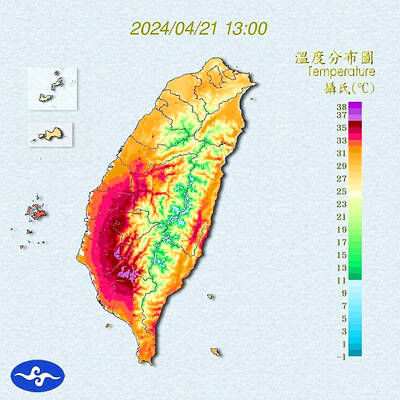
Heat advisories were in effect for nine administrative regions yesterday afternoon as warm southwesterly winds pushed temperatures above 38°C in parts of southern Taiwan, the Central Weather Administration (CWA) said. As of 3:30pm yesterday, Tainan’s Yujing District (玉井) had recorded the day’s highest temperature of 39.7°C, though the measurement will not be included in Taiwan’s official heat records since Yujing is an automatic rather than manually operated weather station, the CWA said. Highs recorded in other areas were 38.7°C in Kaohsiung’s Neimen District (內門), 38.2°C in Chiayi City and 38.1°C in Pingtung’s Sandimen Township (三地門), CWA data showed. The spell of scorching


 RSS
RSS