


Former president Lee Tung-hui's (
Lee, who arrived in Japan on Wednesday for a 10-day visit, said that he would like to visit the shrine where his elder brother is enshrined.
Lee's elder brother served in the Japanese navy during World War II and died while on duty in February 1945 in the Philippines.
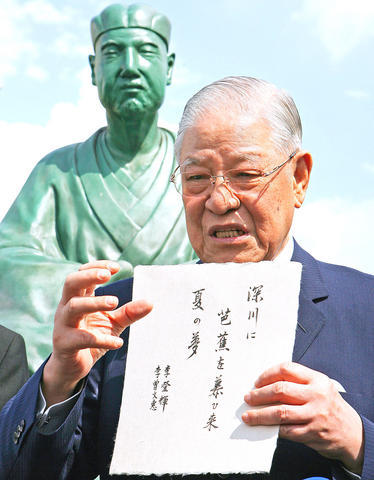
PHOTO: AFP
KMT lawmakers Hung Hsiu-chu (
They said the spirit of Lee's elder brother had been brought back to Taiwan about 20 years ago and put in Chihua Temple (濟化宮), Peipu Township (北埔), Hsinchu County.
They showed a picture of a tablet bearing the Japanese name of Lee's brother, his date of birth and pointed to the name of Lee's father, Lee Ching-long (李金龍), as evidence.
"There is no tablet, remains or any spirit of his brother at Yasukuni. There is only an enshrinement list there. The spirits of [Taiwanese] soldiers enshrined at Yasukuni were all relocated to the Chihua temple. I don't know what Lee is going to honor." Hung said.
Hung said she suspected that Lee's planned visit to the shrine was aimed at infuriating China.
Rebutting Hung and Lei's claim, TSU Secretary-General Chien Cheng-shan (
"It's already very tragic that Taiwanese had to die for the Japanese," Chien said. "Those who are unfamiliar with Taiwanese history should not manipulate this incident and harm the feelings of Taiwanese."
Responding to Hung's claim about the spirit of Lee's elder brother, Chien said "the [Chihua] temple is only a private memorial to those who died during the war."
"According to Taiwanese custom, there's a religious ritual to call the spirits home and this was never performed," he said, adding that the Yasukuni shrine is the only place that could connect Lee to his deceased brother.
Asked by reporters yesterday about his plans to visit the shrine, Lee said "no date has been set."
"If you were me, would you want to visit your elder brother?" Lee asked.
Association of East Asian Relations secretary-general Huang Ju-hou (黃諸侯) said at a separate conference yesterday that Lee's visit to Japan was a personal trip and the Ministry of Foreign Affairs, to which the association is affiliated, respected Lee's decision to pray for his elder brother.
"Japanese Prime Minister Shinzo Abe has said that praying at the shrine is Lee's freedom of faith and the foreign ministry of Taiwan will certainly respect Lee's personal decision," Huang said.
Huang said he did not think that Lee's visit to the shrine would affect Taiwan-Japan or cross-strait relations.
"If there are any political repercussions, it would only result from China's unreasonable objections," he said.
Huang said the ministries of foreign affairs of Taiwan and Japan were not involved in the arrangement of Lee's trip and Lee also declined the offer of Taiwan's representative to Japan Koh Se-kai (許世楷) to receive him at the airport.
It showed that Lee did not want his journey to be tainted with a political hue, Huang said.
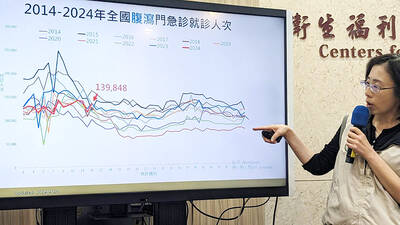
FLU SEASON: Twenty-six severe cases were reported from Tuesday last week to Monday, including a seven-year-old girl diagnosed with influenza-associated encephalopathy Nearly 140,000 people sought medical assistance for diarrhea last week, the Centers for Disease Control (CDC) said on Tuesday. From April 7 to Saturday last week, 139,848 people sought medical help for diarrhea-related illness, a 15.7 percent increase from last week’s 120,868 reports, CDC Epidemic Intelligence Center Deputy Director Lee Chia-lin (李佳琳) said. The number of people who reported diarrhea-related illness last week was the fourth highest in the same time period over the past decade, Lee said. Over the past four weeks, 203 mass illness cases had been reported, nearly four times higher than the 54 cases documented in the same period
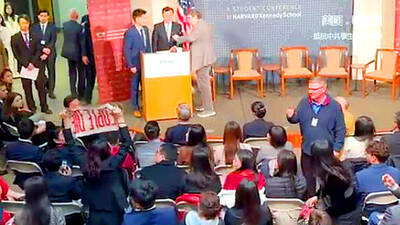
A group of Taiwanese-American and Tibetan-American students at Harvard University on Saturday disrupted Chinese Ambassador to the US Xie Feng’s (謝鋒) speech at the school, accusing him of being responsible for numerous human rights violations. Four students — two Taiwanese Americans and two from Tibet — held up banners inside a conference hall where Xie was delivering a speech at the opening ceremony of the Harvard Kennedy School China Conference 2024. In a video clip provided by the Coalition of Students Resisting the CCP (Chinese Communist Party), Taiwanese-American Cosette Wu (吳亭樺) and Tibetan-American Tsering Yangchen are seen holding banners that together read:

UNAWARE: Many people sit for long hours every day and eat unhealthy foods, putting them at greater risk of developing one of the ‘three highs,’ an expert said More than 30 percent of adults aged 40 or older who underwent a government-funded health exam were unaware they had at least one of the “three highs” — high blood pressure, high blood lipids or high blood sugar, the Health Promotion Administration (HPA) said yesterday. Among adults aged 40 or older who said they did not have any of the “three highs” before taking the health exam, more than 30 percent were found to have at least one of them, Adult Preventive Health Examination Service data from 2022 showed. People with long-term medical conditions such as hypertension or diabetes usually do not
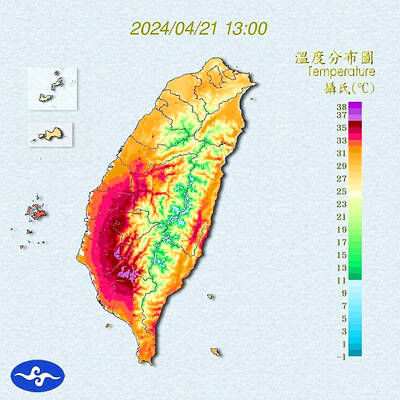
Heat advisories were in effect for nine administrative regions yesterday afternoon as warm southwesterly winds pushed temperatures above 38°C in parts of southern Taiwan, the Central Weather Administration (CWA) said. As of 3:30pm yesterday, Tainan’s Yujing District (玉井) had recorded the day’s highest temperature of 39.7°C, though the measurement will not be included in Taiwan’s official heat records since Yujing is an automatic rather than manually operated weather station, the CWA said. Highs recorded in other areas were 38.7°C in Kaohsiung’s Neimen District (內門), 38.2°C in Chiayi City and 38.1°C in Pingtung’s Sandimen Township (三地門), CWA data showed. The spell of scorching


 RSS
RSS