


Distinguished marine ecologist Jeng Ming-shiou (
Jeng made the remarks at a press conference in Taipei yesterday held to celebrate his receiving this year's Biwako Prize, Japan's prestigious ecology award, for his extraordinary research into crustaceans and their habitats and his contribution to marine ecological protection.
Jeng told the press conference yesterday that big fish like giant manta rays and two-meter long parrot fish are "star creatures" that pull in big eco-tourism bucks, but they have been killed off around Taiwan by habitat destruction and overfishing.
"Many older fishermen have told me that they've seen creatures like these in our coastal waters but they are not found any more," he said
Jeng has called for 20 percent of Taiwan's 1,200km coastline to be protected and for the swift passage of draft laws regulating the coastline that come before the Legislative Yuan next week.
Jeng, of the Research Center for Biodiversity at Academia Sinica, is best known for his work uncovering the secret life of hydrothermal vent crabs that live off Ilan's Kuei-San Island, published in the journal Nature.
At a marine biology conference held last year on Green Island, Jeng issued a challenge; he promised NT$10,000 to anyone who could take a picture of a coral fish longer than 50cm while diving off Green Island.
Nobody was able to do so during the duration of the conference.
Meanwhile, seafood restaurants at the diving mecca were openly selling freshly caught coral-reef fish.
"They'd say to their customers, you'd better try this fish, experts say they are disappearing so it may be your last chance to eat it," Jeng said.
"You can only eat a fish once," he said, "but a living fish is an asset that will keep tourists coming back year after year."
Jeng said he felt the need to speak in terms of eco-tourist dollars because incentives matter.
"It doesn't make sense that Taiwanese go to Australia and Indonesia, spending tens of thousands of dollars on each trip, when we could be attracting tourists from all over the world to come to Taiwan."
"It's not too late," Jeng said, who said he believed the big fish would return to Taiwan's waters with proper conservation measures, bringing tourists with them.
However, some changes are irreversible.
Jeng mentioned that he recently documented the demise of a coral reef twice the size of the city of Taipei in Dongsha (東沙) caused by warmer ocean temperatures. The wetland in Shalun (
"The ironic thing is, nobody wanted to live there," Jeng said. "The development was a big flop."
Additional reporting by CNA

Former president Ma Ying-jeou’s (馬英九) mention of Taiwan’s official name during a meeting with Chinese President Xi Jinping (習近平) on Wednesday was likely a deliberate political play, academics said. “As I see it, it was intentional,” National Chengchi University Graduate Institute of East Asian Studies professor Wang Hsin-hsien (王信賢) said of Ma’s initial use of the “Republic of China” (ROC) to refer to the wider concept of “the Chinese nation.” Ma quickly corrected himself, and his office later described his use of the two similar-sounding yet politically distinct terms as “purely a gaffe.” Given Ma was reading from a script, the supposed slipup
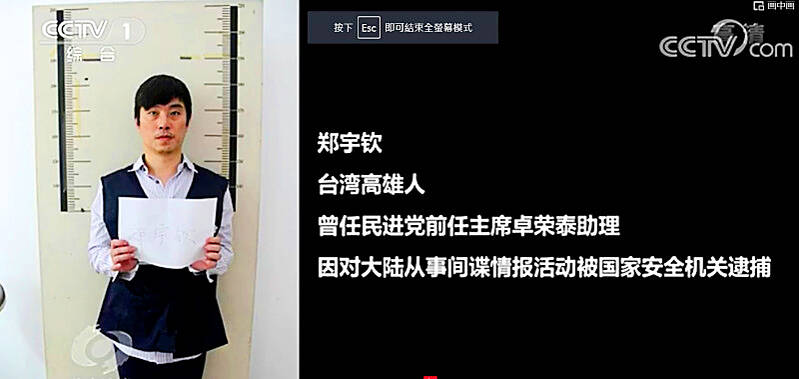
Former Czech Republic-based Taiwanese researcher Cheng Yu-chin (鄭宇欽) has been sentenced to seven years in prison on espionage-related charges, China’s Ministry of State Security announced yesterday. China said Cheng was a spy for Taiwan who “masqueraded as a professor” and that he was previously an assistant to former Cabinet secretary-general Cho Jung-tai (卓榮泰). President-elect William Lai (賴清德) on Wednesday last week announced Cho would be his premier when Lai is inaugurated next month. Today is China’s “National Security Education Day.” The Chinese ministry yesterday released a video online showing arrests over the past 10 years of people alleged to be

THE HAWAII FACTOR: While a 1965 opinion said an attack on Hawaii would not trigger Article 5, the text of the treaty suggests the state is covered, the report says NATO could be drawn into a conflict in the Taiwan Strait if Chinese forces attacked the US mainland or Hawaii, a NATO Defense College report published on Monday says. The report, written by James Lee, an assistant research fellow at Academia Sinica’s Institute of European and American Studies, states that under certain conditions a Taiwan contingency could trigger Article 5 of NATO, under which an attack against any member of the alliance is considered an attack against all members, necessitating a response. Article 6 of the North Atlantic Treaty specifies that an armed attack in the territory of any member in Europe,
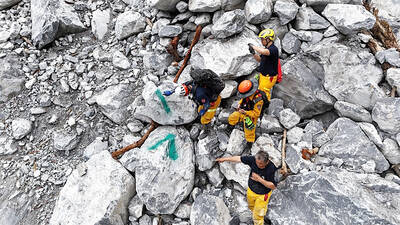
The bodies of two individuals were recovered and three additional bodies were discovered on the Shakadang Trail (砂卡礑) in Taroko National Park, eight days after the devastating earthquake in Hualien County, search-and-rescue personnel said. The rescuers reported that they retrieved the bodies of a man and a girl, suspected to be the father and daughter from the Yu (游) family, 500m from the entrance of the trail on Wednesday. The rescue team added that despite the discovery of the two bodies on Friday last week, they had been unable to retrieve them until Wednesday due to the heavy equipment needed to lift


 RSS
RSS