


A coalition of non-governmental organizations said yesterday that its members will be sitting in on select legislative meetings to keep an eye on the nation's shoe-throwing, committee-skipping legislators in the new legislative session.
A South Korean program with similar aims has been watching the National Assembly in Seoul for the past eight years.
"Once legislators are elected, they are accountable to nobody. We want this to change," said Ho Tsung-hsun (何宗勳), deputy executor of the new Citizen Watch Alliance, which has the support of more than 30 non-governmental organizations, including the Taiwan Environmental Protection Union and the National Union of Taiwanese Women Association.
Ho cited showboating politicians, the stalled budget and neglected committee meetings as some of the reason why oversight was needed for the Legislative Yuan.
"Unlike the media cameras that only capture sensational moments, we will be watching whether legislators actually turn up to committee meetings and whether they are well-prepared," said Ho, who said that it was all too easy for legislators to sign in at a meeting before absconding soon after.
Lee Kyong-yul, chairman of South Korea's Environment Action Association and the founder of a similar citizen's watch scheme, was in Taipei yesterday to share his experience with legislator-watching.
For 20 days a year, his group submits legislative sessions to intense scrutiny, logging legislators' actions at half-hour intervals so that none could even take an extended "toilet break" without their absence being noted.
"The first time we tried to gain access [to the National Assembly], we were thrown out by staffers and security. We tried to sneak back in, but they threw us out again," he said.
Undeterred, Lee and his monitors started protesting outside the National Assembly.
Eventually, they were accepted and even granted their own seats so that they could better observe the proceedings.
Now that they have become established, Lee said, the tables have been turned, with legislators who formerly wanted to throw the monitors out now eager to court their approval.
"Now the legislators always make a point of greeting the monitors politely," Lee said. "They even make sure we're informed if they have a legitimate reason to be away from the meeting."
Response from legislators in Taiwan has been very positive so far, Ho said.
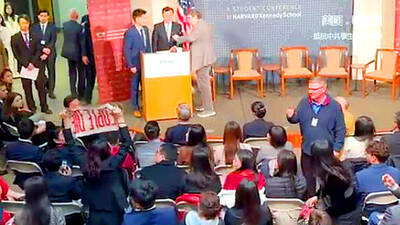
A group of Taiwanese-American and Tibetan-American students at Harvard University on Saturday disrupted Chinese Ambassador to the US Xie Feng’s (謝鋒) speech at the school, accusing him of being responsible for numerous human rights violations. Four students — two Taiwanese Americans and two from Tibet — held up banners inside a conference hall where Xie was delivering a speech at the opening ceremony of the Harvard Kennedy School China Conference 2024. In a video clip provided by the Coalition of Students Resisting the CCP (Chinese Communist Party), Taiwanese-American Cosette Wu (吳亭樺) and Tibetan-American Tsering Yangchen are seen holding banners that together read:

UNAWARE: Many people sit for long hours every day and eat unhealthy foods, putting them at greater risk of developing one of the ‘three highs,’ an expert said More than 30 percent of adults aged 40 or older who underwent a government-funded health exam were unaware they had at least one of the “three highs” — high blood pressure, high blood lipids or high blood sugar, the Health Promotion Administration (HPA) said yesterday. Among adults aged 40 or older who said they did not have any of the “three highs” before taking the health exam, more than 30 percent were found to have at least one of them, Adult Preventive Health Examination Service data from 2022 showed. People with long-term medical conditions such as hypertension or diabetes usually do not
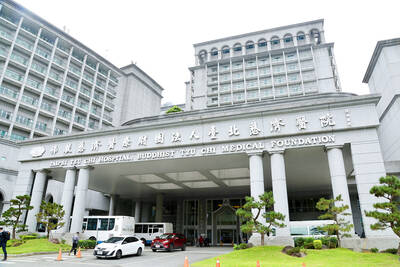
POLICE INVESTIGATING: A man said he quit his job as a nurse at Taipei Tzu Chi Hospital as he had been ‘disgusted’ by the behavior of his colleagues A man yesterday morning wrote online that he had witnessed nurses taking photographs and touching anesthetized patients inappropriately in Taipei Tzu Chi Hospital’s operating theaters. The man surnamed Huang (黃) wrote on the Professional Technology Temple bulletin board that during his six-month stint as a nurse at the hospital, he had seen nurses taking pictures of patients, including of their private parts, after they were anesthetized. Some nurses had also touched patients inappropriately and children were among those photographed, he said. Huang said this “disgusted” him “so much” that “he felt the need to reveal these unethical acts in the operating theater
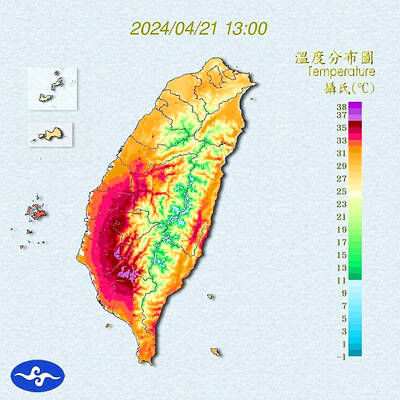
Heat advisories were in effect for nine administrative regions yesterday afternoon as warm southwesterly winds pushed temperatures above 38°C in parts of southern Taiwan, the Central Weather Administration (CWA) said. As of 3:30pm yesterday, Tainan’s Yujing District (玉井) had recorded the day’s highest temperature of 39.7°C, though the measurement will not be included in Taiwan’s official heat records since Yujing is an automatic rather than manually operated weather station, the CWA said. Highs recorded in other areas were 38.7°C in Kaohsiung’s Neimen District (內門), 38.2°C in Chiayi City and 38.1°C in Pingtung’s Sandimen Township (三地門), CWA data showed. The spell of scorching


 RSS
RSS