


It is the height of firefly season, said Chen Tsan-jong (陳燦榮), a firefly chaser for more than fifteen years, describing this time of year as "explosive" in terms of the number of fireflies.
According to Chen's observations, there are double or triple the number of fireflies nationwide compared with previous seasons, with even greater growth in some areas.
He has written three books on the subject of fireflies and regularly makes records of their activity in Yilan, Hualien, Tainan, Hsinchu and Taipei among other places.
This year, he said, he found hundreds of fireflies in locales where he had only recorded ten or twenty in his records from previous years.
Ho Chien-jong (何健鎔), the secretary of the Firefly Preservation Society also reported a rise in numbers this year, despite the difficulties of ascertaining accurate numbers.
The warm winter followed by plentiful spring showers might have caused the firefly population explosion, Chen said.
Mild, moist conditions cause a higher number of snails because of the increased amount of rotting vegetation for them to feed on. Fireflies in turn feed on snails.
However, Wu Chia-hsiung (吳加雄), a graduate student at National Taiwan University's Institute of Entomology, explained that all insects are affected by temperature and develop fastest when it is between 20oC and 30oC. Growth decelerates if the temperature either goes above or below that range. Whether this year's bountiful firefly season is connected to a warm winter requires further verification, Wu said.
What does seem clear, Wu said, is that the warm winter has brought an early firefly season. Black-winged fireflies ordinarily appear at the end of March, but this year they were spotted in Chiayi in the middle of February.
There are more than 50 varieties of fireflies in Taiwan, meaning that even though April and May are the best months for spotting fireflies, they are visible in some localities as late as August and September, and even in the depth of winter.
Older Taiwanese hold fond memories of the "golden-fire ladies," Chen said, but with the overdevelopment of their environment and the ubiquity of modern lighting, firefly spotting has become much harder.
To encourage a firefly revival, schools, communities and farms have worked to reduce pesticide usage and light pollution.
Firefly spotting has also become big business, as a type of ecological tourism.
Chen said that the earliest destination to offer firefly spotting was Tungshih Forest Park back in 1990.
In recent years, other locations have also offered "firefly seasons," attracting up to ten thousand visitors in some popular spots in a single night. However, he added, it is not necessary to spend a lot of money to see fireflies -- even residents of Taipei can find fireflies in secluded areas near the capital city.
Yeh Ruoh-lan (葉若蘭) is the proprieter of Ruoh-lan Villa in Chiayi where tens of thousands of fireflies can be seen on April evenings. The villa was fully booked for this month by January this year. Some visitors come every year to see the fireflies, she said, others are moved to tears by the sight.
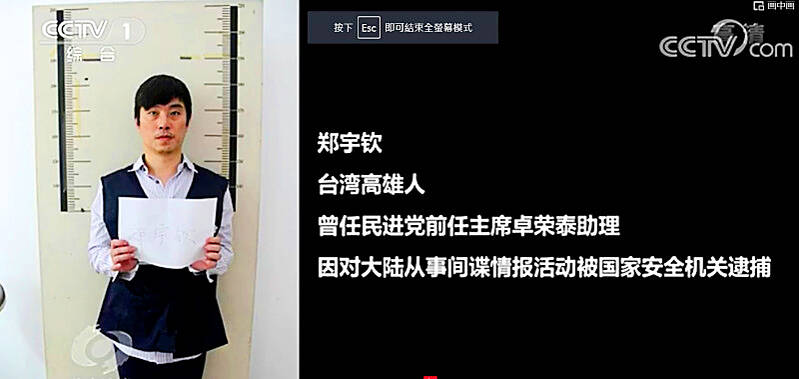
Former Czech Republic-based Taiwanese researcher Cheng Yu-chin (鄭宇欽) has been sentenced to seven years in prison on espionage-related charges, China’s Ministry of State Security announced yesterday. China said Cheng was a spy for Taiwan who “masqueraded as a professor” and that he was previously an assistant to former Cabinet secretary-general Cho Jung-tai (卓榮泰). President-elect William Lai (賴清德) on Wednesday last week announced Cho would be his premier when Lai is inaugurated next month. Today is China’s “National Security Education Day.” The Chinese ministry yesterday released a video online showing arrests over the past 10 years of people alleged to be

THE HAWAII FACTOR: While a 1965 opinion said an attack on Hawaii would not trigger Article 5, the text of the treaty suggests the state is covered, the report says NATO could be drawn into a conflict in the Taiwan Strait if Chinese forces attacked the US mainland or Hawaii, a NATO Defense College report published on Monday says. The report, written by James Lee, an assistant research fellow at Academia Sinica’s Institute of European and American Studies, states that under certain conditions a Taiwan contingency could trigger Article 5 of NATO, under which an attack against any member of the alliance is considered an attack against all members, necessitating a response. Article 6 of the North Atlantic Treaty specifies that an armed attack in the territory of any member in Europe,

LIKE FAMILY: People now treat dogs and cats as family members. They receive the same medical treatments and tests as humans do, a veterinary association official said The number of pet dogs and cats in Taiwan has officially outnumbered the number of human newborns last year, data from the Ministry of Agriculture’s pet registration information system showed. As of last year, Taiwan had 94,544 registered pet dogs and 137,652 pet cats, the data showed. By contrast, 135,571 babies were born last year. Demand for medical care for pet animals has also risen. As of Feb. 29, there were 5,773 veterinarians in Taiwan, 3,993 of whom were for pet animals, statistics from the Animal and Plant Health Inspection Agency showed. In 2022, the nation had 3,077 pediatricians. As of last

XINJIANG: Officials are conducting a report into amending an existing law or to enact a special law to prohibit goods using forced labor Taiwan is mulling an amendment prohibiting the importation of goods using forced labor, similar to the Uyghur Forced Labor Prevention Act (UFLPA) passed by the US Congress in 2021 that imposed limits on goods produced using forced labor in China’s Xinjiang region. A government official who wished to remain anonymous said yesterday that as the US customs law explicitly prohibits the importation of goods made using forced labor, in 2021 it passed the specialized UFLPA to limit the importation of cotton and other goods from China’s Xinjiang Uyghur region. Taiwan does not have the legal basis to prohibit the importation of goods


 RSS
RSS