


Strawberries from Dahu (
The Council of Agriculture (COA) is fighting back against the practice by contesting the trademarks with Chinese authorities. However, so far their efforts have only resulted in two trademarks being revoked, that of Alishan teas and Sun Moon Lake teas.
The council said that, the problem of produce piracy first came to light three years ago when Taiwanese tea merchants found that the location names of their teas had been appropriated by Chinese firms.
This not only harmed their sales in China, but has the potential to impact the home market as well if the cheap "counterfeit" teas end up flooding the Taiwanese market.
The names of eight famous Taiwanese tea-producing areas fell prey to a rush-registration by Chinese firms. The Taiwan Tea Merchants Association appealed to the Chinese Copyright Evaluation Committee on behalf of the COA and other Taiwanese governmental departments last June to get the copycat trademarks revoked.
They were successful in the case of Alishan and Sun Moon Lake teas, but the evaluation committee turned down its request to revoke the trademark Meishan on the grounds that an area called Meishan also exists in China.
An attempt to revoke the trademark Hsitou (溪頭) was also turned down by the committee, saying that the name could literally mean "the source of a creek" and therefore does not necessarily refer to the Taiwanese area name.
Apart from tea production names, the council is targeting five major local specialties whose names have been appropriated by Chinese firms -- Coffee from Gukeng (古坑), rice noodles from Hsinchu, soy sauce from Hsilo(西螺), rice from Chishang (池上) and guava from Yenchao (燕巢).
When and if those exclusive trademarks have been revoked, these names will then become common trademarks, a COA official said.
Chinese firms would still be able to sell their own produce under those names, but the authentic article could also be sold using those names without infringing on Chinese trademark law.
COA officials said that the best solution to the problem would be to register the names of Taiwanese specialties ahead of Chinese companies with the Chinese authorities. As soon as this was done, products that were not produced in that location could not be sold using that name.
However, for many well-loved Taiwanese agricultural and food specialties, it is already too late.
A search conducted at the request of Taiwan's Intellectual Property Office (IPO), under the Ministry of Economic Affairs, has found that 51 Taiwanese specialties had been registered as trademarks by Chinese firms ahead of any legitimate claims. Even local snacks such as cow tongue cookies from Ilan had not been spared.
IPO officials said that under Taiwanese laws, a particular area cannot be registered as a trademark -- but produce must refer to its actual production location. The Chinese government, however, accepts areas as trademarks as long as they are below the state level.
Trademark claims in Taiwan are always scrutinized for legitimacy, said IPO officials, so that those who seek to register place names or existing brands as their own are always turned down.
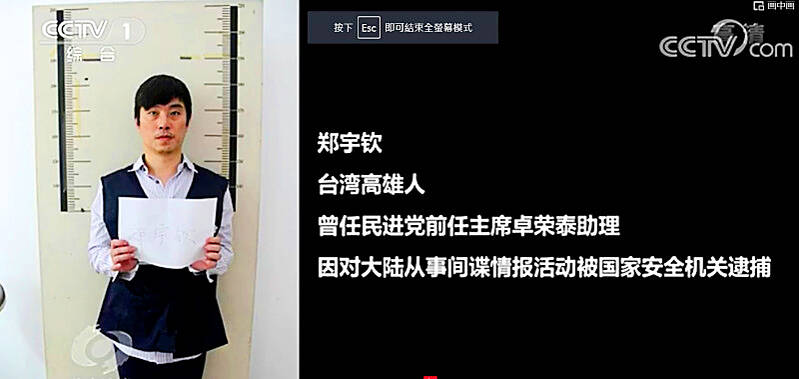
Former Czech Republic-based Taiwanese researcher Cheng Yu-chin (鄭宇欽) has been sentenced to seven years in prison on espionage-related charges, China’s Ministry of State Security announced yesterday. China said Cheng was a spy for Taiwan who “masqueraded as a professor” and that he was previously an assistant to former Cabinet secretary-general Cho Jung-tai (卓榮泰). President-elect William Lai (賴清德) on Wednesday last week announced Cho would be his premier when Lai is inaugurated next month. Today is China’s “National Security Education Day.” The Chinese ministry yesterday released a video online showing arrests over the past 10 years of people alleged to be

THE HAWAII FACTOR: While a 1965 opinion said an attack on Hawaii would not trigger Article 5, the text of the treaty suggests the state is covered, the report says NATO could be drawn into a conflict in the Taiwan Strait if Chinese forces attacked the US mainland or Hawaii, a NATO Defense College report published on Monday says. The report, written by James Lee, an assistant research fellow at Academia Sinica’s Institute of European and American Studies, states that under certain conditions a Taiwan contingency could trigger Article 5 of NATO, under which an attack against any member of the alliance is considered an attack against all members, necessitating a response. Article 6 of the North Atlantic Treaty specifies that an armed attack in the territory of any member in Europe,

LIKE FAMILY: People now treat dogs and cats as family members. They receive the same medical treatments and tests as humans do, a veterinary association official said The number of pet dogs and cats in Taiwan has officially outnumbered the number of human newborns last year, data from the Ministry of Agriculture’s pet registration information system showed. As of last year, Taiwan had 94,544 registered pet dogs and 137,652 pet cats, the data showed. By contrast, 135,571 babies were born last year. Demand for medical care for pet animals has also risen. As of Feb. 29, there were 5,773 veterinarians in Taiwan, 3,993 of whom were for pet animals, statistics from the Animal and Plant Health Inspection Agency showed. In 2022, the nation had 3,077 pediatricians. As of last

XINJIANG: Officials are conducting a report into amending an existing law or to enact a special law to prohibit goods using forced labor Taiwan is mulling an amendment prohibiting the importation of goods using forced labor, similar to the Uyghur Forced Labor Prevention Act (UFLPA) passed by the US Congress in 2021 that imposed limits on goods produced using forced labor in China’s Xinjiang region. A government official who wished to remain anonymous said yesterday that as the US customs law explicitly prohibits the importation of goods made using forced labor, in 2021 it passed the specialized UFLPA to limit the importation of cotton and other goods from China’s Xinjiang Uyghur region. Taiwan does not have the legal basis to prohibit the importation of goods


 RSS
RSS