


The Ministry of Justice (MOJ) last November implemented regulations requiring sexual assault parolees to wear radio frequency identification devices (RFID), which will help police track the offenders' movements.
The regulation has been the focus of criticism recently as several assault parolees not wearing such devices are suspected of having raped women or girls shortly after leaving prison.
A Kaohsiung man, Wang Hui-ming (
Wang had only been released 12 hours earlier from Kaohsiung Prison on parole.
Late last month Chiang Ke-hui (
Chiang was released in January by the Banciao District Court pending a case on charges of sexually assaulting three girls from elementary schools in Jhonghe (
In another case, a Hualien man named Wei Yung-ching (魏永慶) is suspected of raping a six-year-old girl on Jan. 9 -- only a few days after being released on parole.
The regulation has been criticized as the three men were not required to wear RFID tags when they left the prison.
Director of the Department of Corrections at the Ministry of Justice Chang Ching-yun (張清雲) told a press conference last week that although 633 sexual offenders were currently on parole nationwide, authorities only considered 227 of them as threats to the community.
Only 21 parolees were required to wear RFID tags between Nov. 22 and March 20 and only 9 are currently wearing RFID tags, he said.
The RFID regulation is flawed and the ministry is seeking to review it, Chang said.
The regulation stipulates that the ministry, as well as the city or county government where a sexual offender lives must observe that person's behavior for three months before jointly deciding whether the parolee needs to wear an RFID tag, Chang said.
Chang said the ministry was proposing to shorten the three month period to two weeks, which would better prevent sexual offenders from repeating offences shortly after leaving prison.
The ministry has procured a total of 150 RFIDs, which are expensive, and the budget for further purchases is limited, Chang said.
He said the ministry also lacked the human resources necessary to monitor more sexual offenders.
Wang Lih-rong (王麗容), a professor of social work at National Taiwan University, criticized the ministry's measures as "lackluster."
She said while the ministry agreed to free serial sexual offenders, it was unable to monitor their behavior.
Women are not safe living in the neighborhoods of sexual offenders, she said.
Law professor Jeng Shann-yinn (鄭善印) of Kainan University said the ministry's measure would be more effective if the ministry cooperated with private security firms.
The ministry has said that individuals wearing the RFID tags are required to remain in their homes from 8pm to 7am.
If they leave their homes during those hours, a computer located in the ministry receives a signal and the ministry immediately informs the police and officers at local governments' Sexual Assault Prevention Centers to locate them.
Individuals are not required to wear the device for longer than six months.
In case of parole violations, the ministry said serious transgressions could result in a prolongation of the parole period or its cancelation.
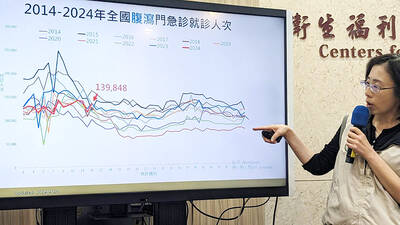
FLU SEASON: Twenty-six severe cases were reported from Tuesday last week to Monday, including a seven-year-old girl diagnosed with influenza-associated encephalopathy Nearly 140,000 people sought medical assistance for diarrhea last week, the Centers for Disease Control (CDC) said on Tuesday. From April 7 to Saturday last week, 139,848 people sought medical help for diarrhea-related illness, a 15.7 percent increase from last week’s 120,868 reports, CDC Epidemic Intelligence Center Deputy Director Lee Chia-lin (李佳琳) said. The number of people who reported diarrhea-related illness last week was the fourth highest in the same time period over the past decade, Lee said. Over the past four weeks, 203 mass illness cases had been reported, nearly four times higher than the 54 cases documented in the same period

A group of Taiwanese-American and Tibetan-American students at Harvard University on Saturday disrupted Chinese Ambassador to the US Xie Feng’s (謝鋒) speech at the school, accusing him of being responsible for numerous human rights violations. Four students — two Taiwanese Americans and two from Tibet — held up banners inside a conference hall where Xie was delivering a speech at the opening ceremony of the Harvard Kennedy School China Conference 2024. In a video clip provided by the Coalition of Students Resisting the CCP (Chinese Communist Party), Taiwanese-American Cosette Wu (吳亭樺) and Tibetan-American Tsering Yangchen are seen holding banners that together read:

UNAWARE: Many people sit for long hours every day and eat unhealthy foods, putting them at greater risk of developing one of the ‘three highs,’ an expert said More than 30 percent of adults aged 40 or older who underwent a government-funded health exam were unaware they had at least one of the “three highs” — high blood pressure, high blood lipids or high blood sugar, the Health Promotion Administration (HPA) said yesterday. Among adults aged 40 or older who said they did not have any of the “three highs” before taking the health exam, more than 30 percent were found to have at least one of them, Adult Preventive Health Examination Service data from 2022 showed. People with long-term medical conditions such as hypertension or diabetes usually do not
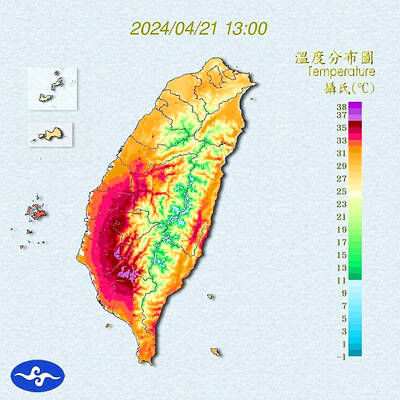
Heat advisories were in effect for nine administrative regions yesterday afternoon as warm southwesterly winds pushed temperatures above 38°C in parts of southern Taiwan, the Central Weather Administration (CWA) said. As of 3:30pm yesterday, Tainan’s Yujing District (玉井) had recorded the day’s highest temperature of 39.7°C, though the measurement will not be included in Taiwan’s official heat records since Yujing is an automatic rather than manually operated weather station, the CWA said. Highs recorded in other areas were 38.7°C in Kaohsiung’s Neimen District (內門), 38.2°C in Chiayi City and 38.1°C in Pingtung’s Sandimen Township (三地門), CWA data showed. The spell of scorching


 RSS
RSS