


If anything positive has come out of Jaw Shaw-kong's (
On the day before the Lunar New Year holidays, the commission ruled that the nation's largest radio station must fulfill several requirements before its application for a change in ownership could be approved.
The ruling dictated that the company must first return the frequencies that were previously used to broadcast political propaganda to China to the government.
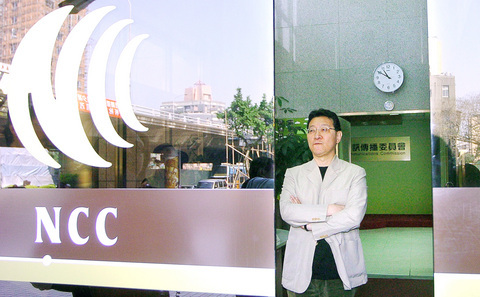
PHOTO: LIU HSIN-DE, TAIPEI TIMES
BCC must also strive to raise the percentage of self-produced programs. And to prevent a potential monopoly in the media market, the commission asked Liang Lei (
Also, BCC and UFO must operate as two separate organizations.
The results were surprising to many, since the commission found no serious breaches of the regulations when Jaw was interviewed by the commission in January.
But the controversies surrounding the BCC case went beyond the unexpected verdict. Because it involved the purchase of an asset previously owned by the Chinese Nationalist Party (KMT), the case had the potential to generate more shouting matches between the Government Information Office (GIO) and NCC than any other case the latter has handled, with the GIO demanding that BCC return the previously mentioned radio frequencies immediately.
Meanwhile, the four companies that possess the majority of BCC's shares are said to be affiliated with Jaw, and have been alleged to be fake operations established to enable him to buy BCC without violating regulations in the Broadcasting and Television Law (
To media observers, the BCC case exposed the commission's passivity when it handled such a controversial case.
"Jaw was no fool when he purchased BCC, knowing that he couldn't be touched as long as he fulfilled the minimum requirements of the [Broadcasting and Television] law," said Wei Ti (
"The commission should have proactively investigated this dubious transaction in the first place. Unfortunately, it only began to question Jaw after the commission had been criticized by the public for doing almost nothing," he said.
Wei pointed to a bigger issue that lies at the center of all broadcasting disputes.
"We have not seen any fundamental changes in communications policies, particularly with regard to the reappropriation and readjustment of the nation's television broadcasters, and telecommunications resources," he added.
workload
The size of the commission's workload and the time a review process consumes perhaps explain the lack of a proactive stance in the BCC case.
Since last year, the commission has had its hands full reviewing cases previously handled by the GIO and the Directorate-General of Telecommunications.
The nine commission members have discussed the application for a Multimedia-On-Demand (MOD) service from Chunghwa Telecom; ETTV-S and Long Shong Movie Station's applications to renew their broadcasting licenses; applications to launch TV stations for mobile phones; reshuffles of channels on the cable television service; and constructing a new formula to determine the base charge for local telephone calls. In every single one of the cases -- whether large or small -- the commission is required to deliver a ruling resulting from a consensus among its members.
In the case of the MOD service, it took the commission nine months to reach a settlement. The case revolved around whether an online television service run by a government-affiliated company would violate the regulation forbidding the government, political parties and the military operating media organizations.
While the NCC's operational model guarantees a thorough consideration of each case, it compromises the efficiency required to mediate over disputes in the rapidly-changing media and telecommunications markets. The urgency and time spent on these cases left hardly any time for the commission to consider overhauling outdated policies and regulations.
NCC chairman Su Yeong-ching (蘇永欽) said in an press conference before the Lunar New Year that the commission's main task this year was to amend three important communications laws -- the Satellite and Broadcasting Law (衛星廣播電視法), Cable Radio and Television Law (有線廣播電視法) and Broadcasting and Television Law (廣播電視法).
The task, he said, "would take a lot of their time."
Wei, however, said that the commission's capacity to handle such a big project was questionable.
"I am not too optimistic about it [the amendments], given that the Grand Council of Justices ruled that the NCC's formation was unconstitutional and its members have expressed their wish to resign by January next year," Wei said. "It seems unlikely that they would begin any long-term policy reviews. They would probably just keep their fingers crossed that they won't make any mistakes or cause any trouble."
muscle
Criticism notwithstanding, many have noted that the commission has begun to flex its under-utilized administrative muscle during some of the recent issues. When the Executive Yuan accused the NCC of making an out-of-court settlement with BCC regarding the unreturned frequencies and threatened to annul its ruling, the NCC fought back with legal documents and said bluntly that the Executive Yuan had no right to interfere in the ruling.
Another incident was the MBK Partners' purchase of China Network Systems (CNS), the nation's second largest cable TV operator.
NCC spokesperson Howard Shyr (石世豪) said in an interview with the Chinese-language Economic Daily News that MBK had to clearly state the source of its funding and demonstrate to the commission plans to create a digital TV system in the next few years, or the commission would rule "that it [the deal] was not in CNS' interests."
Despite the more hardline attitude, the specter of an unregulated media market when the commission members resign in January next year has left the Executive Yuan with a problem.
In a statement last month Su urged the Executive Yuan to quickly start amending the organic law of the National Communications Commission (國家通訊傳播委員會組織法).
Chen Yaw-shyang (陳耀祥), assistant professor of the public administration and policy department at the National Taipei University, said the amendment must allow the Premier to nominate candidates for the commission.
Chen said the NCC, even as an independent organization, must still be under the supervision of the Executive Yuan.
"The `independence' here simply means it functions independently, but it is still considered as an entity within the group of government administrative organizations," Media Watch president Kuan Chung-hsiang (
Kuan added that since it has proven politically unviable to choose commission members based on the representation of political parties in the legislature, the Executive Yuan should consider the model used by the Public Television Service Foundation, where directors are first nominated by the Executive Yuan and then reviewed by a special panel authorized by the Legislative Yuan.
He also stressed the importance of including a "revolving-door" article in the amendment, which would prevent former commission members from accepting key positions in the private sector immediately after their resignation.
Kuan suggested that in addition to legal experts and media academics, the commission should include ordinary citizens in the decision-making process.
The amendment should also cut the number of members who serve on the commission and delegate some of the less important tasks to second-tier officials.
"Having nine is way too many. The Federal Communications Commission in the US only has five," he said. "They [commission members] all seem to be busy, but when you look closely at some of the cases, a lot of them are minute."
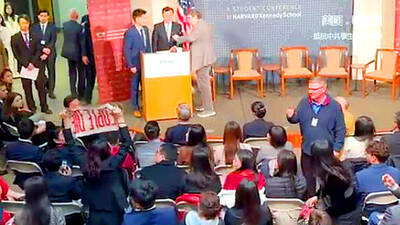
A group of Taiwanese-American and Tibetan-American students at Harvard University on Saturday disrupted Chinese Ambassador to the US Xie Feng’s (謝鋒) speech at the school, accusing him of being responsible for numerous human rights violations. Four students — two Taiwanese Americans and two from Tibet — held up banners inside a conference hall where Xie was delivering a speech at the opening ceremony of the Harvard Kennedy School China Conference 2024. In a video clip provided by the Coalition of Students Resisting the CCP (Chinese Communist Party), Taiwanese-American Cosette Wu (吳亭樺) and Tibetan-American Tsering Yangchen are seen holding banners that together read:

UNAWARE: Many people sit for long hours every day and eat unhealthy foods, putting them at greater risk of developing one of the ‘three highs,’ an expert said More than 30 percent of adults aged 40 or older who underwent a government-funded health exam were unaware they had at least one of the “three highs” — high blood pressure, high blood lipids or high blood sugar, the Health Promotion Administration (HPA) said yesterday. Among adults aged 40 or older who said they did not have any of the “three highs” before taking the health exam, more than 30 percent were found to have at least one of them, Adult Preventive Health Examination Service data from 2022 showed. People with long-term medical conditions such as hypertension or diabetes usually do not

Heat advisories were in effect for nine administrative regions yesterday afternoon as warm southwesterly winds pushed temperatures above 38°C in parts of southern Taiwan, the Central Weather Administration (CWA) said. As of 3:30pm yesterday, Tainan’s Yujing District (玉井) had recorded the day’s highest temperature of 39.7°C, though the measurement will not be included in Taiwan’s official heat records since Yujing is an automatic rather than manually operated weather station, the CWA said. Highs recorded in other areas were 38.7°C in Kaohsiung’s Neimen District (內門), 38.2°C in Chiayi City and 38.1°C in Pingtung’s Sandimen Township (三地門), CWA data showed. The spell of scorching
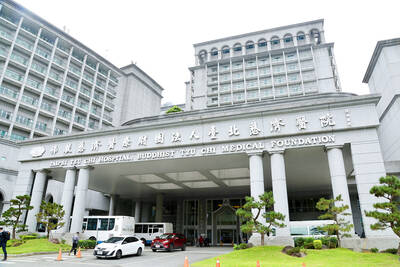
POLICE INVESTIGATING: A man said he quit his job as a nurse at Taipei Tzu Chi Hospital as he had been ‘disgusted’ by the behavior of his colleagues A man yesterday morning wrote online that he had witnessed nurses taking photographs and touching anesthetized patients inappropriately in Taipei Tzu Chi Hospital’s operating theaters. The man surnamed Huang (黃) wrote on the Professional Technology Temple bulletin board that during his six-month stint as a nurse at the hospital, he had seen nurses taking pictures of patients, including of their private parts, after they were anesthetized. Some nurses had also touched patients inappropriately and children were among those photographed, he said. Huang said this “disgusted” him “so much” that “he felt the need to reveal these unethical acts in the operating theater


 RSS
RSS