


The government said yesterday that it will not deport a foreign correspondent that the ruling party wants expelled for quoting Beijing's criticism of Vice President Annette Lu (
Cabinet Spokesman Cheng Wen-tsang (
The Government Information Office (GIO) said foreign reporters who -- like Lee -- are on temporary assignments in Taiwan do not need a specific type of visa for a short stay. However, foreign reporters stationed in Taiwan for an extended period of time need to report to the GIO to have their credentials validated.
"Lee was sent to Taipei on [temporary] assignment, so he does not require any credentials from the GIO. As such, there is no question of whether we should suspend his credentials," Cheng said during yesterday morning's legislative meeting.
"In addition, President Chen Shui-bian (
People First Party Legislator Lee Hun-chun (
Cheng told Lee Hung-chun that bottomline, the government is working to end the issue without harming any party.
Now that AP has promised to run an interview with the vice president to balance out its report, the government would naturally respect AP's decision, Cheng said.
"It seems to me that it is the best way to end the issue," Cheng said. "The government still welcomes AP reporters to be stationed and to work in Taiwan."
Meanwhile, two Democratic Progressive Party (DPP) legislators yesterday continued to insist that the government should deport Lee within 24 hours.
DPP legislators Tsai Chi-fang (
The AP story described Lu as an "outspoken" vice president who China had called "insane" and "the scum of the nation." CNN posted the AP article on its Web site under the headline: "Taiwan's `scum of the nation' runs for president."
The article aroused a furious reaction not only from Lu but also from the DPP caucus. Caucus whip Wang Sing-nan (
Meanwhile, the office of the vice president said late yesterday that the AP and CNN had replied to Lu's letter of protest and top executives from both media organizations said they were willing to cautiously look into the incident.
Thomas Curley, president and chief executive officer of AP and Christopher Cramer, executive vice president and managing director of CNN International, responded to Lu by personally signed letters, the vice president's office said.
Curley said that the AP did not agree with the attacks on Lu and respected the Taiwanese government and its people, adding that covering Taiwan's next presidential election would be a major task for AP, the vice president's office said

Former president Ma Ying-jeou’s (馬英九) mention of Taiwan’s official name during a meeting with Chinese President Xi Jinping (習近平) on Wednesday was likely a deliberate political play, academics said. “As I see it, it was intentional,” National Chengchi University Graduate Institute of East Asian Studies professor Wang Hsin-hsien (王信賢) said of Ma’s initial use of the “Republic of China” (ROC) to refer to the wider concept of “the Chinese nation.” Ma quickly corrected himself, and his office later described his use of the two similar-sounding yet politically distinct terms as “purely a gaffe.” Given Ma was reading from a script, the supposed slipup
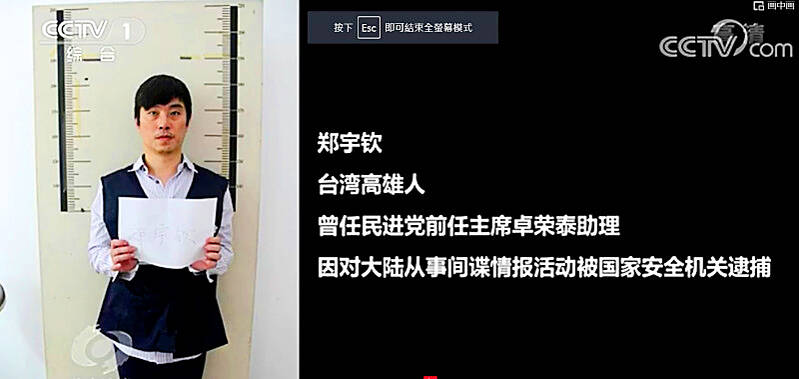
Former Czech Republic-based Taiwanese researcher Cheng Yu-chin (鄭宇欽) has been sentenced to seven years in prison on espionage-related charges, China’s Ministry of State Security announced yesterday. China said Cheng was a spy for Taiwan who “masqueraded as a professor” and that he was previously an assistant to former Cabinet secretary-general Cho Jung-tai (卓榮泰). President-elect William Lai (賴清德) on Wednesday last week announced Cho would be his premier when Lai is inaugurated next month. Today is China’s “National Security Education Day.” The Chinese ministry yesterday released a video online showing arrests over the past 10 years of people alleged to be
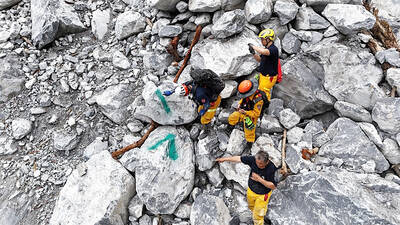
The bodies of two individuals were recovered and three additional bodies were discovered on the Shakadang Trail (砂卡礑) in Taroko National Park, eight days after the devastating earthquake in Hualien County, search-and-rescue personnel said. The rescuers reported that they retrieved the bodies of a man and a girl, suspected to be the father and daughter from the Yu (游) family, 500m from the entrance of the trail on Wednesday. The rescue team added that despite the discovery of the two bodies on Friday last week, they had been unable to retrieve them until Wednesday due to the heavy equipment needed to lift

THE HAWAII FACTOR: While a 1965 opinion said an attack on Hawaii would not trigger Article 5, the text of the treaty suggests the state is covered, the report says NATO could be drawn into a conflict in the Taiwan Strait if Chinese forces attacked the US mainland or Hawaii, a NATO Defense College report published on Monday says. The report, written by James Lee, an assistant research fellow at Academia Sinica’s Institute of European and American Studies, states that under certain conditions a Taiwan contingency could trigger Article 5 of NATO, under which an attack against any member of the alliance is considered an attack against all members, necessitating a response. Article 6 of the North Atlantic Treaty specifies that an armed attack in the territory of any member in Europe,


 RSS
RSS