


It's easy to mistake Harold "Hal" Raveche as just the charismatic president of an innovative science and technology school.
In the time it takes to guzzle two cappuccinos, however, the maverick visionary in Raveche emerges, as do his plans to change the world -- one university at a time.
His business card reads "Stevens Institute of Technology" -- the top-ranked tech school in New Jersey -- but Raveche, 65, is everywhere: He serves on the boards of universities from Singapore to Saudi Arabia ("Saudi Arabia is a powder keg," he says), and advises the Dominican Republic on science-related issues.
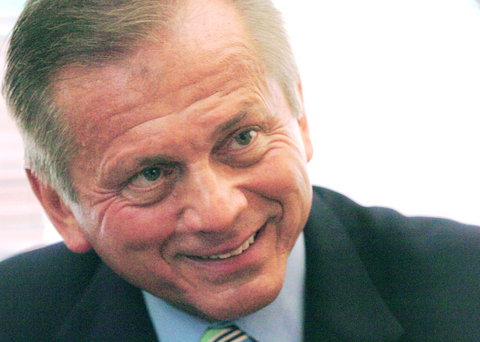
PHOTO: CHANG CHIA-MING, TAIPEI TIMES
"See this?" Raveche says, digging out a laminated ID from his bag. "This pass gives me unlimited access to the [Dominican Republic's] presidential palace."
Secret agents stalk him in Turkey; Saudi Customs think he's CIA.
Raveche once advised a Kuwaiti finance minister before Muslim Brotherhood-backed members of parliament sacked the official "for being too Western."
"One-third of Kuwaiti parliamentarians are Muslim Brothers -- not many people know that. Those guys are bad news," Raveche says, referring to the radical Sunni Islamic group.
He knows when his ideas on changing society by revolutionizing higher education have hit a brick wall -- like they did at Alfaisal University in Saudi Arabia.
Bankrolled by Boeing and the Bin Laden Saudi Group -- among other strange bedfellows -- Saudi Arabia's first private university is already mired in bureaucracy before its opening in September, Raveche says, sighing.
Though he's on Alfaisal's board, he hardly visits Saudi Arabia anymore.
These days, Raveche prefers to set his sights on places like Taiwan -- bastions of democracy and hope in a world beset by tyranny, he says.
With three sister schools in Taipei, the Stevens Institute sees its jet-set president visit here regularly to chum with political heavyweights with a view to revamping Taiwanese higher education.
"As a US citizen and as a person who feels strongly that the world must democratize, I believe in Taiwan's sovereignty," Raveche says. "I want this nation to succeed."
The key to Taiwan's continued success amid China's rise, he adds, is "creative enterprise," a fancy term meaning innovation. That is, Taiwan must shift its focus from high-tech manufacturing to invention -- beginning on college campuses nationwide -- if it is to avoid becoming eclipsed by the likes of China and India, Raveche says, his voice filled with urgency.
"Taiwan has to say to itself, `We've made great progress, but the next two decades will determine our ultimate standing in the world.' Taiwan can't stay in manufacturing with China and India poised to eat its lunch -- it has to start inventing, and now is the time," he says.
That message is not lost on Chinese Culture University president Lee Tien-Rein (
Calling the Stevens Institute a "mainstay" in marketplace innovation since 1870, Lee welcomed his sister school's chief like a celebrity.
With a slew of inventions oozing out of Stevens yearly -- earning the school top ratings by Princeton Review -- more and more academic and political powerbrokers are listening carefully to what Raveche has to say.
After all, his ideas on revolutionizing education aren't just theories; they're actually working at Stevens, and, Raveche claims, they could work for entire nations.
At the heart of Raveche's higher education model is profit.
A 19-year-old Stevens engineering major, for example, wakes up every morning on the campus in Hoboken, overlooking the Hudson River, and skateboards to class to brainstorm.
Together with his classmates and teachers, the student cooks up a brainchild -- a new product or service -- around which Stevens forms a company to market that product once it's patented.
"Angel investors" then swoop in to finance the endeavor, while outside marketing specialists advise the inventors on business-related aspects.
The project culminates with the invention hitting the market and everybody -- from the faculty, investors, specialists, to the students -- all profiting because of their equity in the new company selling the invention.
"Everybody, especially the students, is allowed to fully participate in the reward system. So, they produce because they're motivated to do so. Where else can an undergraduate -- or even a graduate student -- go to create a product and a company?" Raveche says, adding with a sly smile: "Being a Stevens student can be quite lucrative."
In the traditional model of higher education, he says, students rarely participate in product development with their teachers.
Product patents, meanwhile, are typically licensed to outside companies, earning the university royalties but no equity in homegrown companies like at Stevens.
Raveche's model, on the other hand, not only encourages partnerships at all levels of academia, but also allows students to innovate while capitalizing on their own creations in the marketplace -- skills not easily duplicated by competitors in, say, India or China, he says.
"By developing this model in Taiwanese universities, by providing incentives to companies to invest and work with universities in such a way, and with universities owning equity in new companies that grow from inventions, students and faculty will become highly motivated to make projects work," Raveche says.
"In this way, you bring the knowledge of the global marketplace into Taiwanese universities and then work won't be outsourced to India, China and Korea," he says.
"Taiwan will have something to offer that no other country can," he adds.
"Taiwan would become so vibrant [if it were to follow Stevens' model], it would gain such economic potential that its relationship with China would be determined by that. China would have to respect its innovation -- far more than it would have to respect Taiwan's buying a hundred new missiles," he says. "Much more."
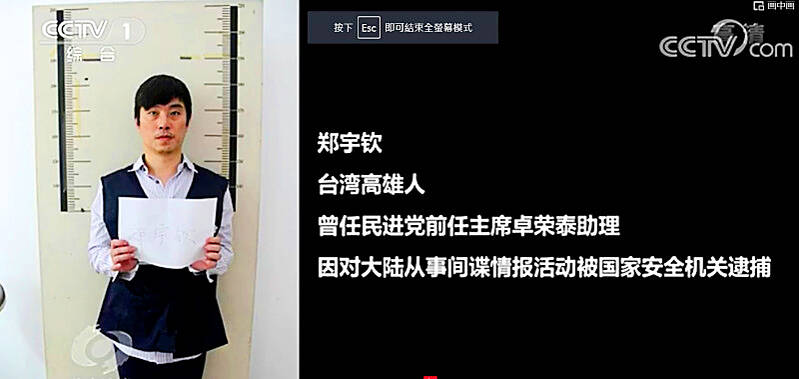
Former Czech Republic-based Taiwanese researcher Cheng Yu-chin (鄭宇欽) has been sentenced to seven years in prison on espionage-related charges, China’s Ministry of State Security announced yesterday. China said Cheng was a spy for Taiwan who “masqueraded as a professor” and that he was previously an assistant to former Cabinet secretary-general Cho Jung-tai (卓榮泰). President-elect William Lai (賴清德) on Wednesday last week announced Cho would be his premier when Lai is inaugurated next month. Today is China’s “National Security Education Day.” The Chinese ministry yesterday released a video online showing arrests over the past 10 years of people alleged to be
THE HAWAII FACTOR: While a 1965 opinion said an attack on Hawaii would not trigger Article 5, the text of the treaty suggests the state is covered, the report says NATO could be drawn into a conflict in the Taiwan Strait if Chinese forces attacked the US mainland or Hawaii, a NATO Defense College report published on Monday says. The report, written by James Lee, an assistant research fellow at Academia Sinica’s Institute of European and American Studies, states that under certain conditions a Taiwan contingency could trigger Article 5 of NATO, under which an attack against any member of the alliance is considered an attack against all members, necessitating a response. Article 6 of the North Atlantic Treaty specifies that an armed attack in the territory of any member in Europe,
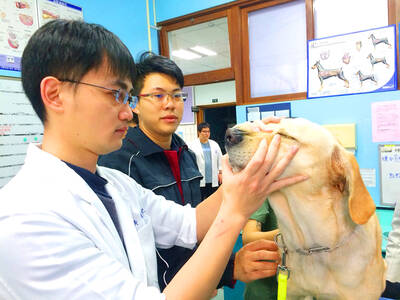
LIKE FAMILY: People now treat dogs and cats as family members. They receive the same medical treatments and tests as humans do, a veterinary association official said The number of pet dogs and cats in Taiwan has officially outnumbered the number of human newborns last year, data from the Ministry of Agriculture’s pet registration information system showed. As of last year, Taiwan had 94,544 registered pet dogs and 137,652 pet cats, the data showed. By contrast, 135,571 babies were born last year. Demand for medical care for pet animals has also risen. As of Feb. 29, there were 5,773 veterinarians in Taiwan, 3,993 of whom were for pet animals, statistics from the Animal and Plant Health Inspection Agency showed. In 2022, the nation had 3,077 pediatricians. As of last
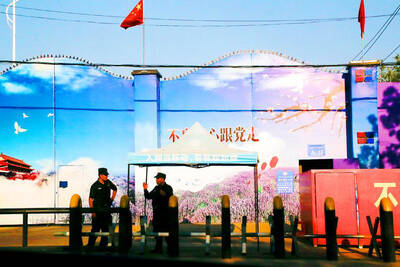
XINJIANG: Officials are conducting a report into amending an existing law or to enact a special law to prohibit goods using forced labor Taiwan is mulling an amendment prohibiting the importation of goods using forced labor, similar to the Uyghur Forced Labor Prevention Act (UFLPA) passed by the US Congress in 2021 that imposed limits on goods produced using forced labor in China’s Xinjiang region. A government official who wished to remain anonymous said yesterday that as the US customs law explicitly prohibits the importation of goods made using forced labor, in 2021 it passed the specialized UFLPA to limit the importation of cotton and other goods from China’s Xinjiang Uyghur region. Taiwan does not have the legal basis to prohibit the importation of goods


 RSS
RSS