


Twenty-four-year-old Vietnamese Ah-ying, identified only by her nickname, looks younger than her years. But behind the pretty face are years of tears and agony in her pursuit of the "Taiwanese dream."
Ah-ying, a third-generation Chinese from Ho Chi Minh City, had hoped that marrying a Taiwanese man would help improve her family's financial condition.
But the dream quickly turned to a nightmare and she now sees herself as a cautionary tale.
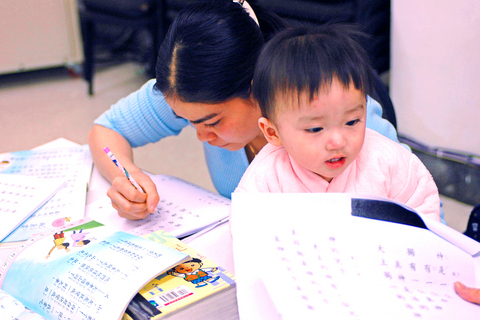
PHOTO: AFP
"I have told my three unmarried sisters not to come to Taiwan. They should stay back home to find their happiness," she said in an interview.
Ah-ying, formerly a worker at an electronics factory, met a Taiwanese man and his son in 2000 through a Vietnamese match-making agency.
Three days after the first meeting, she married the son Ah-teh, then 24, and flew to Taiwan to what she expected would be a better life.
Ah-ying said her husband's family had paid approximately NT$200,000 (US$6,060) to the matchmaker, a small portion of which went to her parents.
It wasn't long after she arrived in Taiwan that her dreams began to sour.
"Perhaps because of language barrier, I did not realize my husband [had] slight mental deficiency problems until we [had] lived together for three months," Ah-ying said, speaking Mandarin Chinese with a strong Cantonese accent.
On some occasions she had difficulty communicating with her husband, who speaks Mandarin and Taiwanese, she said.
Ah-ying said she was shocked by her husband's condition, but probably because she had been taught since childhood not to fight against "destiny" she adapted to and accepted her situation.
"I bowed to fate at that time and started treating him like my son," she said.
Sharing a house in Taipei with her husband, her father-in-law -- who is guardian of his mentally challenged son -- and his second wife, Ah-ying said her husband treated her well.
She did household chores and looked after a shop owned by her father-in-law. Her husband, meanwhile, worked in a factory owned by his aunt.
Life was good enough under the circumstances, she said, until after she gave birth to a healthy baby boy two years into her marriage.
In 2004, her son now two years old, her in-laws threw her out for reasons she still does not understand.
Her husband did not give her any support, although his family did initially allow her to see her son twice a week.
"I suspect her father-in-law used her as a surrogate mother," said Chang Hsin-yi (
Ah-ying said she suspected her husband's family had decided to get rid of her after she asked her father-in-law in 2004 if she could apply for long-term residency, as foreign wives, except Chinese ones, are able to do after three years of living in Taiwan.
"But he said there is no rush to do that since you're already part of this family and have a child," Ah-ying said.
Police records show that some Taiwanese men abuse their foreign wives before the women obtain the ID cards that confer the right to seek protection. Many abusive husbands also try to prevent their spouses from obtaining residency.
Ah-ying then turned to Eden for help and obtained her Taiwanese ID on Feb. 12. She now lives on her own on a monthly salary of NT$20,000 from her job in a Taipei electronics plant.
She is also fighting, with Eden's help, for custody of her son.
"I don't want a divorce, but I want my son back. I miss him so much," said Ah-ying, who is allowed to visit her five-year-old son only twice a month.

A group of Taiwanese-American and Tibetan-American students at Harvard University on Saturday disrupted Chinese Ambassador to the US Xie Feng’s (謝鋒) speech at the school, accusing him of being responsible for numerous human rights violations. Four students — two Taiwanese Americans and two from Tibet — held up banners inside a conference hall where Xie was delivering a speech at the opening ceremony of the Harvard Kennedy School China Conference 2024. In a video clip provided by the Coalition of Students Resisting the CCP (Chinese Communist Party), Taiwanese-American Cosette Wu (吳亭樺) and Tibetan-American Tsering Yangchen are seen holding banners that together read:

UNAWARE: Many people sit for long hours every day and eat unhealthy foods, putting them at greater risk of developing one of the ‘three highs,’ an expert said More than 30 percent of adults aged 40 or older who underwent a government-funded health exam were unaware they had at least one of the “three highs” — high blood pressure, high blood lipids or high blood sugar, the Health Promotion Administration (HPA) said yesterday. Among adults aged 40 or older who said they did not have any of the “three highs” before taking the health exam, more than 30 percent were found to have at least one of them, Adult Preventive Health Examination Service data from 2022 showed. People with long-term medical conditions such as hypertension or diabetes usually do not
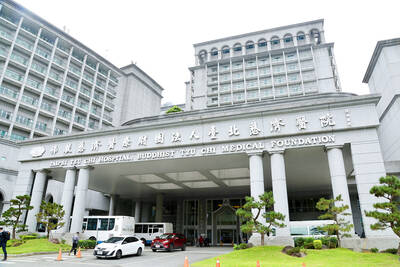
POLICE INVESTIGATING: A man said he quit his job as a nurse at Taipei Tzu Chi Hospital as he had been ‘disgusted’ by the behavior of his colleagues A man yesterday morning wrote online that he had witnessed nurses taking photographs and touching anesthetized patients inappropriately in Taipei Tzu Chi Hospital’s operating theaters. The man surnamed Huang (黃) wrote on the Professional Technology Temple bulletin board that during his six-month stint as a nurse at the hospital, he had seen nurses taking pictures of patients, including of their private parts, after they were anesthetized. Some nurses had also touched patients inappropriately and children were among those photographed, he said. Huang said this “disgusted” him “so much” that “he felt the need to reveal these unethical acts in the operating theater
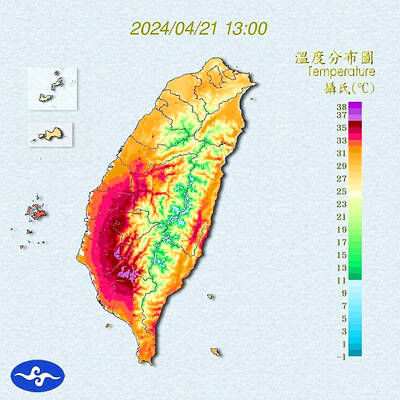
Heat advisories were in effect for nine administrative regions yesterday afternoon as warm southwesterly winds pushed temperatures above 38°C in parts of southern Taiwan, the Central Weather Administration (CWA) said. As of 3:30pm yesterday, Tainan’s Yujing District (玉井) had recorded the day’s highest temperature of 39.7°C, though the measurement will not be included in Taiwan’s official heat records since Yujing is an automatic rather than manually operated weather station, the CWA said. Highs recorded in other areas were 38.7°C in Kaohsiung’s Neimen District (內門), 38.2°C in Chiayi City and 38.1°C in Pingtung’s Sandimen Township (三地門), CWA data showed. The spell of scorching


 RSS
RSS