


Taipei Times: Why was the NIA created?
Wu Chen-chi (
Vietnamese spouses, meanwhile, total 80,000. Many spouses from Laos, Cambodia, the Philippines and Indonesia have also immigrated here. They're the new Taiwanese citizens and they give birth here. One out of eight newly-wed couples are cross-border couples and one out of four newborn babies have an immigrant parent. They're the new lifeblood of Taiwan.
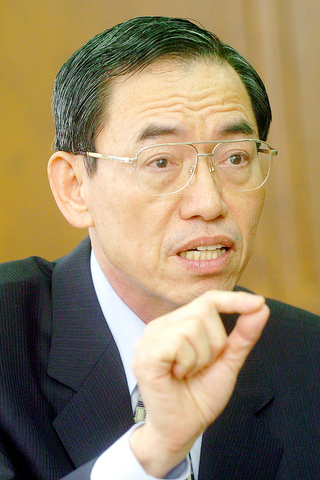
PHOTO: CHEN TSE-MING, TAIPEI TIMES
This agency will manage NT$3 billion [US$91 million] in funds to help immigrant spouses adjust to life here. That is, we plan to distribute NT$300 million yearly to certain non-government organizations [NGOs] to pay for language courses, medical care and childcare for such spouses. Many NGOs and local-level agencies are more experienced in helping foreign spouses, so we will play a supporting role for them.
Taipei Times: Regarding organization and duties, how is this agency different from the Bureau of Immigration?
Wu: The bureau had more than 700 employees. The agency has 2,012. Our digital infrastructure has also grown and now we have a branch office and task force in every county and city. The bureau only had five offices nationwide. We've absorbed personnel and resources from the Council of Labor Affairs, the Ministry of the Interior, airport and harbor police agencies, foreign affairs police at the local level and the NPA. For example, problems pertaining to financially disadvantaged foreigners that were previously handled by the foreign affairs police are now our responsibility, as are matters previously handled by the harbor and aviation police and border control authorities. The foreign labor affairs section from the Council of Labor Affairs has also been put under us. We will also be in charge of overseeing Chinese tourists when the nation opens up to them, at which point our personnel will increase to 2,044.
Taipei Times: Last October, the bureau was rocked by bribery scandals involving two officers helping human-trafficking rings to smuggle in foreign prostitutes. Do you view these cases as isolated cases, or as signs that the bureau was wracked by corruption?
Wu: I believe that's a single, isolated case. The media said there was a whole group involved, but that's just not possible. It was an isolated incident. The person involved Lee Juo-ling [李若玲] is still in detention and hasn't been indicted. She's innocent until proven guilty.
Taipei Times: Have you taken measures to make sure that such cases don't repeat themselves?
Wu: We were very distressed by Lee's case and I called a meeting of all the bureau's offices to warn them of what they needed to pay more attention to. We also needed to improve the interview process for would-be immigrants. We were short of interviewers. However, now that we have task forces in every county and city, I don't think another case like that of Lee Juo-ling will occur.
Taipei Times: What was your response to Taiwan slipping down to the Tier-2 watchlist in the US state department's latest Trafficking in Human Persons report?
Wu: From the president to the Cabinet to the ministry level, we are all concerned about human rights. I was very nervous at the time. People were saying that we weren't doing our jobs in preventing human trafficking from China.
Detaining and repatriating illegal aliens from China was the bureau's job. People said we weren't taking care of the Chinese, but that wasn't the case. Many of them were girls who had been smuggled here or tricked into coming and I went to a detention center to assess their treatment. We gave them a very beautiful facility to stay in, complete with tables, chairs and a big TV, like a cafe. Even a US State Department official visiting there was impressed.
The problem was that we couldn't send the trafficked people back to China because China wouldn't accept them. So I went to Matsu six times to meet Chinese officials about this problem and finally got them to accept more of their illegal aliens. In the past two years, I've repatriated nearly 5,000 Chinese.
Last week, there was a meeting held by Minister of the Interior Lee Yi-yang [
Taipei Times: Are you confident that Taiwan will be bumped back up to Tier 1 in the next report?
Wu: Of course, we need to invest more effort. I'm confident that my agency will bust at least two rings by March. But busting them is not easy.
Taipei Times: You've said that interviewing officers are no longer allowed to ask overly personal questions while interviewing would-be immigrant fiancees from China and their Taiwanese partners. But, according to many of your critics, bureau officers have been asking questions regarding panties and sex for a long time. How long have such questions been a part of the interview process and why is this policy changing now?
Wu: This is a good opportunity for clarification. When we first began the interview process in 2003, we consulted AIT and New Zealand trade office officials, asking them what questions they asked would-be immigrant spouses in their interviews. Questions about panties, for example, are allowed in the US and other countries. Questions to establish that the applying couple genuinely intend to wed and aren't using a sham marriage to get the foreigner in, are allowed.
But we don't ask about sex. We do ask about engagement rings, finances, living arrangements and other details to weed out any discrepancies and we ask the man and the woman. Human traffickers who coach illegal immigrants on how to answer questions in interviews spread rumors that we ask questions regarding sex and panties. They allege such questions are asked, preparing the illegal immigrants accordingly. We record every interview and catalogue them, so we have proof that such questions are not asked.
Taipei Times: There has been talk of drafting a refugee law of some sort. How is it coming along?
Wu: We are still in the process of mapping out such a law. However, the complexity of the matter and the need to incorporate inputs from other government agencies make this a very time-consuming endeavor.
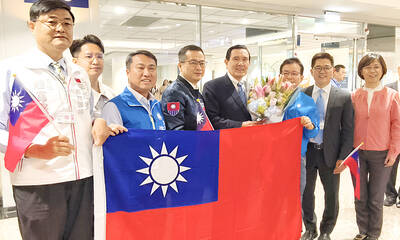
Former president Ma Ying-jeou’s (馬英九) mention of Taiwan’s official name during a meeting with Chinese President Xi Jinping (習近平) on Wednesday was likely a deliberate political play, academics said. “As I see it, it was intentional,” National Chengchi University Graduate Institute of East Asian Studies professor Wang Hsin-hsien (王信賢) said of Ma’s initial use of the “Republic of China” (ROC) to refer to the wider concept of “the Chinese nation.” Ma quickly corrected himself, and his office later described his use of the two similar-sounding yet politically distinct terms as “purely a gaffe.” Given Ma was reading from a script, the supposed slipup
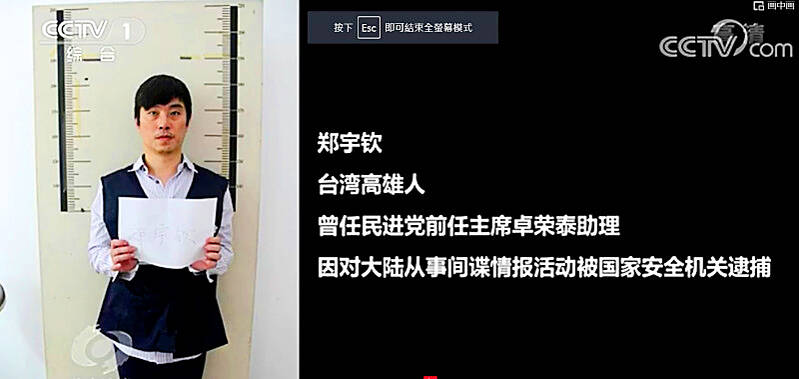
Former Czech Republic-based Taiwanese researcher Cheng Yu-chin (鄭宇欽) has been sentenced to seven years in prison on espionage-related charges, China’s Ministry of State Security announced yesterday. China said Cheng was a spy for Taiwan who “masqueraded as a professor” and that he was previously an assistant to former Cabinet secretary-general Cho Jung-tai (卓榮泰). President-elect William Lai (賴清德) on Wednesday last week announced Cho would be his premier when Lai is inaugurated next month. Today is China’s “National Security Education Day.” The Chinese ministry yesterday released a video online showing arrests over the past 10 years of people alleged to be
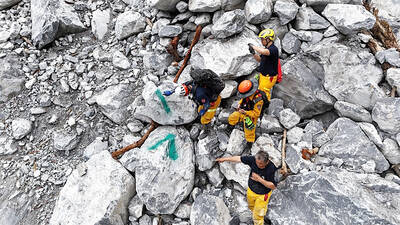
The bodies of two individuals were recovered and three additional bodies were discovered on the Shakadang Trail (砂卡礑) in Taroko National Park, eight days after the devastating earthquake in Hualien County, search-and-rescue personnel said. The rescuers reported that they retrieved the bodies of a man and a girl, suspected to be the father and daughter from the Yu (游) family, 500m from the entrance of the trail on Wednesday. The rescue team added that despite the discovery of the two bodies on Friday last week, they had been unable to retrieve them until Wednesday due to the heavy equipment needed to lift
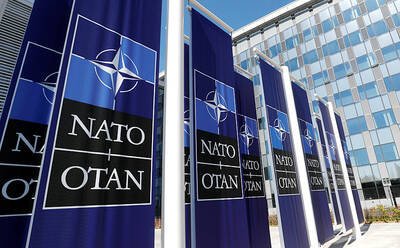
THE HAWAII FACTOR: While a 1965 opinion said an attack on Hawaii would not trigger Article 5, the text of the treaty suggests the state is covered, the report says NATO could be drawn into a conflict in the Taiwan Strait if Chinese forces attacked the US mainland or Hawaii, a NATO Defense College report published on Monday says. The report, written by James Lee, an assistant research fellow at Academia Sinica’s Institute of European and American Studies, states that under certain conditions a Taiwan contingency could trigger Article 5 of NATO, under which an attack against any member of the alliance is considered an attack against all members, necessitating a response. Article 6 of the North Atlantic Treaty specifies that an armed attack in the territory of any member in Europe,


 RSS
RSS