


With the Democratic Progressive Party's (DPP) presidential primary a few months away, the party's "four superstars" are trying to boost their chances of emerging as the party's candidate.
The DPP is planning to hold the presidential primary in May, pending the approval of its Central Executive Committee.
In the past, the party did not nominate presidential candidates until July. However, the DPP hopes to nominate the candidates early, taking into consideration that the presidential poll could be held in tandem with the legislative election.
The party is mulling whether to hold the presidential primary at the same time as the legislative primary.
After the Dec. 9 municipal elections, the DPP's "four superstars" have been strenuously trying to consolidate their support bases, although all remain tight-lipped about whether they will run for election.
Vice President Annette Lu (
The stated goal of the DPU is to make concerted efforts to improve democracy, peace and prosperity in the world.
Lu also made a big fuss about a book written about her by a South Korean writer. She said nothing about her presidential bid but lauded the rising trend of women entering politics and becoming heads of state.
Premier Su Tseng-chang (
Su visited Gambia last week, the journey marking his first overseas trip since he assumed the premiership in January.
Since then, Su has visited Matsu, Nantou, Yunlin and Kaohsiung. He also conducted several trips to Pingtung County -- his birthplace and where he served as county commissioner between 1989 and 1993 -- and Taipei County -- where he served as the county commissioner from 1997 to 2001.
DPP Chairman Yu Shyi-kun has been criticizing his Chinese Nationalist Party (KMT) counterpart Ma Ying-jeou (
Former premier Frank Hsieh (
Joseph Tsai (
"Her problem is not gender but personality," he said.
After her brother called for Chen's resignation, Tsai said that Lu's chance of becoming the president went out of the window.
Lin Jih-wen (
Unlike Lu, Su enjoys a sound relationship with the former New Tide faction and his no-nonsense attitude has won him and his administration much acclaim.
Su's close ties with the faction, however, may be a liability because faction members are unpopular in the party and the faction's liberal cross-strait polices have upset many.
Another of Su's problems lies in his lack of political vision when it comes to issues like the economy, cross-strait relations, the Constitution and national identity, Tsai said.
Hsieh's advantage is his experience in international affairs and leadership.
In order to win the party primary, Tsai said that it would be a challenge for Hsieh to win the support of Chen and faction members. It is an open secret that Hsieh does not have a close relationship with Chen and tension exists between Hsieh and the New Tide faction.
While Chen is more likely to endorse Su, Tsai said that Hsieh might want to seek support from other political bigwigs such as former president Lee Teng-hui (李登輝).
It will be to Hsieh's disadvantage if the two primaries are held together, Lin said, because Hsieh does not enjoy as much factional support as Su does.
As the party leader, Yu's chance of a presidential bid hinges on next year's legislative election. If the party wins, he will get a strong boost. If it loses, he may have to follow precedent and step down.
Yu, however, would make a good candidate for vice president if Su is willing to run with him on the same ticket, Tsai said, because Yu is hard-working and responsible.
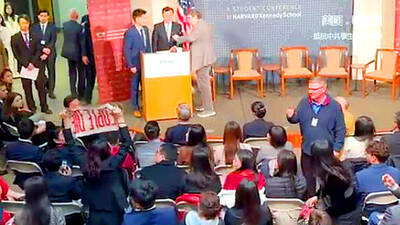
A group of Taiwanese-American and Tibetan-American students at Harvard University on Saturday disrupted Chinese Ambassador to the US Xie Feng’s (謝鋒) speech at the school, accusing him of being responsible for numerous human rights violations. Four students — two Taiwanese Americans and two from Tibet — held up banners inside a conference hall where Xie was delivering a speech at the opening ceremony of the Harvard Kennedy School China Conference 2024. In a video clip provided by the Coalition of Students Resisting the CCP (Chinese Communist Party), Taiwanese-American Cosette Wu (吳亭樺) and Tibetan-American Tsering Yangchen are seen holding banners that together read:

UNAWARE: Many people sit for long hours every day and eat unhealthy foods, putting them at greater risk of developing one of the ‘three highs,’ an expert said More than 30 percent of adults aged 40 or older who underwent a government-funded health exam were unaware they had at least one of the “three highs” — high blood pressure, high blood lipids or high blood sugar, the Health Promotion Administration (HPA) said yesterday. Among adults aged 40 or older who said they did not have any of the “three highs” before taking the health exam, more than 30 percent were found to have at least one of them, Adult Preventive Health Examination Service data from 2022 showed. People with long-term medical conditions such as hypertension or diabetes usually do not
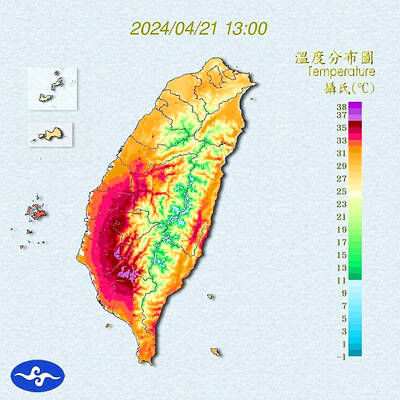
Heat advisories were in effect for nine administrative regions yesterday afternoon as warm southwesterly winds pushed temperatures above 38°C in parts of southern Taiwan, the Central Weather Administration (CWA) said. As of 3:30pm yesterday, Tainan’s Yujing District (玉井) had recorded the day’s highest temperature of 39.7°C, though the measurement will not be included in Taiwan’s official heat records since Yujing is an automatic rather than manually operated weather station, the CWA said. Highs recorded in other areas were 38.7°C in Kaohsiung’s Neimen District (內門), 38.2°C in Chiayi City and 38.1°C in Pingtung’s Sandimen Township (三地門), CWA data showed. The spell of scorching
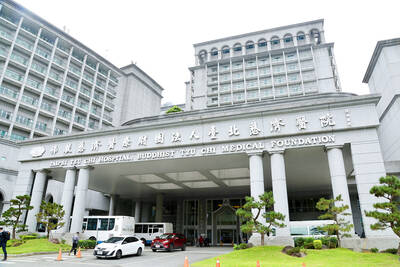
POLICE INVESTIGATING: A man said he quit his job as a nurse at Taipei Tzu Chi Hospital as he had been ‘disgusted’ by the behavior of his colleagues A man yesterday morning wrote online that he had witnessed nurses taking photographs and touching anesthetized patients inappropriately in Taipei Tzu Chi Hospital’s operating theaters. The man surnamed Huang (黃) wrote on the Professional Technology Temple bulletin board that during his six-month stint as a nurse at the hospital, he had seen nurses taking pictures of patients, including of their private parts, after they were anesthetized. Some nurses had also touched patients inappropriately and children were among those photographed, he said. Huang said this “disgusted” him “so much” that “he felt the need to reveal these unethical acts in the operating theater


 RSS
RSS