


The pan-green parties submitted a request for a constitutional interpretation to the Judicial Yuan yesterday on the legality of prosecutors questioning President Chen Shui-bian (陳水扁) over the "state affairs fund" case.
Backing the request were 81 Democratic Progressive Party (DPP) lawmakers -- out of a total of 84 -- and two lawmakers from the Taiwan Solidarity Union.
Judicial Yuan Secretary-General Fan Kuang-chun (范光群) yesterday said that the judicial body would deal with the case objectively.
A petition calling on the Council of Grand Justices of Judicial Yuan to issue an injunction to suspend the trial of first lady Wu Shu-jen (
If the petition were approved, the trial of Wu on charges of forgery and corruption for allegedly using fraudulent receipts to claim funds totaling NT$14.8 million (US$450,000) would be suspended.
The trial starts today.
"We filed the request to protect the dignity of the presidency and the integrity of the Constitution, rather than the president himself," DPP legislative caucus whip Ker Chien-ming (
Chen is also suspected of graft and forgery in the state affairs fund case, but he can not be charged while in office due to presidential immunity granted in Article 52 of the Constitution.
The article reads: "The President shall not, without having been recalled, or having been relieved of his functions, be liable to criminal prosecution unless he is charged with having committed an act of rebellion or treason."
Prosecutors said in the indictment that Chen was a principle offender in the case and will face prosecution once his term ends.
Meanwhile, a report in yesterday's Chinese-language China Times said that DPP lawmakers were arguing that the president enjoys permanent immunity.
"We regret that the China Times took a distorted view of our argument. Its reporters didn't represent our words in context," DPP Legislator Wu Bing-ray (
Wu said that not all the president's acts are under the protection of permanent immunity.
"Of course corrupt acts are excluded," he said. Wu said the article should be interpreted in two parts.
"For one thing, the president should receive permanent immunity and substantive immunity for his official acts, even after he leaves office," he said.
"For the other, the president should receive litigation immunity and temporary immunity from non-official acts, official acts, and acts performed prior to his presidency while he is in office," Wu said.
Therefore, the prosecutors' questioning of the president is unconstitutional, and thus the information that prosecutors gathered from the interrogation could not be used as evidence in court, Wu said.
Nevertherless, Chinese Nationalist Party (KMT) lawmakers condemned pan-green counterparts' view of "permanent immunity," as expressed in yesterday's newspaper report.
"How dare DPP lawmakers argue that the president has permanent immunity?" KMT Legislator Chu Feng-chi (
"Are you treating the president as an emperor? Why can't a president involved in corruption be questioned?" Chu said.
In other news, former presidential adviser Koo Kwang-ming (
But he said that he supported the DPP's move.
Additional reporting by Ko Shu-ling
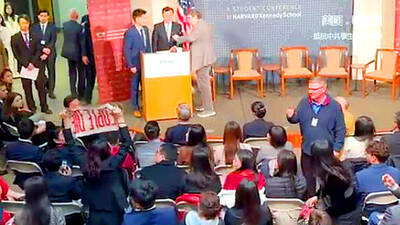
A group of Taiwanese-American and Tibetan-American students at Harvard University on Saturday disrupted Chinese Ambassador to the US Xie Feng’s (謝鋒) speech at the school, accusing him of being responsible for numerous human rights violations. Four students — two Taiwanese Americans and two from Tibet — held up banners inside a conference hall where Xie was delivering a speech at the opening ceremony of the Harvard Kennedy School China Conference 2024. In a video clip provided by the Coalition of Students Resisting the CCP (Chinese Communist Party), Taiwanese-American Cosette Wu (吳亭樺) and Tibetan-American Tsering Yangchen are seen holding banners that together read:

UNAWARE: Many people sit for long hours every day and eat unhealthy foods, putting them at greater risk of developing one of the ‘three highs,’ an expert said More than 30 percent of adults aged 40 or older who underwent a government-funded health exam were unaware they had at least one of the “three highs” — high blood pressure, high blood lipids or high blood sugar, the Health Promotion Administration (HPA) said yesterday. Among adults aged 40 or older who said they did not have any of the “three highs” before taking the health exam, more than 30 percent were found to have at least one of them, Adult Preventive Health Examination Service data from 2022 showed. People with long-term medical conditions such as hypertension or diabetes usually do not
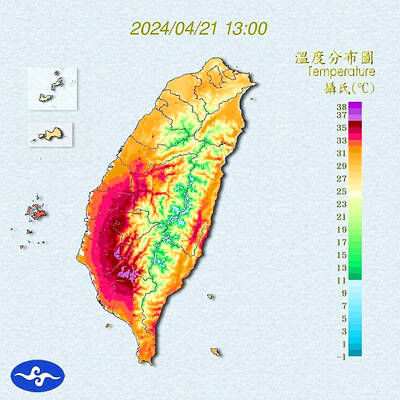
Heat advisories were in effect for nine administrative regions yesterday afternoon as warm southwesterly winds pushed temperatures above 38°C in parts of southern Taiwan, the Central Weather Administration (CWA) said. As of 3:30pm yesterday, Tainan’s Yujing District (玉井) had recorded the day’s highest temperature of 39.7°C, though the measurement will not be included in Taiwan’s official heat records since Yujing is an automatic rather than manually operated weather station, the CWA said. Highs recorded in other areas were 38.7°C in Kaohsiung’s Neimen District (內門), 38.2°C in Chiayi City and 38.1°C in Pingtung’s Sandimen Township (三地門), CWA data showed. The spell of scorching
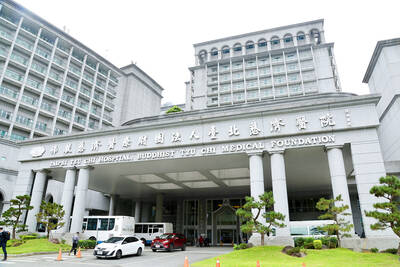
POLICE INVESTIGATING: A man said he quit his job as a nurse at Taipei Tzu Chi Hospital as he had been ‘disgusted’ by the behavior of his colleagues A man yesterday morning wrote online that he had witnessed nurses taking photographs and touching anesthetized patients inappropriately in Taipei Tzu Chi Hospital’s operating theaters. The man surnamed Huang (黃) wrote on the Professional Technology Temple bulletin board that during his six-month stint as a nurse at the hospital, he had seen nurses taking pictures of patients, including of their private parts, after they were anesthetized. Some nurses had also touched patients inappropriately and children were among those photographed, he said. Huang said this “disgusted” him “so much” that “he felt the need to reveal these unethical acts in the operating theater


 RSS
RSS