


Lung Ying-tai (龍應台) is a complex woman. Widely hailed as an important voice in Taiwan for democracy during the Chinese Nationalist Party (KMT) authoritarian era, more recently she has been condemned by some as a tool for China.
Clearly mindful of her upbringing in the world of the KMT martial law dictatorship, she has also become a sharp critic of President Chen Shui-bian (陳水扁), the arch anti-KMT politician, in recent years. And, while she has been a prominent Taiwanese writer and professor, she has also published in major Chinese newspapers for 15 years and teaches at the University of Hong Kong.
On Thursday, Lung was in Washington to berate the international community for not helping Taiwan out of the global isolation imposed on it by Beijing and, indeed, for acquiescing to it and to twit Taiwan for not doing enough on its own behalf to break out of that isolation.
"Are the Taiwanese being punished for their democracy?" Lung asked dozens of senior diplomats, academics and international affairs experts in a presentation on China-Taiwan relations at a seminar on worldviews and human rights sponsored by the Swedish embassy and foreign ministry.
In the 37 years of martial law after 1950, she recalled, the people of Taiwan "were sent straight into isolation" by China and the nations of the world.
"The global village looks on as the children of Taiwan, generation after generation, grow up in the global village but denied global citizenship and deprived of dignity," she said.
"In China's search for modernity, Taiwan democracy has always been the most important reference," she said.
"If a democratic China is essential for world peace, then it is urgent that the global village do the pre-emptive work to prevent war, which means that the young democracy of Taiwan has to be cared for by the world community and the isolation has to stop," she said.
Five ambassadors, senior diplomats from 27 other embassies, and a large number of European foreign ministry officials and representatives of the EU signed up for the symposium at the Swedish embassy, "Worldviews, International Relations and Globalization," giving Lung a broad diplomatic audience for her plea for help for Taiwan.
Later, in an interview with the Taipei Times, Lung said that instead of punishing Taiwan and bowing to Beijing's efforts to isolate it, "the world community should actually encourage Taiwan, protect Taiwan, and really take a hard look at the situation the Taiwanese are in."
Lung said that there has been some international response to Taiwan's plight, "but I think it would take some very determined act from some world leaders who really confront the situation," for things to change.
Turning to Taiwan's own response, Lung said, "I think the Taiwanese are too timid in voicing [their concerns] and telling the world how frustrated they are. The world community is not aware what this long isolation is doing to the psyche to this group of people."
She also saw the isolation poisoning cross-strait relations.
"I think it is really going to turn out very negatively in terms of cross-strait relations, because it is going to make the Taiwanese even more hostile toward China. And that is something that nobody wants to see," she said.
For China, on its part, the Beijing leadership "are not very aware of what this isolation and ostracization is doing to the Taiwanese, and how it is have a very negative impact on cross-strait relations," she said.
Lung complained that Taiwan has to "bribe" other nations to keep diplomatic ties.
"When political leaders want to visit other nations, they have to go incognito and still would be humiliated like orphans no one accepts," she said.
She also said that years of isolation has given Taiwanese "a sense of alienation from the global village."
She pointed to a recent opinion poll in Taipei, in which 80 percent of respondents didn't know where the UN headquarters was located, 60 percent did not know on which continent Athens was located, 80 percent did not know where the Nobel Prize was awarded and 60 percent did not know Germany's currency, for example.
These results showed, Lung said, that decades of isolation have denied the Taiwanese the "right to social and cultural life in the world community."
This, in turn, violates the UN universal declaration of human rights, the world's basic human rights document.
"Everybody" is entitled to basic rights and freedoms, the declaration states. "No distinction" should be made on the basis of the "political, jurisdictional or international status of the country or territory to which a person belongs, whether it be independent, trust, non-self governing or under any other limitation of sovereignty," Lung quoted the document as saying.
Taiwan, by the nature of its global isolation, is denied these rights because the world complies with Beijing's isolation campaign, she said.
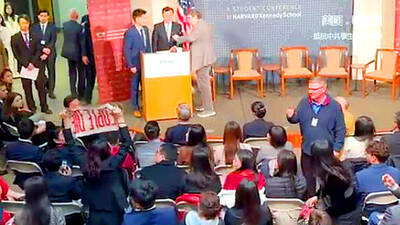
A group of Taiwanese-American and Tibetan-American students at Harvard University on Saturday disrupted Chinese Ambassador to the US Xie Feng’s (謝鋒) speech at the school, accusing him of being responsible for numerous human rights violations. Four students — two Taiwanese Americans and two from Tibet — held up banners inside a conference hall where Xie was delivering a speech at the opening ceremony of the Harvard Kennedy School China Conference 2024. In a video clip provided by the Coalition of Students Resisting the CCP (Chinese Communist Party), Taiwanese-American Cosette Wu (吳亭樺) and Tibetan-American Tsering Yangchen are seen holding banners that together read:

UNAWARE: Many people sit for long hours every day and eat unhealthy foods, putting them at greater risk of developing one of the ‘three highs,’ an expert said More than 30 percent of adults aged 40 or older who underwent a government-funded health exam were unaware they had at least one of the “three highs” — high blood pressure, high blood lipids or high blood sugar, the Health Promotion Administration (HPA) said yesterday. Among adults aged 40 or older who said they did not have any of the “three highs” before taking the health exam, more than 30 percent were found to have at least one of them, Adult Preventive Health Examination Service data from 2022 showed. People with long-term medical conditions such as hypertension or diabetes usually do not
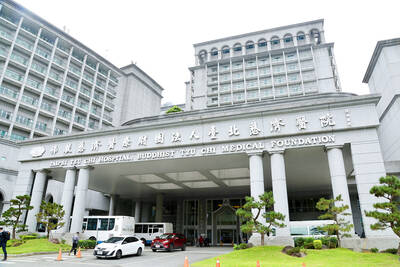
POLICE INVESTIGATING: A man said he quit his job as a nurse at Taipei Tzu Chi Hospital as he had been ‘disgusted’ by the behavior of his colleagues A man yesterday morning wrote online that he had witnessed nurses taking photographs and touching anesthetized patients inappropriately in Taipei Tzu Chi Hospital’s operating theaters. The man surnamed Huang (黃) wrote on the Professional Technology Temple bulletin board that during his six-month stint as a nurse at the hospital, he had seen nurses taking pictures of patients, including of their private parts, after they were anesthetized. Some nurses had also touched patients inappropriately and children were among those photographed, he said. Huang said this “disgusted” him “so much” that “he felt the need to reveal these unethical acts in the operating theater
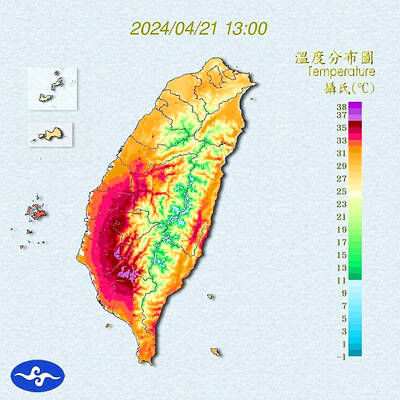
Heat advisories were in effect for nine administrative regions yesterday afternoon as warm southwesterly winds pushed temperatures above 38°C in parts of southern Taiwan, the Central Weather Administration (CWA) said. As of 3:30pm yesterday, Tainan’s Yujing District (玉井) had recorded the day’s highest temperature of 39.7°C, though the measurement will not be included in Taiwan’s official heat records since Yujing is an automatic rather than manually operated weather station, the CWA said. Highs recorded in other areas were 38.7°C in Kaohsiung’s Neimen District (內門), 38.2°C in Chiayi City and 38.1°C in Pingtung’s Sandimen Township (三地門), CWA data showed. The spell of scorching


 RSS
RSS