


"Do I have to take so many?" asked an old man to his tuberculosis outreach worker who brings him his pills every day.
In his weakened state, the man requires rests between swallowing each pill. His outreach worker stayed with him until he finished them all.
This story was recounted by Wang Kwei-feng (
Wang said more than 400 outreach workers provide treatment to tuberculosis patients all over Taiwan as a part of the Department of Health's (DOH) big push to cut tuberculosis cases in half by 2015.
This year alone, the DOH has allocated nearly NT$1 billion (US$30 million) out of its budget on tuberculosis care and prevention, with NT$180 million going towards directly observed treatment short courses (DOTS).
"The program just came online this year, so it's too early to see any improvements," said Chou Chih-hao (周志浩), deputy director-general of the CDC. "But there is an international consensus, and support from WHO, that the DOTS approach is the best way to deal with tuberculosis."
In addition to the DOTS program, measures taken by the CDC to curb tuberculosis include BCG (Bacillus Calmette-Guerin) vaccines administered to more than 90 percent of Taiwanese children, free tuberculosis-related programs for all, including those who did not pay their National Health Insurance premiums and compulsory hospitalization for those deemed to be an infection risk.
"Initially, the compulsory hospitalization lasts about two weeks," said Chou. "After that, patients are allowed to go home, where they are tracked by outreach workers. If they don't take their pills, however, then it's back to the hospital."
Bai Kuan-jen (
"Tuberculosis bacteria grows slowly and has different levels of persistence," he said. "Interrupted treatment can result in the development of resistance, making the disease far more difficult to tackle."
Some patients end up with multi-drug resistance, and may become all but incurable while capable of passing on the more virulent strain of the bacteria, he said.
Despite the rising specter of AIDS, tuberculosis remains Taiwan's deadliest infectious disease and the 13th leading cause of death overall.
According to the statistics office at the DOH, 970 people died of tuberculosis last year.
The elderly and patients with AIDS, both growing demographic groups, are particularly vulnerable to tuberculosis, said Chou.
On the ground-level, Wang said, the official and non-governmental organizations are working in tandem to support tuberculosis patients in their long and often economically onerous recovery.
"In the early days, outreach workers and local health workers down south would help patients with money out of their own pockets to buy food, or go out of the way to give patients rides to the hospital in their own time," Wang said. "It was very touching ... but not a solution for the long term."
Wang's section received NT$600,000 from the National Tuberculosis Association and NT$180,000 from the Taipei Dental Association.
"Those funds go straight to tuberculosis sufferers in need," she added.
Wang said that since tuberculosis strikes most among the economically marginalized, many families are put into hardship by the disease.
"Government rules tend to be inflexible. There are many rules regarding the condition that must be met before someone can be declared destitute and receive aid," she said. "This is where non-governmental organizations can step in and really make a difference in patients' lives."

Former president Ma Ying-jeou’s (馬英九) mention of Taiwan’s official name during a meeting with Chinese President Xi Jinping (習近平) on Wednesday was likely a deliberate political play, academics said. “As I see it, it was intentional,” National Chengchi University Graduate Institute of East Asian Studies professor Wang Hsin-hsien (王信賢) said of Ma’s initial use of the “Republic of China” (ROC) to refer to the wider concept of “the Chinese nation.” Ma quickly corrected himself, and his office later described his use of the two similar-sounding yet politically distinct terms as “purely a gaffe.” Given Ma was reading from a script, the supposed slipup
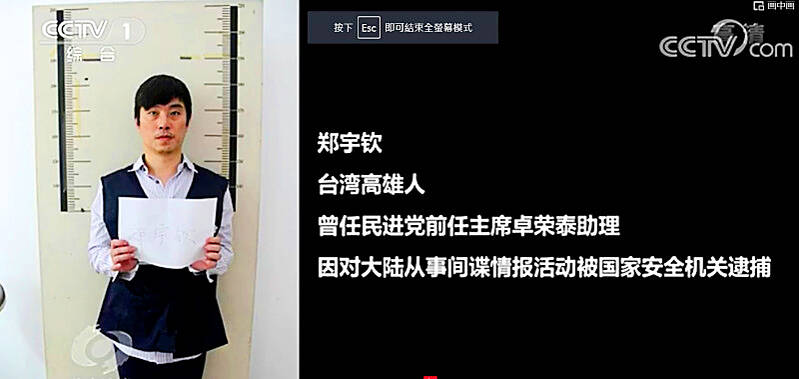
Former Czech Republic-based Taiwanese researcher Cheng Yu-chin (鄭宇欽) has been sentenced to seven years in prison on espionage-related charges, China’s Ministry of State Security announced yesterday. China said Cheng was a spy for Taiwan who “masqueraded as a professor” and that he was previously an assistant to former Cabinet secretary-general Cho Jung-tai (卓榮泰). President-elect William Lai (賴清德) on Wednesday last week announced Cho would be his premier when Lai is inaugurated next month. Today is China’s “National Security Education Day.” The Chinese ministry yesterday released a video online showing arrests over the past 10 years of people alleged to be

THE HAWAII FACTOR: While a 1965 opinion said an attack on Hawaii would not trigger Article 5, the text of the treaty suggests the state is covered, the report says NATO could be drawn into a conflict in the Taiwan Strait if Chinese forces attacked the US mainland or Hawaii, a NATO Defense College report published on Monday says. The report, written by James Lee, an assistant research fellow at Academia Sinica’s Institute of European and American Studies, states that under certain conditions a Taiwan contingency could trigger Article 5 of NATO, under which an attack against any member of the alliance is considered an attack against all members, necessitating a response. Article 6 of the North Atlantic Treaty specifies that an armed attack in the territory of any member in Europe,
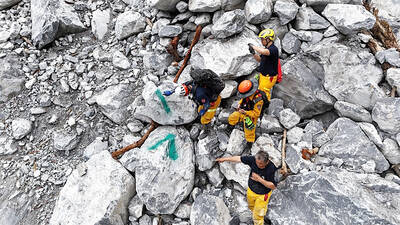
The bodies of two individuals were recovered and three additional bodies were discovered on the Shakadang Trail (砂卡礑) in Taroko National Park, eight days after the devastating earthquake in Hualien County, search-and-rescue personnel said. The rescuers reported that they retrieved the bodies of a man and a girl, suspected to be the father and daughter from the Yu (游) family, 500m from the entrance of the trail on Wednesday. The rescue team added that despite the discovery of the two bodies on Friday last week, they had been unable to retrieve them until Wednesday due to the heavy equipment needed to lift


 RSS
RSS