


Amid concerns that judicial wrangling may escalate into a political storm, proposals have been made to resolve the controversies involving the president's "state affairs fund" and the Taipei mayoral special allowance through political means.
While President Chen Shui-bian (陳水扁), who has been accused of graft, forgery and perjury in connection with the handling of Chen's "state affairs fund," could not be charged because of his presidential immunity, first lady Wu Shu-jen (吳淑珍) was indicted earlier this month on a similar range of charges. Prosecutors have also questioned Chinese Nationalist Party (KMT) Chairman Ma Ying-jeou (馬英九) for the alleged mishandling of his special allowance fund.
In response to these events, Democratic Progressive Party (DPP) caucus whip Yeh Yi-chin (
KMT and People First Party lawmakers have also advocated reforming the special allowance fund system through enactment of a special law to stipulate clear-cut regulations for the use of expense budgets by government officials.
With Judicial Yuan President Weng Yueh-Sheng (
Y.C. Kao (
"You can't simply paint the sky black to hide the crows," he said. "The public cannot pretend that nothing happened because all local chiefs embezzled money from their special funds."
When the government pursues civilians suspected of tax evasion or forgery with considerable enthusiasm, it doesn't make sense for the judicial system to let corrupt local chiefs off the hook, Kao said.
Instead of resorting to political means, Kao said the judicial system must get to the bottom of the matter.
"I'm not saying that they should all be convicted or go to jail, but the people have the right to know why so many government officials dare to pocket public funds and how the wrongdoing could be corrected and the system improved," he said.
The judge could lessen the sentence if the defendant can produce "appropriate reasons" to justify their illegal activities, Kao said, but the defendant cannot be exempted from any criminal responsibility just because he or she claimed ignorance of the law.
Kao said he believed Chen and Ma were not corrupt politicians but it was wrong to pocket public funds.
Kao said he thought it was a bad idea to enact a special retrospective law to resolve the controversy, but if the legislature or politicians insisted on doing so, they would have to brace themselves for the political consequences.
Allen Houng (
"Some people might have to pay the price for a poorly designed system but their sacrifice would benefit the country's democratic development," he said.
Describing the controversy caused by special allowance funds as an example of "justice in transition," Houng said the DPP administration should be held partially responsible for the political mayhem because of its failure to tackle these problems.
Houng said local chiefs' special allowance funds were part of a "weird" system developed during the KMT's reign.
As the country has moved beyond authoritarianism to democracy, a better-thought-out mechanism for the reimbursement of expenses and salaries must be established.
If the controversy of discretionary funds sparks debate over problems caused by transitional justice, Houng said he would not have any problem seeing local chiefs be given a presidential pardon for the crime they committed if such debate transcends partisan politics and political strife.
Prosecutors, however, should wait until Chen serves out his term of office before being prosecuted, Houng said, and he should not relinquish his criminal immunity to give testimony in court.
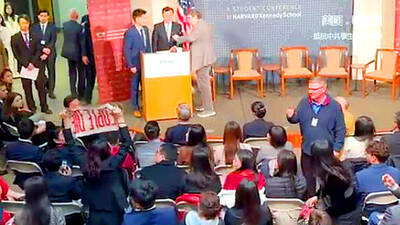
A group of Taiwanese-American and Tibetan-American students at Harvard University on Saturday disrupted Chinese Ambassador to the US Xie Feng’s (謝鋒) speech at the school, accusing him of being responsible for numerous human rights violations. Four students — two Taiwanese Americans and two from Tibet — held up banners inside a conference hall where Xie was delivering a speech at the opening ceremony of the Harvard Kennedy School China Conference 2024. In a video clip provided by the Coalition of Students Resisting the CCP (Chinese Communist Party), Taiwanese-American Cosette Wu (吳亭樺) and Tibetan-American Tsering Yangchen are seen holding banners that together read:

UNAWARE: Many people sit for long hours every day and eat unhealthy foods, putting them at greater risk of developing one of the ‘three highs,’ an expert said More than 30 percent of adults aged 40 or older who underwent a government-funded health exam were unaware they had at least one of the “three highs” — high blood pressure, high blood lipids or high blood sugar, the Health Promotion Administration (HPA) said yesterday. Among adults aged 40 or older who said they did not have any of the “three highs” before taking the health exam, more than 30 percent were found to have at least one of them, Adult Preventive Health Examination Service data from 2022 showed. People with long-term medical conditions such as hypertension or diabetes usually do not
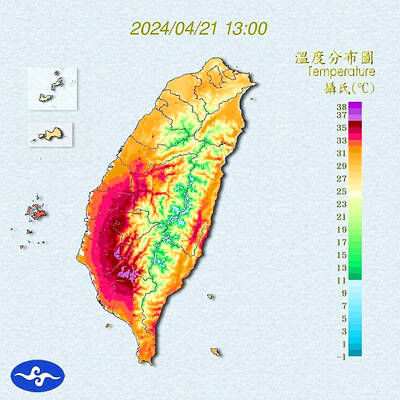
Heat advisories were in effect for nine administrative regions yesterday afternoon as warm southwesterly winds pushed temperatures above 38°C in parts of southern Taiwan, the Central Weather Administration (CWA) said. As of 3:30pm yesterday, Tainan’s Yujing District (玉井) had recorded the day’s highest temperature of 39.7°C, though the measurement will not be included in Taiwan’s official heat records since Yujing is an automatic rather than manually operated weather station, the CWA said. Highs recorded in other areas were 38.7°C in Kaohsiung’s Neimen District (內門), 38.2°C in Chiayi City and 38.1°C in Pingtung’s Sandimen Township (三地門), CWA data showed. The spell of scorching
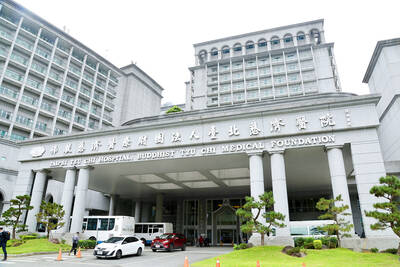
POLICE INVESTIGATING: A man said he quit his job as a nurse at Taipei Tzu Chi Hospital as he had been ‘disgusted’ by the behavior of his colleagues A man yesterday morning wrote online that he had witnessed nurses taking photographs and touching anesthetized patients inappropriately in Taipei Tzu Chi Hospital’s operating theaters. The man surnamed Huang (黃) wrote on the Professional Technology Temple bulletin board that during his six-month stint as a nurse at the hospital, he had seen nurses taking pictures of patients, including of their private parts, after they were anesthetized. Some nurses had also touched patients inappropriately and children were among those photographed, he said. Huang said this “disgusted” him “so much” that “he felt the need to reveal these unethical acts in the operating theater


 RSS
RSS