


The controversy involving President Chen Shui-bian's (陳水扁) alleged misuse of the "state affairs fund" highlights the poor design and oversight of the special expense funds used by government officials.
In a televised address two days after the indictment of his wife, Chen complained that the regulations governing the presidential "state affairs fund" were vague and confusing.
He also called for clear and comprehensive rules regarding the use of the fund.
Unlike Vice President Annette Lu (
The name and nature of the president's special expense fund have changed over the years, causing confusion not only for accountants but also for presidents.
Two special expense funds for the president -- a "secret fund" and a "special fund" -- were established in 1949. The two funds were merged into one called the "state affairs fund" in 1963. In 1992, the fund was renamed the "special expense fund" and then changed again to "secret fund" in 1995.
Two internal Presidential Office documents from August 1952 provide the first evidence showing that the secret portion of the president's "state affairs fund" was handled through a separate account.
However, that portion of the fund was not disclosed in the Presidential Office's budget statement.
Since the fund's inception in 1949, expenses drawn from its secret portion have been reimbursed with claim forms explaining how the fund was used, while expenses from the non-secret portion have been reimbursed with receipts or invoices.
All the slips and receipts were kept at the Presidential Office's accounting department.
In 1997, the Ministry of Audit agreed to let the Presidential Office handle the fund in accordance with Article 44 of the Audit Law (
In a bid to more transparently manage the fund, Presidential Office Deputy Secretary-General Cho Jung-tai (
Any funds distributed to individuals involved in sensitive tasks such as diplomacy, military affairs or cross-strait issues are handled in accordance with the Classified National Security Information Protection Act (
The change made in September came in the wake of corruption allegations swirling around the first family and the president's aides.
Acting on the claim made by fashion designer Ligi Lee (
After four visits in two months, the ministry reported to the Taiwan High Prosecutors Office in July that it suspected the Presidential Office of misusing the fund.
The ministry also reported to the Control Yuan, complaining that the Presidential Office had obstructed its auditing process by refusing to provide documents it deemed sensitive and confidential.
The ministry also said it was innappropriate for the Presidential Office to assign someone who was not a certified accountant to handle the special account.
The Directorate General of Budget, Accounting and Statistics (DGBAS), however, has a different view of the nature and function of the fund.
DGBAS defined the fund as a "special fund" and "secret fund" and as such it is not necessary to produce receipts or invoices if the fund is used for confidential purposes.
Accounting and Statistics Director-General Hsu Jan-yau (許璋瑤) said his department did not send auditors to check on the use of the fund because it "trusted and respected the national leader."
Chen has said that it was unfair to hold him accountable for the fund's poor controls since he merely followed the practice exercised by his predecessors.
Shih Cheng-feng (施正鋒), a professor at Tamkang University's Department of public administration, agreed that Chen should not be held solely responsible for the ill-designed system, but the administration should have taken the initiative to change the modus operandi as soon as it discovered the flaw.
It did not make sense, however, that the head of the state should go without a special allowance fund while other government officials use them, he said.
As Chen has complained that even government officials are confused about the nature of the fund and that nobody had explained how to use it, Shih said the Ministry of Audit should be held responsible for "procedural errors" relating to the "state affairs fund."
"While President Chen only oversees policies involving the funds, the relevant accountants are in charge of how the cash is handled," Shih said. "Many of the nation's problems lie in the lack of institutional transparency and legal mechanisms."
Philip Yang (
Even if part of the fund was normally used for clandestine diplomatic undertakings, it still should have been placed under legislative oversight, he said.
Yang's comments cast doubt on Chen's argument that presidents should have business expenses at their disposal because they set foreign policy rather than execute it.
also see story:
Editorial: Friedman's straightforward legacy
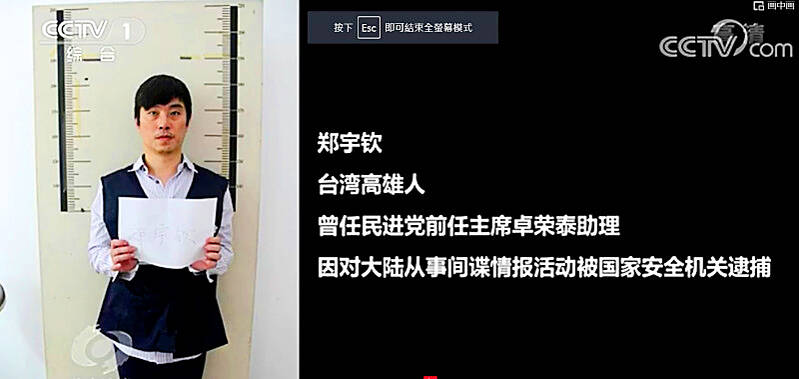
Former Czech Republic-based Taiwanese researcher Cheng Yu-chin (鄭宇欽) has been sentenced to seven years in prison on espionage-related charges, China’s Ministry of State Security announced yesterday. China said Cheng was a spy for Taiwan who “masqueraded as a professor” and that he was previously an assistant to former Cabinet secretary-general Cho Jung-tai (卓榮泰). President-elect William Lai (賴清德) on Wednesday last week announced Cho would be his premier when Lai is inaugurated next month. Today is China’s “National Security Education Day.” The Chinese ministry yesterday released a video online showing arrests over the past 10 years of people alleged to be
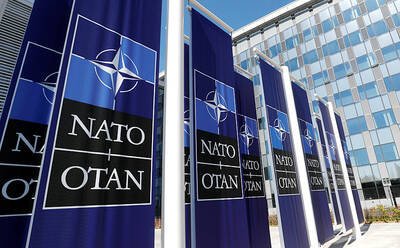
THE HAWAII FACTOR: While a 1965 opinion said an attack on Hawaii would not trigger Article 5, the text of the treaty suggests the state is covered, the report says NATO could be drawn into a conflict in the Taiwan Strait if Chinese forces attacked the US mainland or Hawaii, a NATO Defense College report published on Monday says. The report, written by James Lee, an assistant research fellow at Academia Sinica’s Institute of European and American Studies, states that under certain conditions a Taiwan contingency could trigger Article 5 of NATO, under which an attack against any member of the alliance is considered an attack against all members, necessitating a response. Article 6 of the North Atlantic Treaty specifies that an armed attack in the territory of any member in Europe,
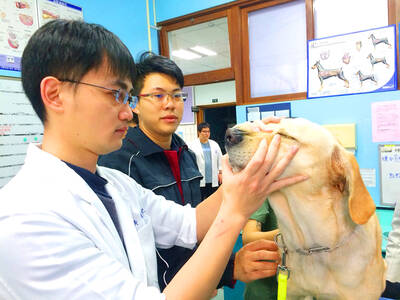
LIKE FAMILY: People now treat dogs and cats as family members. They receive the same medical treatments and tests as humans do, a veterinary association official said The number of pet dogs and cats in Taiwan has officially outnumbered the number of human newborns last year, data from the Ministry of Agriculture’s pet registration information system showed. As of last year, Taiwan had 94,544 registered pet dogs and 137,652 pet cats, the data showed. By contrast, 135,571 babies were born last year. Demand for medical care for pet animals has also risen. As of Feb. 29, there were 5,773 veterinarians in Taiwan, 3,993 of whom were for pet animals, statistics from the Animal and Plant Health Inspection Agency showed. In 2022, the nation had 3,077 pediatricians. As of last
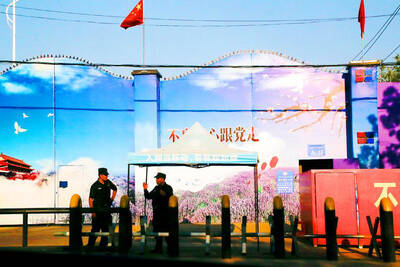
XINJIANG: Officials are conducting a report into amending an existing law or to enact a special law to prohibit goods using forced labor Taiwan is mulling an amendment prohibiting the importation of goods using forced labor, similar to the Uyghur Forced Labor Prevention Act (UFLPA) passed by the US Congress in 2021 that imposed limits on goods produced using forced labor in China’s Xinjiang region. A government official who wished to remain anonymous said yesterday that as the US customs law explicitly prohibits the importation of goods made using forced labor, in 2021 it passed the specialized UFLPA to limit the importation of cotton and other goods from China’s Xinjiang Uyghur region. Taiwan does not have the legal basis to prohibit the importation of goods


 RSS
RSS