


The "commercialization" of cross-border marriages in Taiwan is contributing to human rights abuses, according to academics and Taiwan Solidarity Union (TSU) Legislator Lai Shin-yuan (賴幸媛).
With fewer Taiwanese women willing to marry, Taiwanese men have turned to local matchmaking companies to broker marriages for them with women from Southeast Asia.
The high demand for "submissive" wives from developing countries has created an industry that puts profit ahead of foreign brides' rights, Lai said.
"These matchmaking companies see that there's a profit to be made. So they deceive women overseas in order to get them to enter into a marriage contract," Lai told the Taipei Times in a telephone interview.
So why are so many Taiwanese women refusing to marry?
Marloes Schoonheim, a demographic researcher at Academia Sinica, said that as their socio-economic status is elevated, women tend to focus more on their careers than marriage and family.
Lai said that although the commercialization of the matchmaking industry was fueling human rights abuses, the industry was "here to stay" due to the sheer demand for foreign brides.
"You can't stop it," she said.
She said the government should regulate the market, allowing only non-for-profit non-governmental organizations (NGOs) to broker the marriages.
However, My-nga Le, Director of Policy and Planning at the Taoyuan-based Vietnamese Migrant Workers and Brides Office, disagreed.
Le said that as long as matchmakers' clients are predominantly male, such organizations must cater to certain interests that put women at a disadvantage.
"I don't think it's a good idea for NGOs to get involved in this business," Le said by telephone yesterday, adding that the market for foreign brides was "humongous."
"There are 350,000 foreign brides in Taiwan, accounting for 20 percent of all newly-weds," Le said.
She claimed that matchmaking in Taiwan alone is an NT$8 billion-a-year business.
Melody Lu (呂家紋), a cross-border marriage researcher at the International Institute for Asian Studies in the Netherlands, said that Taiwanese men pay local matchmakers NT$200,000 to pair them with virgin brides from Vietnam.
"Prices also vary according to the women's Mandarin and cooking abilities," Lu said on Wednesday at a conference at Academia Sinica.
She said that Southeast Asian brides usually agree to be "bought" so that they can raise their socio-economic status.
According to Le, such commidification of women breeds conditions in which they are vulnerable to abuse, especially by families who "pay thousands of dollars for a bride and expect certain services in return."
"A lot of these [Vietnamese] women enter into a marriage with a local man and find they are more servants than anything else. And, of course, they're expected to satisfy their husband's sexual requests, or sexually service the men of the household," Le said.
Ministry of the Interior (MOI) spokeswoman Patricia Huang (黃美秀) said that matchmaking was a private matter, but that matchmaking companies cannot operate legally as profit-making businesses.
"We don't collect statistics regarding matchmaking services because of privacy rights," Huang said.
A top ministry official, who spoke on condition of anonymity because she was not authorized to speak to the media, confirmed that providing matchmaking services for profit was illegal, but that such organizations can accept "donations" as long as they don't request payment.
Le said this was just a legal loophole.
"There is always a base price for a foreign bride depending on where she comes from and other criteria," Le said, adding that the widely advertised industry standard was between NT$200,000 and NT$300,000.
"I can't imagine how the cost of taking care of the paperwork involved could be NT$200,000 to NT$300,000, so there is very clearly a profit being made here," Le said, adding that she had never heard of such firms accepting "donations."
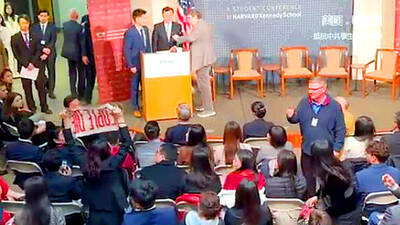
A group of Taiwanese-American and Tibetan-American students at Harvard University on Saturday disrupted Chinese Ambassador to the US Xie Feng’s (謝鋒) speech at the school, accusing him of being responsible for numerous human rights violations. Four students — two Taiwanese Americans and two from Tibet — held up banners inside a conference hall where Xie was delivering a speech at the opening ceremony of the Harvard Kennedy School China Conference 2024. In a video clip provided by the Coalition of Students Resisting the CCP (Chinese Communist Party), Taiwanese-American Cosette Wu (吳亭樺) and Tibetan-American Tsering Yangchen are seen holding banners that together read:

UNAWARE: Many people sit for long hours every day and eat unhealthy foods, putting them at greater risk of developing one of the ‘three highs,’ an expert said More than 30 percent of adults aged 40 or older who underwent a government-funded health exam were unaware they had at least one of the “three highs” — high blood pressure, high blood lipids or high blood sugar, the Health Promotion Administration (HPA) said yesterday. Among adults aged 40 or older who said they did not have any of the “three highs” before taking the health exam, more than 30 percent were found to have at least one of them, Adult Preventive Health Examination Service data from 2022 showed. People with long-term medical conditions such as hypertension or diabetes usually do not
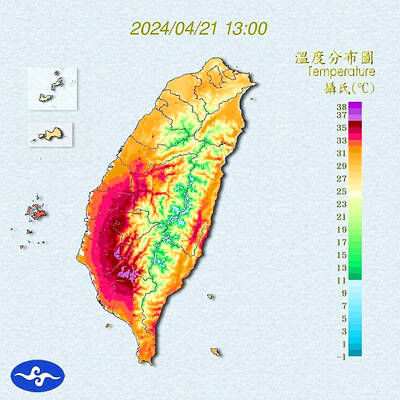
Heat advisories were in effect for nine administrative regions yesterday afternoon as warm southwesterly winds pushed temperatures above 38°C in parts of southern Taiwan, the Central Weather Administration (CWA) said. As of 3:30pm yesterday, Tainan’s Yujing District (玉井) had recorded the day’s highest temperature of 39.7°C, though the measurement will not be included in Taiwan’s official heat records since Yujing is an automatic rather than manually operated weather station, the CWA said. Highs recorded in other areas were 38.7°C in Kaohsiung’s Neimen District (內門), 38.2°C in Chiayi City and 38.1°C in Pingtung’s Sandimen Township (三地門), CWA data showed. The spell of scorching
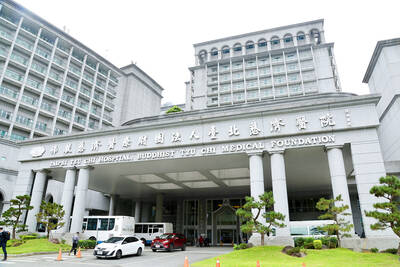
POLICE INVESTIGATING: A man said he quit his job as a nurse at Taipei Tzu Chi Hospital as he had been ‘disgusted’ by the behavior of his colleagues A man yesterday morning wrote online that he had witnessed nurses taking photographs and touching anesthetized patients inappropriately in Taipei Tzu Chi Hospital’s operating theaters. The man surnamed Huang (黃) wrote on the Professional Technology Temple bulletin board that during his six-month stint as a nurse at the hospital, he had seen nurses taking pictures of patients, including of their private parts, after they were anesthetized. Some nurses had also touched patients inappropriately and children were among those photographed, he said. Huang said this “disgusted” him “so much” that “he felt the need to reveal these unethical acts in the operating theater


 RSS
RSS