


For Ron Hsue-ming (
"Whenever we fought, I would grab my Vietnamese-Mandarin dictionary, and he would grab his Mandarin-Vietnamese dictionary, and we would go at it," Ron said.
She added that their method of bickering was so absurd they couldn't keep a straight face, no matter how angry they were.
However, for many other "cross-border couples," communication problems are no laughing matter, Ron said at the three-day Conference on Intermediated Cross-Border Marriages in Asia and Europe, which concluded yesterday at Academia Sinica.
She and other Southeast Asian "foreign brides" shared their experiences of acclimating to Taiwan at the conference.
"Communication is the biggest problem between Vietnamese and Taiwanese spouses," Ron said in fluent Mandarin, adding that the problem was often just as much cultural in nature as linguistic.
Cross-cultural communication in the context of international couples and migration was a major theme of the conference, which drew on the research of experts worldwide.
The timeliness of the conference, organized by the National Science Council and the International Institute for Asian Studies in the Netherlands, was underscored by a recent Ministry of the Interior announcement that one out of every four newly-wed couples in Taiwan this year is a cross-border couple -- meaning that at least one spouse is from another country.
The ministry also announced in a recent press release that it will offer free Mandarin courses to foreign spouses nationwide, and encouraged migrants to contact their county or municipal governments for further details. According to the release, each student will be given NT$500 (US$15) for transportation costs, and free child care services will also be provided.
But some panelists at the conference slammed the ministry for basing its migration policies on allegedly ill-conceived notions of "population quality."
Wang Hong-zen (
"[According to the ministry's] `Migration Policy Guiding Principles' draft released in 2004, skilled professionals and overseas investors are targeted as a `high quality population,' and the government should provide all necessary means to help them [immigrate]," the paper stated, adding that the draft openly excluded "foreign workers, which in Taiwan ... means unskilled guest workers from South Asia," from receiving permanent residence status.
Foreign brides, meanwhile, are valued for their reproductive capabilities amid plummeting fertility rates among native women, the paper added.
Daniele Belanger, a professor of sociology at the University of Western Ontario and a co-author of the paper, wrote that biases behind migration policies were more blatantly expressed by Taiwan Solidarity Union (TSU) Legislator Liao Pen-yan (
Liao was quoted by local media as saying that Vietnamese brides should be tested for Agent Orange before being allowed to give birth in Taiwan.
Liao told the Taipei Times by phone yesterday that he was just expressing his concern for Vietnamese brides, and called on the government to help them because they are an "underprivileged group."
"But too many are entering into fake marriages with Taiwanese men to come over here, and that needs to be stopped," he said.
Agent Orange was a toxic defoliant that the US sprayed on the jungles of Vietnam during the Vietnam War.
Lucy Williams, a University of Kent researcher of migration trends, said at the conference that migrants are often viewed as "pollutants" by the host society, and are thus rejected as the impure "other."
Marloes Schoonheim, an Academia Sinica demographer from the Netherlands, said that members of host societies often fear migrants.
She added that the term "foreign bride" (
The conference's own press release referred to the fact that one out of every 8 newborns in Taiwan is from a cross-border family as a "severe" situation. Vice Minister of the Interior Chien Tai-lang (簡太郎) admitted at the conference's opening ceremony that such wording was inappropriate. Chien added that the government welcomed foreign brides and would continue to help them adjust to their adopted country.
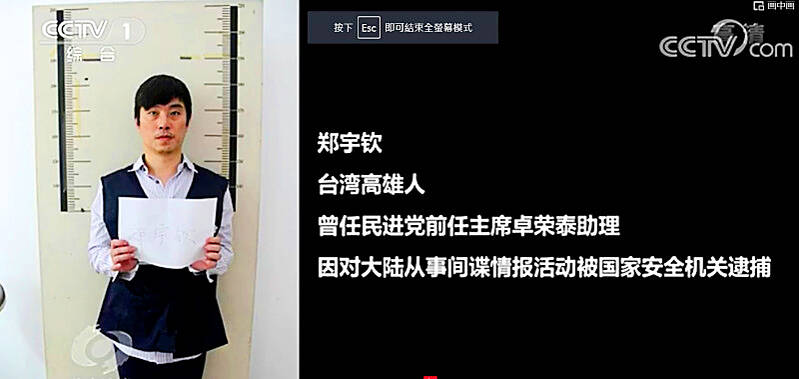
Former Czech Republic-based Taiwanese researcher Cheng Yu-chin (鄭宇欽) has been sentenced to seven years in prison on espionage-related charges, China’s Ministry of State Security announced yesterday. China said Cheng was a spy for Taiwan who “masqueraded as a professor” and that he was previously an assistant to former Cabinet secretary-general Cho Jung-tai (卓榮泰). President-elect William Lai (賴清德) on Wednesday last week announced Cho would be his premier when Lai is inaugurated next month. Today is China’s “National Security Education Day.” The Chinese ministry yesterday released a video online showing arrests over the past 10 years of people alleged to be

THE HAWAII FACTOR: While a 1965 opinion said an attack on Hawaii would not trigger Article 5, the text of the treaty suggests the state is covered, the report says NATO could be drawn into a conflict in the Taiwan Strait if Chinese forces attacked the US mainland or Hawaii, a NATO Defense College report published on Monday says. The report, written by James Lee, an assistant research fellow at Academia Sinica’s Institute of European and American Studies, states that under certain conditions a Taiwan contingency could trigger Article 5 of NATO, under which an attack against any member of the alliance is considered an attack against all members, necessitating a response. Article 6 of the North Atlantic Treaty specifies that an armed attack in the territory of any member in Europe,
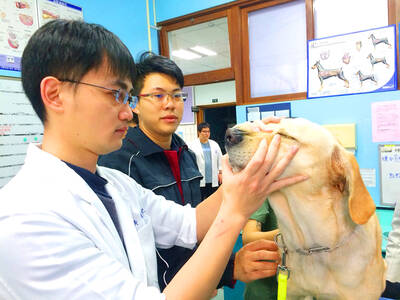
LIKE FAMILY: People now treat dogs and cats as family members. They receive the same medical treatments and tests as humans do, a veterinary association official said The number of pet dogs and cats in Taiwan has officially outnumbered the number of human newborns last year, data from the Ministry of Agriculture’s pet registration information system showed. As of last year, Taiwan had 94,544 registered pet dogs and 137,652 pet cats, the data showed. By contrast, 135,571 babies were born last year. Demand for medical care for pet animals has also risen. As of Feb. 29, there were 5,773 veterinarians in Taiwan, 3,993 of whom were for pet animals, statistics from the Animal and Plant Health Inspection Agency showed. In 2022, the nation had 3,077 pediatricians. As of last

XINJIANG: Officials are conducting a report into amending an existing law or to enact a special law to prohibit goods using forced labor Taiwan is mulling an amendment prohibiting the importation of goods using forced labor, similar to the Uyghur Forced Labor Prevention Act (UFLPA) passed by the US Congress in 2021 that imposed limits on goods produced using forced labor in China’s Xinjiang region. A government official who wished to remain anonymous said yesterday that as the US customs law explicitly prohibits the importation of goods made using forced labor, in 2021 it passed the specialized UFLPA to limit the importation of cotton and other goods from China’s Xinjiang Uyghur region. Taiwan does not have the legal basis to prohibit the importation of goods


 RSS
RSS