


Media watchers responded warily to the announcement by the National Communications Com-mission (NCC) last week that it would amend relevant laws in order to better regulate "cut-ins" -- subtitles running down the sides of television screens during broadcasts.
Television stations nowadays frequently run cut-ins from the top to bottom or left to right of the screen, which the commission said clutters TV screens and confuses many viewers.
But Wu Wen-long (
Wu said while some viewers may be disoriented when seeing so many separate news feeds on the screen, others may appreciate the cut-ins because they can absorb diversified news content, both video footage and subtitles, in a short period of time.
The commission needs to take the interests of both types of viewers into consideration, he said.
"If [the commission] holds on to outdated broadcasting concepts and negates the value of news content that can be presented by more than one image or a single cut-in, [the amendments] would actually lead the country backward," Wu said.
Wu noted that major international TV news stations such as CNN, BBC, FOX and Bloomberg, use sub-screens or cut-in subtitles to provide updated news coverage. Moreover, their subtitles often point to more in-depth coverage on their respective Web sites, which could appeal to viewers interested in learning more.
"Both the government and network operators have to change their concepts in the multimedia age," he said. "On the government's side, it needs to facilitate the process of digital convergence and encourage innovation."
Last week, after holding seminars with media experts and receiving complaints from viewers, the commission decided to amend the Broadcasting and Television Law (廣播電視法), the Cable Television Law (有線電視法) and the Satellite Broadcasting Law (衛星廣播電視法) regarding the use of subtitles.
"Consumers have complained that subtitles occupy too much space on the screen and feel that their interests have not been taken into account," said Huang Ching-yi (黃金益), a spokesman for the commission's contents department.
The amendment will define clearly the conditions under which cut-ins can be used and specify how they should be run on TV screens.
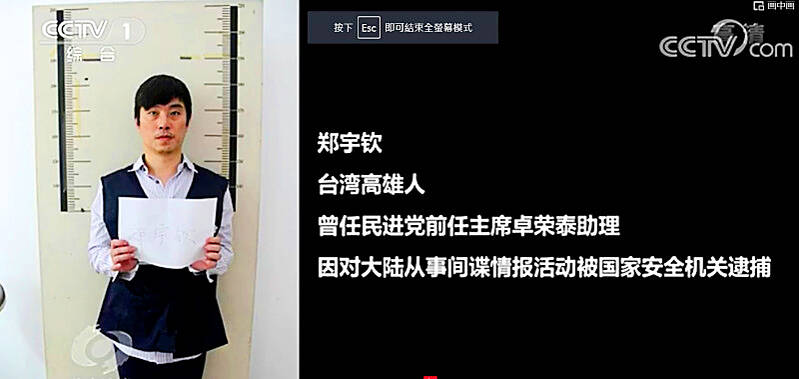
Former Czech Republic-based Taiwanese researcher Cheng Yu-chin (鄭宇欽) has been sentenced to seven years in prison on espionage-related charges, China’s Ministry of State Security announced yesterday. China said Cheng was a spy for Taiwan who “masqueraded as a professor” and that he was previously an assistant to former Cabinet secretary-general Cho Jung-tai (卓榮泰). President-elect William Lai (賴清德) on Wednesday last week announced Cho would be his premier when Lai is inaugurated next month. Today is China’s “National Security Education Day.” The Chinese ministry yesterday released a video online showing arrests over the past 10 years of people alleged to be
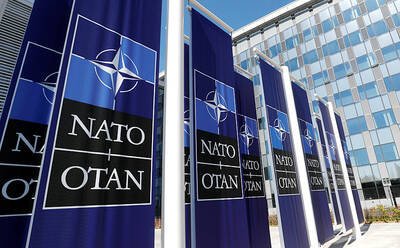
THE HAWAII FACTOR: While a 1965 opinion said an attack on Hawaii would not trigger Article 5, the text of the treaty suggests the state is covered, the report says NATO could be drawn into a conflict in the Taiwan Strait if Chinese forces attacked the US mainland or Hawaii, a NATO Defense College report published on Monday says. The report, written by James Lee, an assistant research fellow at Academia Sinica’s Institute of European and American Studies, states that under certain conditions a Taiwan contingency could trigger Article 5 of NATO, under which an attack against any member of the alliance is considered an attack against all members, necessitating a response. Article 6 of the North Atlantic Treaty specifies that an armed attack in the territory of any member in Europe,

LIKE FAMILY: People now treat dogs and cats as family members. They receive the same medical treatments and tests as humans do, a veterinary association official said The number of pet dogs and cats in Taiwan has officially outnumbered the number of human newborns last year, data from the Ministry of Agriculture’s pet registration information system showed. As of last year, Taiwan had 94,544 registered pet dogs and 137,652 pet cats, the data showed. By contrast, 135,571 babies were born last year. Demand for medical care for pet animals has also risen. As of Feb. 29, there were 5,773 veterinarians in Taiwan, 3,993 of whom were for pet animals, statistics from the Animal and Plant Health Inspection Agency showed. In 2022, the nation had 3,077 pediatricians. As of last

XINJIANG: Officials are conducting a report into amending an existing law or to enact a special law to prohibit goods using forced labor Taiwan is mulling an amendment prohibiting the importation of goods using forced labor, similar to the Uyghur Forced Labor Prevention Act (UFLPA) passed by the US Congress in 2021 that imposed limits on goods produced using forced labor in China’s Xinjiang region. A government official who wished to remain anonymous said yesterday that as the US customs law explicitly prohibits the importation of goods made using forced labor, in 2021 it passed the specialized UFLPA to limit the importation of cotton and other goods from China’s Xinjiang Uyghur region. Taiwan does not have the legal basis to prohibit the importation of goods


 RSS
RSS