


With lower rates and a service that covers 90 percent of Taipei's population, Wifly -- the wireless service launched by Taipei City Government -- yesterday announced that the whole city is now wireless.
In addition to MRT stations, Starbucks coffee shops, municipal hospitals and libraries, the public can also now enjoy Wifly in more than 600 7-Eleven convenience stores around the city, according to Jason Lin (林蒼生), president of the Q-ware Systems and Services Corp, the contractor of the Wifly project.
Calling Taipei County Commissioner Chou Hsi-wei (周錫瑋) using Wifly's Internet phone feature, Taipei Mayor Ma Ying-jeou (馬英九) encouraged Taipei residents to "frequent the Net, and free up the road."
"This city-wide wireless project is the first in the world, and required a lot of courage, but we did it," Ma said during a press conference held at a 7-Eleven.
extended coverage
According to 7-Eleven, plans are in the offing to extend coverage of Wifly service to all of its 4,000 stores nationwide by the end of this year.
The wireless initiative began with free trials in September 2004 and is part of the government's "M-City" (mobile city) project, which aims to turn Taipei into a wireless city. Total investment in the project now stands at more than NT$1 billion (US$30.6 million).
Despite its high coverage rate, only 50,000 of Taipei's 2.6 million residents have signed up to the service since January.
"I've never used the service ? I think it's convenient, but I did not use it before," Wen Chun-wei (溫純葳), a college student who attended the press conference to get a free Wifly card, told the Taipei Times.
To attract more users, Wifly is introducing lower price rates, such as a seven-day card for NT$200 and a 110-minute card for NT$99.
dual-mode handset
Meanwhile, to boost its user base, Q-ware Systems and Services Corp will introduce a dual-mode handset by the fourth quarter.
The company is currently in talks with the US' UT Starcom Inc, Taiwan's Wistron NeWeb Corp and Ambit Microsystems Inc, and will select one supplier for its first dual-mode phone soon, according to Chang Sheng (張聖), vice president of the company's wireless business group.
"Voice service is the main attraction to users on Wifly, as they all want to enjoy cheaper rates," he said.
Dual-mode phones can work on both the ordinary second-generation (2G) and Wi-Fi, or wireless, networks. Users can switch to the Wi-Fi mode when they are covered by the Internet.
The company, which has pumped more than NT$1 billion into Wifly, hopes to break even by the end of next year, Chang said.

Former president Ma Ying-jeou’s (馬英九) mention of Taiwan’s official name during a meeting with Chinese President Xi Jinping (習近平) on Wednesday was likely a deliberate political play, academics said. “As I see it, it was intentional,” National Chengchi University Graduate Institute of East Asian Studies professor Wang Hsin-hsien (王信賢) said of Ma’s initial use of the “Republic of China” (ROC) to refer to the wider concept of “the Chinese nation.” Ma quickly corrected himself, and his office later described his use of the two similar-sounding yet politically distinct terms as “purely a gaffe.” Given Ma was reading from a script, the supposed slipup
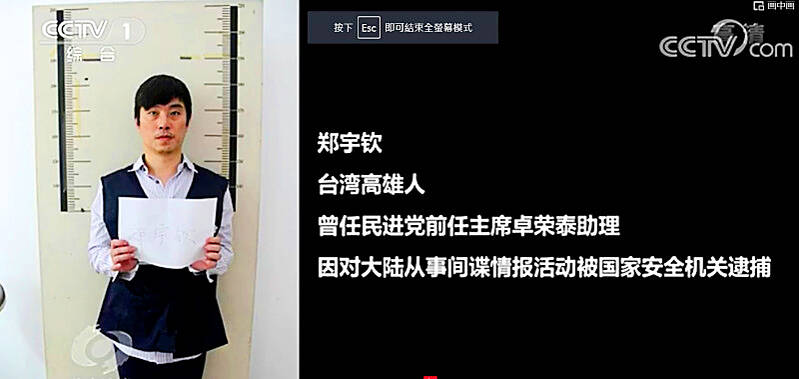
Former Czech Republic-based Taiwanese researcher Cheng Yu-chin (鄭宇欽) has been sentenced to seven years in prison on espionage-related charges, China’s Ministry of State Security announced yesterday. China said Cheng was a spy for Taiwan who “masqueraded as a professor” and that he was previously an assistant to former Cabinet secretary-general Cho Jung-tai (卓榮泰). President-elect William Lai (賴清德) on Wednesday last week announced Cho would be his premier when Lai is inaugurated next month. Today is China’s “National Security Education Day.” The Chinese ministry yesterday released a video online showing arrests over the past 10 years of people alleged to be
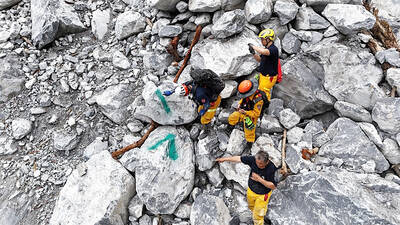
The bodies of two individuals were recovered and three additional bodies were discovered on the Shakadang Trail (砂卡礑) in Taroko National Park, eight days after the devastating earthquake in Hualien County, search-and-rescue personnel said. The rescuers reported that they retrieved the bodies of a man and a girl, suspected to be the father and daughter from the Yu (游) family, 500m from the entrance of the trail on Wednesday. The rescue team added that despite the discovery of the two bodies on Friday last week, they had been unable to retrieve them until Wednesday due to the heavy equipment needed to lift
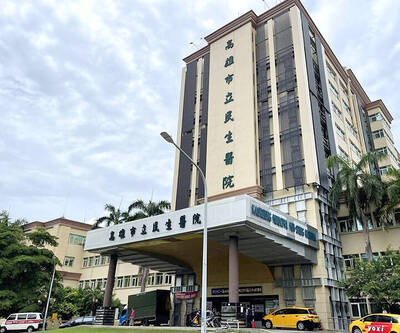
MIX-UP: Kaohsiung Municipal Min-Sheng Hospital director Yen Chia-chi was suspended from his duties after surgeons operated on the wrong patient last week The Kaohsiung Department of Health yesterday fined Kaohsiung Municipal Min-Sheng Hospital NT$500,0000 for misidentifying two patients and consequently causing one of them to undergo the wrong surgery last week. The hospital’s director Yen Chia-chi (顏家祺) was suspended from his duties. The surgeon who was scheduled to operate on the patient was given a major demerit and is subject to subsequent disciplinary actions. Demerits were given to the anesthesiologist, the nurse in the operation room, the nurse in the ward and the worker who helped transfer the patient from the ward to the operation room for having failed to verify the patient’s identity. Meanwhile, the


 RSS
RSS