


As China turns the screws on the dwindling number of countries that recognize Taiwan, the Chen Shui-bian (
The first annual Taiwan-Pacific Allies Summit in Palau is a perfect example. Chen on Sunday led a delegation to attend the one-day event in Palau. The nation and its six Pacific allies inked the Palau Declaration and agreed to pursue four goals highlighted in the Pacific Plan, as adopted by leaders at the 36th Pacific Islands Forum held in Papua New Guinea in October last year.
The four goals are economic growth, sustainable development, good governance and security. To that end, the allies agreed to enhance cooperation in the areas of economic development, capacity building, and society and culture.
They also acknowledged Taiwan as a sovereign nation whose right to participate in international organizations cannot be denied and agreed to support Taiwan's achievements in political democratization and economic development.
Since Chinese Premier Wen Jiabao (
Substance
Lin Chen-wei (
"It is meaningless to talk about money, although it would be easy to give you a figure if all we wanted to do here was to randomly throw money away," he said. "The annual budget of the Ministry of Foreign Affairs is NT$28 billion (US$875 million) and it would be impossible for them to put all of their eggs in one basket. Besides, the legislature would not allow them to do that."
The competition between China and Taiwan for recognition in the Pacific has worried analysts in the region, who fear it could increase political instability.
Impoverished island countries have swapped their allegiance between Beijing and Taipei over the years and have been adept at playing the two off against each other, winning handsome aid packages.
There have also been accusations that local politicians have been bribed for their support.
Analyzing the nation's diplomatic strategy, Lin said that the administration used to focus too much on the sovereignty issue and tended to ignore what the nation could do for its allies.
"What matters is not what we can get in return, but what we can do for them," he said. "There are various ways of conducting diplomatic work: leader diplomacy, public diplomacy, energy diplomacy and of course, checkbook diplomacy."
Despite China's relentless efforts to lure away Taiwan's diplomatic allies, Lin said he remains "hopelessly upbeat" about the nation's diplomatic prospects because Taiwan has more to offer than just money.
Criticism
Former senior presidential adviser Koo Kwang-ming (
"They are not poor countries because they have ample oceanic resources," he said.
Koo, who invested in the Marshal Islands' fishing industry, said that it would be more practical for the Chen administration to help its allies become self-reliant, instead of just giving them money.
"Our allies are like people who own a movie theater and live off the ticket sales, while Hollywood makes the big bucks," Koo said.
As the nation has impressive foreign reserves, Koo said the administration might want to consider spending some of that money on helping its diplomatic allies to stand on their own feet.
Commenting on the anti-Chen campaign initiated by former Democratic Progressive Party chairman Shih Ming-teh (
"But do you think it's possible [that Chen would be forced to resign]? Do you think people want instability? I personally don't think so," he said. "Shih said that he has written his will. If he ends up dead, I'd be happy to go to his funeral and burn incense."
While Koo's sister-in-law Cecilia Koo (
"She should have known the kind of ripple effect [her comments] would create," he said, adding that the family of his late brother, Koo Chen-fu (
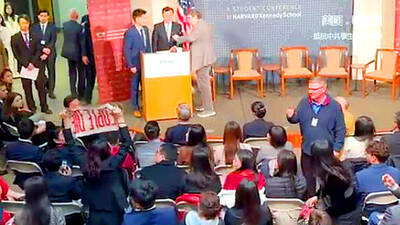
A group of Taiwanese-American and Tibetan-American students at Harvard University on Saturday disrupted Chinese Ambassador to the US Xie Feng’s (謝鋒) speech at the school, accusing him of being responsible for numerous human rights violations. Four students — two Taiwanese Americans and two from Tibet — held up banners inside a conference hall where Xie was delivering a speech at the opening ceremony of the Harvard Kennedy School China Conference 2024. In a video clip provided by the Coalition of Students Resisting the CCP (Chinese Communist Party), Taiwanese-American Cosette Wu (吳亭樺) and Tibetan-American Tsering Yangchen are seen holding banners that together read:

UNAWARE: Many people sit for long hours every day and eat unhealthy foods, putting them at greater risk of developing one of the ‘three highs,’ an expert said More than 30 percent of adults aged 40 or older who underwent a government-funded health exam were unaware they had at least one of the “three highs” — high blood pressure, high blood lipids or high blood sugar, the Health Promotion Administration (HPA) said yesterday. Among adults aged 40 or older who said they did not have any of the “three highs” before taking the health exam, more than 30 percent were found to have at least one of them, Adult Preventive Health Examination Service data from 2022 showed. People with long-term medical conditions such as hypertension or diabetes usually do not
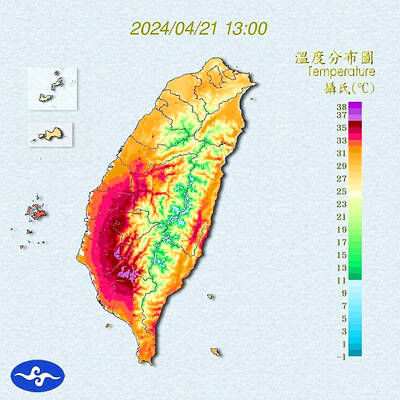
Heat advisories were in effect for nine administrative regions yesterday afternoon as warm southwesterly winds pushed temperatures above 38°C in parts of southern Taiwan, the Central Weather Administration (CWA) said. As of 3:30pm yesterday, Tainan’s Yujing District (玉井) had recorded the day’s highest temperature of 39.7°C, though the measurement will not be included in Taiwan’s official heat records since Yujing is an automatic rather than manually operated weather station, the CWA said. Highs recorded in other areas were 38.7°C in Kaohsiung’s Neimen District (內門), 38.2°C in Chiayi City and 38.1°C in Pingtung’s Sandimen Township (三地門), CWA data showed. The spell of scorching
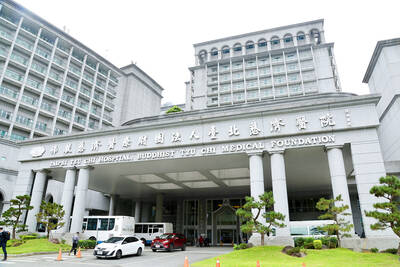
POLICE INVESTIGATING: A man said he quit his job as a nurse at Taipei Tzu Chi Hospital as he had been ‘disgusted’ by the behavior of his colleagues A man yesterday morning wrote online that he had witnessed nurses taking photographs and touching anesthetized patients inappropriately in Taipei Tzu Chi Hospital’s operating theaters. The man surnamed Huang (黃) wrote on the Professional Technology Temple bulletin board that during his six-month stint as a nurse at the hospital, he had seen nurses taking pictures of patients, including of their private parts, after they were anesthetized. Some nurses had also touched patients inappropriately and children were among those photographed, he said. Huang said this “disgusted” him “so much” that “he felt the need to reveal these unethical acts in the operating theater


 RSS
RSS