


The two-day Conference on Sustaining Taiwan's Economic Development ended yesterday without major breakthroughs in cross-strait trade issues, and with mixed reactions from analysts, government officials and business representatives.
Several recommendations for facilitating cross-strait trade did not make it to the conference's "consensus" list -- measures which the government has vowed to push after the forum. Rather, they were put under the category of "other opinions," which means they will be put on hold until government agencies have the time to conduct further studies.
Analysts criticized the "other opinions" list as a stalling tactic that it has no intention of following through. One analyst disagreed, however.
"I am more optimistic about cross-strait relaxation occurring in the next one to two years after the meeting," said Alex Huang (
Huang said that the past two days showed the Cabinet's willigness to include the proposed liberalization measures into the conference's agenda, although those suggestions ended up in the "other opinions" category.
"That meant the Cabinet still wanted to achieve something in this area," Huang said.
The proposed relaxation measures, including direct transportation links and lifting the ceiling on China-bound investments, which is currently capped at 40 percent of listed company's net worth, had originally been removed from the agenda due to the Taiwan Solidarity Union's (TSU) boycott during the preparatory meetings. The removal, however, caused participating industry representatives to twice threaten to quit the conference.
Vice Premier Tsai Ing-wen (
Nevertheless, the much anticipated liberalization of the financial sector, including allowing banks to set up branches and subsidiaries across the Strait and investing in Chinese financial institutions, were moved from the "consensus" list to the "other opinions" category in the face of strong dissent from TSU members.
Huang said that he expected to see the local tourism market opened up to Chinese visitors before the end of the year and regular cross-strait charter flights early next year -- two issues which are already on the to do list.
The analyst, however, is less positive about the outlook for the easing on China-bound investment restrictions and financial institutions' expansion into China, since those issues are far more complicated and controversial.
"It would give investment confidence a big boost if the government were to lift those bans," Huang said.
The conference did pass an array of financial reform proposals, such as reopening licensing for new banks and financial holding firms coupled with a supporting exit mechanism, proposing requirements for financial transparency, reviewing fund sources and corporate governance in mergers and acquisitions activities.
These efforts were not deemed impressive enough, however, as they lack significant solutions to the sector's core issues, said Shirley Yang (
As the lack of any relaxation on cross-strait regulations could deprive local banks of the opportunity to expand in the Chinese market, the conference did little to help enhance the financial sector's competitiveness, Yang said.
As for tax and land issues, business leaders expressed disappointment while government officials appeared upbeat about conclusions reached at the meeting.
One of the major setbacks for enterprises was their failure to make the Ministry of Finance defer, if not waive, the 10 percent business income tax on companies' undistributed surplus earnings.
Their recommendation, which was recognized in the preparatory meetings -- that undistributed surplus earnings can be reserved for two years, instead of the current one year before the tax is levied -- faced disapproval from delegates on Thursday.
This means that everything returns to the starting point, said finance minister Ho Chih-chin (
Ho said that the finance ministry would study the best possible solution by reviewing the unified tax system and the Statute for Upgrading Industries (
Wang Ying-chieh (
"Like five years ago during the Economic Development Advisory Conference, the proposal to halve the incremental land tax did not gain 100 percent support from the participants, but the government still implemented the policy afterwards," he said during a phone interview.
Timothy Ma (
“Parcels of large-sized land must be effectively developed to improve a
city's landscape and residential environment. If you just reserve them, it
does nothing good for the people,” he said.
Ma said that the government could set restrictions when offering state land
for auction, such as the type of the building that could be constructed or
social benefits that the developer could provide.
Su Wei-chen (蘇維成), deputy director-general of the National Property
Bureau, said that the summit's conclusions would have little impact on how
the bureau disposes of state land.
“We'll evaluate land development projects on a case-by-case basis. If the
government authorities find it imperative to exploit state land, such as the
tourism bureau's plan to establish more three-star hotels, we'll lease out
land for private companies to develop,” he said.
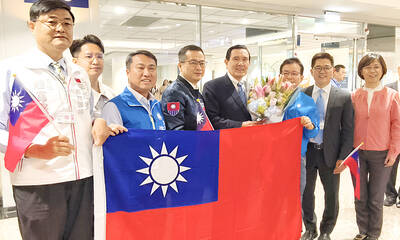
Former president Ma Ying-jeou’s (馬英九) mention of Taiwan’s official name during a meeting with Chinese President Xi Jinping (習近平) on Wednesday was likely a deliberate political play, academics said. “As I see it, it was intentional,” National Chengchi University Graduate Institute of East Asian Studies professor Wang Hsin-hsien (王信賢) said of Ma’s initial use of the “Republic of China” (ROC) to refer to the wider concept of “the Chinese nation.” Ma quickly corrected himself, and his office later described his use of the two similar-sounding yet politically distinct terms as “purely a gaffe.” Given Ma was reading from a script, the supposed slipup
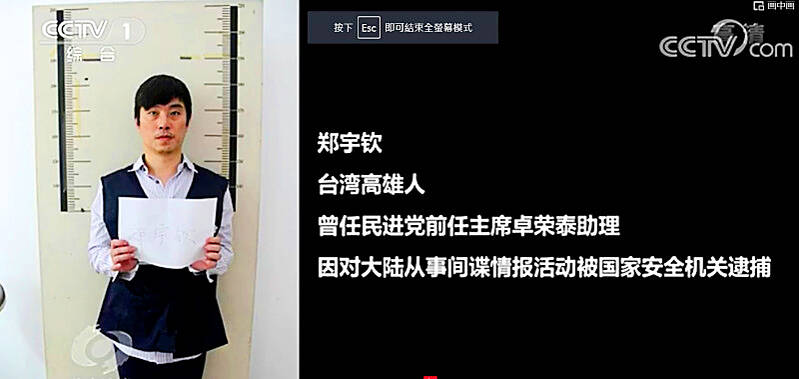
Former Czech Republic-based Taiwanese researcher Cheng Yu-chin (鄭宇欽) has been sentenced to seven years in prison on espionage-related charges, China’s Ministry of State Security announced yesterday. China said Cheng was a spy for Taiwan who “masqueraded as a professor” and that he was previously an assistant to former Cabinet secretary-general Cho Jung-tai (卓榮泰). President-elect William Lai (賴清德) on Wednesday last week announced Cho would be his premier when Lai is inaugurated next month. Today is China’s “National Security Education Day.” The Chinese ministry yesterday released a video online showing arrests over the past 10 years of people alleged to be
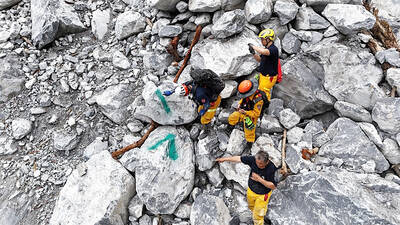
The bodies of two individuals were recovered and three additional bodies were discovered on the Shakadang Trail (砂卡礑) in Taroko National Park, eight days after the devastating earthquake in Hualien County, search-and-rescue personnel said. The rescuers reported that they retrieved the bodies of a man and a girl, suspected to be the father and daughter from the Yu (游) family, 500m from the entrance of the trail on Wednesday. The rescue team added that despite the discovery of the two bodies on Friday last week, they had been unable to retrieve them until Wednesday due to the heavy equipment needed to lift
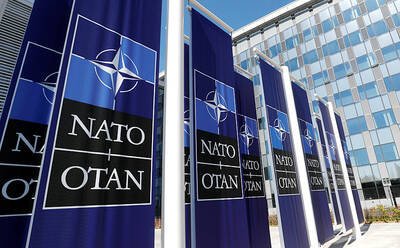
THE HAWAII FACTOR: While a 1965 opinion said an attack on Hawaii would not trigger Article 5, the text of the treaty suggests the state is covered, the report says NATO could be drawn into a conflict in the Taiwan Strait if Chinese forces attacked the US mainland or Hawaii, a NATO Defense College report published on Monday says. The report, written by James Lee, an assistant research fellow at Academia Sinica’s Institute of European and American Studies, states that under certain conditions a Taiwan contingency could trigger Article 5 of NATO, under which an attack against any member of the alliance is considered an attack against all members, necessitating a response. Article 6 of the North Atlantic Treaty specifies that an armed attack in the territory of any member in Europe,


 RSS
RSS