


Taiwan has set a target of becoming a "green value-added island" with an annual average economic growth rate of 5 percent, per capita GDP of US$30,000 and an unemployment rate of below 4 percent by 2015, according to a consensus reached at the industry panel of the Conference on Sustaining Taiwan's Economic Development yesterday.
To achieve these goals, industries should employ world-class talent, form a global network and establish global brands, Ho Mei-yueh (何美玥), a minister without portfolio and convener of the panel, said.
Last year, Taiwan reported an economic growth rate of 4.09 percent, per capita GDP of US$15,271 and a jobless rate of 4.13 percent, according to government statistics.
The government will also continue to promote industrial restructuring, with the service sector accounting for 76.5 percent of the nation's GDP in 2015, up from 73.56 percent last year, Ho said.
Although the goals set by the panel seem to paint a bright future for the economy, participants failed to resolve disputes on key issues.
"We are not satisfied with the conference, but there is nothing we can do but accept it," said Gary Wang (王令麟), chairman of the General Chamber of Commerce.
One major issue that was discussed intensively during the meeting is whether the Statute for Upgrading Industries (
Some representatives suggested that the statute be extended as it was a vital tool for encouraging investment, while some advocated that it be terminated to maintain an equitable taxation system.
Opponents of the statute's extension noted in particular that the tax break should be canceled for projects that are deemed harmful to the environment, such as Formosa Petrochemical Corp's eighth naphtha cracker and the new Kuo Kuang Petrochemical Technology Corp.
The participants also failed to reach an agreement on the tax on companies' undistributed surplus earnings. In preparatory meetings, the industry panel favored giving a grace period of two years before a 10 percent business income tax is levied on companies' undistributed surplus earnings, but some industry representatives yesterday urged that the tax be waived.
With no consensus on the two disputes, Vincent Siew (蕭萬長), head of the Chung-Hua Institution for Economic Research (中經院) who chaired the meeting, ruled that the two issues be listed under "other opinions," leaving the policy to government authorities.
As for environmental issues, the participants agreed to control green- house gas emissions, but failed to set a target volume for reduction or propose any concrete measure to achieve this goal.
"The conference is useless, as all the key issues we hope to sort out here were either not put into the agenda or ended up in disagreement," a participant said on condition of anonymity.
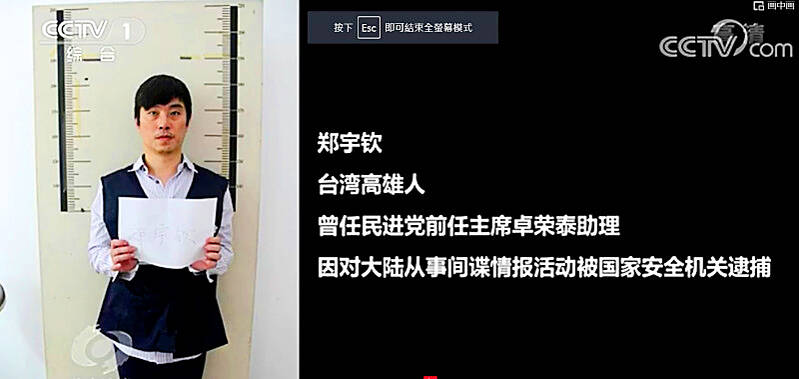
Former Czech Republic-based Taiwanese researcher Cheng Yu-chin (鄭宇欽) has been sentenced to seven years in prison on espionage-related charges, China’s Ministry of State Security announced yesterday. China said Cheng was a spy for Taiwan who “masqueraded as a professor” and that he was previously an assistant to former Cabinet secretary-general Cho Jung-tai (卓榮泰). President-elect William Lai (賴清德) on Wednesday last week announced Cho would be his premier when Lai is inaugurated next month. Today is China’s “National Security Education Day.” The Chinese ministry yesterday released a video online showing arrests over the past 10 years of people alleged to be
THE HAWAII FACTOR: While a 1965 opinion said an attack on Hawaii would not trigger Article 5, the text of the treaty suggests the state is covered, the report says NATO could be drawn into a conflict in the Taiwan Strait if Chinese forces attacked the US mainland or Hawaii, a NATO Defense College report published on Monday says. The report, written by James Lee, an assistant research fellow at Academia Sinica’s Institute of European and American Studies, states that under certain conditions a Taiwan contingency could trigger Article 5 of NATO, under which an attack against any member of the alliance is considered an attack against all members, necessitating a response. Article 6 of the North Atlantic Treaty specifies that an armed attack in the territory of any member in Europe,
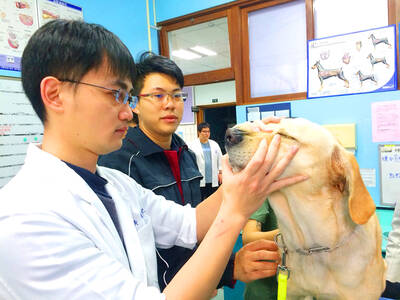
LIKE FAMILY: People now treat dogs and cats as family members. They receive the same medical treatments and tests as humans do, a veterinary association official said The number of pet dogs and cats in Taiwan has officially outnumbered the number of human newborns last year, data from the Ministry of Agriculture’s pet registration information system showed. As of last year, Taiwan had 94,544 registered pet dogs and 137,652 pet cats, the data showed. By contrast, 135,571 babies were born last year. Demand for medical care for pet animals has also risen. As of Feb. 29, there were 5,773 veterinarians in Taiwan, 3,993 of whom were for pet animals, statistics from the Animal and Plant Health Inspection Agency showed. In 2022, the nation had 3,077 pediatricians. As of last

XINJIANG: Officials are conducting a report into amending an existing law or to enact a special law to prohibit goods using forced labor Taiwan is mulling an amendment prohibiting the importation of goods using forced labor, similar to the Uyghur Forced Labor Prevention Act (UFLPA) passed by the US Congress in 2021 that imposed limits on goods produced using forced labor in China’s Xinjiang region. A government official who wished to remain anonymous said yesterday that as the US customs law explicitly prohibits the importation of goods made using forced labor, in 2021 it passed the specialized UFLPA to limit the importation of cotton and other goods from China’s Xinjiang Uyghur region. Taiwan does not have the legal basis to prohibit the importation of goods


 RSS
RSS