


The Democratic Progressive Party's (DPP) legislative caucus said yesterday that it objected to DPP Chairman Yu Shyi-kun's proposal to create a facilitation platform to coordinate opinions between the party and the government, and warned that it would cause "disaster" if the DPP dissolved its factions.
DPP legislative caucus whip Ker Chien-ming (
"The plan is unlikely to be implemented and I do not think the DPP's national convention will pass it," Ker said.
In a response to a call made by certain pan-green academics for the president to step down, the DPP is planning to turn its weekly Central Standing Committee meeting into a communication channel for officials from the Presidential Office, Executive Yuan, Legislative Yuan and the DPP, and also a platform for policy or personnel changes initiated by the Executive Yuan.
Old habits
Ker said application of the "collective leadership" model, particularly as it applies to the central government's personnel arrangements, would make people feel that the DPP had gone back to its old habit of letting "the party lead the government." Ker said this method of government was typical of the Chinese Nationalist Party (KMT) when it was in power, and added that the right to appoint governmental officials should belong to the president and premier. It was inappropriate for the party or caucus to become involved in such matters, he said.
Tuan confirmed yesterday afternoon during a news conference that the idea for a "collective discussion mechanism" came from the New Tide Faction, and said the proposal was designed to place limits on the president's authority in light of his flagging popularity.
"We hope the Central Standing Committee meeting can become a buffer that limits President Chen Shui-bian's (
In reaction to Ker and Tuan's remarks, DPP spokesman Tsai Huang-liang (
He said that it was intended to allow the party and the government to "discuss policy-making jointly and cooperate with each other."
Tsai said that the mechanism would not justify accusations that the party was seeking to "lead the government," and that the DPP remained opposed to having personnel decisions make in the party's Central Standing Committee.
Joint responsibility
Tsai said the "collective discussion mechanism" was proposed to enable the party and the government to take joint responsibility for decisions made, and that the party had no intention of usurping the government's authority.
Meanwhile, Ker yesterday also warned that it would cause "disaster" if the DPP insisted on dissolving the party's factions. He urged Yu to think twice about the proposal to this end that is on agenda of the party's national convention to be held this weekend.
Meanwhile, regarding a possible tip in the balance of power toward the DPP that might arise from introducing the "collective discussion mechanism," the Cabinet yesterday said that it was impossible for the government to entertain an unconstitutional proposal.
"Taiwan is a democratic country. The Cabinet is under the protection of the Constitution. No political party can override the Constitution," Government Information Office Minister and Cabinet Spokesman Cheng Wen-tsang (鄭文燦) said. "And the government should not do anything that is against the Constitution."
Cheng made the comments during a press conference yesterday after the weekly Cabinet meeting. He was asked for comments on the idea that future government personnel decisions would have to be approved by the DPP's Central Standing Committee.
The spokesman said that the proposal had not been implemented yet and that the Cabinet would not comment on it. He added that the DPP government would not emulate the practices of the KMT.
"It took us a long time to turn [the party-state model] upside down. It is impossible for us to repeat the mistake," Cheng said.

Former president Ma Ying-jeou’s (馬英九) mention of Taiwan’s official name during a meeting with Chinese President Xi Jinping (習近平) on Wednesday was likely a deliberate political play, academics said. “As I see it, it was intentional,” National Chengchi University Graduate Institute of East Asian Studies professor Wang Hsin-hsien (王信賢) said of Ma’s initial use of the “Republic of China” (ROC) to refer to the wider concept of “the Chinese nation.” Ma quickly corrected himself, and his office later described his use of the two similar-sounding yet politically distinct terms as “purely a gaffe.” Given Ma was reading from a script, the supposed slipup
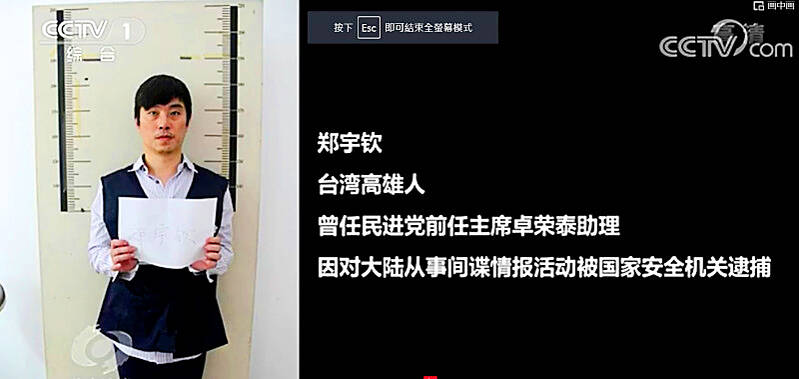
Former Czech Republic-based Taiwanese researcher Cheng Yu-chin (鄭宇欽) has been sentenced to seven years in prison on espionage-related charges, China’s Ministry of State Security announced yesterday. China said Cheng was a spy for Taiwan who “masqueraded as a professor” and that he was previously an assistant to former Cabinet secretary-general Cho Jung-tai (卓榮泰). President-elect William Lai (賴清德) on Wednesday last week announced Cho would be his premier when Lai is inaugurated next month. Today is China’s “National Security Education Day.” The Chinese ministry yesterday released a video online showing arrests over the past 10 years of people alleged to be
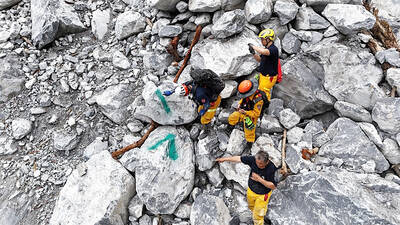
The bodies of two individuals were recovered and three additional bodies were discovered on the Shakadang Trail (砂卡礑) in Taroko National Park, eight days after the devastating earthquake in Hualien County, search-and-rescue personnel said. The rescuers reported that they retrieved the bodies of a man and a girl, suspected to be the father and daughter from the Yu (游) family, 500m from the entrance of the trail on Wednesday. The rescue team added that despite the discovery of the two bodies on Friday last week, they had been unable to retrieve them until Wednesday due to the heavy equipment needed to lift

MIX-UP: Kaohsiung Municipal Min-Sheng Hospital director Yen Chia-chi was suspended from his duties after surgeons operated on the wrong patient last week The Kaohsiung Department of Health yesterday fined Kaohsiung Municipal Min-Sheng Hospital NT$500,0000 for misidentifying two patients and consequently causing one of them to undergo the wrong surgery last week. The hospital’s director Yen Chia-chi (顏家祺) was suspended from his duties. The surgeon who was scheduled to operate on the patient was given a major demerit and is subject to subsequent disciplinary actions. Demerits were given to the anesthesiologist, the nurse in the operation room, the nurse in the ward and the worker who helped transfer the patient from the ward to the operation room for having failed to verify the patient’s identity. Meanwhile, the


 RSS
RSS