


Taiwan-US ties are "stabilizing."
That seems to be the word of choice as officials and observers try to categorize the current state of play in the relationship between Washington and Taipei.
What that means is that Taiwan-watchers in Washington generally agree that President Chen Shui-bian (
"The common wisdom now is that he [Chen] is going to be quiet, understated and careful, and on the defensive, that the Taiwan issue is going to go on the back burner, and that [Chen's] domestic political problems will actually turn out to cramp his style," said one clued-in observer, who wished not to be identified.
This is at odds with statements by officials in the administration, who contend that the US wishes Chen to remain a strong leader.
With the US bogged down in Iraq, facing daunting challenges from Iran and North Korea, and unpopular in much of the world, Washington sorely needs China's cooperation at every turn.
So it is no surprise that when forced to choose between Beijing and Taiwan on any issue, the tendency in Washington is to lean toward Beijing, and hope that developments in Taiwan do not upset the apple cart.
But beyond that lies the question of who, exactly, makes US policy toward Taiwan. The answer is, a group of human beings with their own beliefs, prejudices and egos, who often do not operate in an optimal way.
Some analysts interviewed by the Taipei Times have talked about a "dysfunctional" US policy toward Taiwan as a result of turf battles, ineffective communication and snap judgments.
The situation this year has been exacerbated by the fact that most of the real experts on China and Taiwan who populated the Bush administration in the past have now left or are about to leave.
Gone from the administration are such experts as Richard Armitage and Robert Zoellick, former deputy secretaries of state with deep understanding of the region; deputy assistant secretary Randy Schriver; assistant secretary James Kelly; National Security Council Asia chief Michael Green; his predecessor James Moriarty; American Institute in Taiwan chairwoman Therese Shaheen, a big Taiwan supporter; and Stephen Yates, Vice President Richard Cheney's former Asia specialist with a close affinity to Taiwan (he now is a Taiwan lobbyist).
Now, the people making Taiwan policy are, by and large, Dennis Wilder at the National Security Council, Deputy Assistant Secretary of State James Keith and his boss, Assistant Secretary Christopher Hill.
But Hill has been consumed with the six-party talks on North Korea, which has diverted his attention to such issues as China and Taiwan, and Keith is just about to leave.
That leaves Wilder, who was the administration's envoy earlier this year when Chen made his statement about doing away with the National Unification Council (NUC) and guidelines. While Wilder was earlier seen as a pro-Beijing official, he has become, according to sources, one of Taiwan's biggest defenders in the administration.
He has urged a policy of "balance" on Taiwan over the past several months, and has opposed what sources describe as a "traditional Sino-centric focus" at the State Department, which seeks to emphasize the need for better ties with Beijing.
Over the past three years US policy has been hampered by inter-agency conflicts and, for most of the time, a lack of centralized policy making.
In the early period, former officials say, Moriarty was on one side against Yates and the Pentagon, with Schriver and Armitage generally allied with Moriarty. At the time, Bush, Cheney and then-national security adviser Condoleezza Rice were all frustrated with Chen, but policy-making was hampered by deep divisions among their advisers.
In 2004, Moriarty was replaced by Green, and he and Schriver developed a working relationship that eventually tried to involve all the other policy makers, including Yates and Deputy Assistant Secretary of Defense Richard Lawless, a major Taiwan supporter, in a joint policy process.
Rice agreed to this, and told Bush that the group would coordinate policy. Bush also agreed, sources say, and there was a "fairly collegial" atmosphere among the policy makers.
The main actors in US-Taiwan relations at the time, sources say, were Schriver, Green, Taiwan's representative to Washington, David Lee (李大維) and National Security Council Secretary-General Chiou I-jen (邱義仁).
After Green, Armitage and Schriver left, Wilder, Hill and Keith took their place. And while Green and Schriver had direct access to Lawless and Armitage, their successors do not have such access.
According to some sources, the State Department officials tried to gain control over Taiwan policy. With Rice's successor as national security adviser, Stephen Hadley, relegated to a less powerful role than Rice, Wilder, Keith and Hill "are in a tug of war of who is going to control the policy" toward Taiwan, one source said.
This ended up in a head-to-head fight over Chen's application for a transit visa this spring for a trip to Latin American allies, with Wilder urging for better arrangements for Chen. They reached agreement on a transit stop in San Francisco, with Anchorage, Alaska, as an alternative.
With Rice unaware of the progress the administration specialists made with Taiwan on patching up the NUC tensions, Rice immediately rejected San Francisco "very much on the fly," according to one source.
"She said `Chen Shui-bian. Didn't he just do the NUC thing? Why would we want him to go to San Francisco? No, no, no. Make it Alaska,'" according to the source.
The problem, the source said, was that with everything else occupying her attention, Rice did not know the progress the two sides had made in resolving the NUC fiasco, probably because of the lack of coordination in the administration on Taiwan affairs.

Former president Ma Ying-jeou’s (馬英九) mention of Taiwan’s official name during a meeting with Chinese President Xi Jinping (習近平) on Wednesday was likely a deliberate political play, academics said. “As I see it, it was intentional,” National Chengchi University Graduate Institute of East Asian Studies professor Wang Hsin-hsien (王信賢) said of Ma’s initial use of the “Republic of China” (ROC) to refer to the wider concept of “the Chinese nation.” Ma quickly corrected himself, and his office later described his use of the two similar-sounding yet politically distinct terms as “purely a gaffe.” Given Ma was reading from a script, the supposed slipup
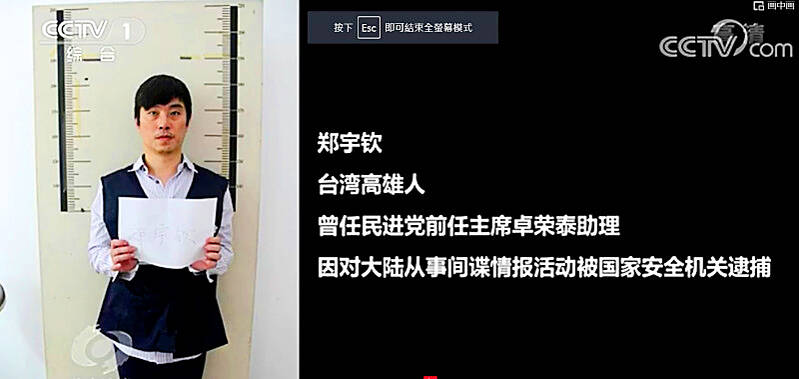
Former Czech Republic-based Taiwanese researcher Cheng Yu-chin (鄭宇欽) has been sentenced to seven years in prison on espionage-related charges, China’s Ministry of State Security announced yesterday. China said Cheng was a spy for Taiwan who “masqueraded as a professor” and that he was previously an assistant to former Cabinet secretary-general Cho Jung-tai (卓榮泰). President-elect William Lai (賴清德) on Wednesday last week announced Cho would be his premier when Lai is inaugurated next month. Today is China’s “National Security Education Day.” The Chinese ministry yesterday released a video online showing arrests over the past 10 years of people alleged to be
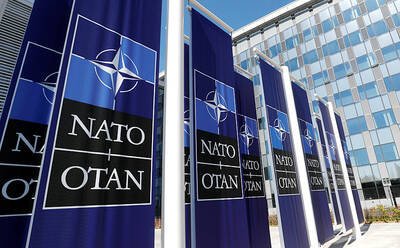
THE HAWAII FACTOR: While a 1965 opinion said an attack on Hawaii would not trigger Article 5, the text of the treaty suggests the state is covered, the report says NATO could be drawn into a conflict in the Taiwan Strait if Chinese forces attacked the US mainland or Hawaii, a NATO Defense College report published on Monday says. The report, written by James Lee, an assistant research fellow at Academia Sinica’s Institute of European and American Studies, states that under certain conditions a Taiwan contingency could trigger Article 5 of NATO, under which an attack against any member of the alliance is considered an attack against all members, necessitating a response. Article 6 of the North Atlantic Treaty specifies that an armed attack in the territory of any member in Europe,
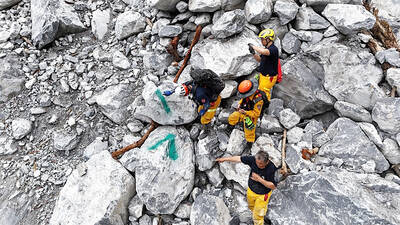
The bodies of two individuals were recovered and three additional bodies were discovered on the Shakadang Trail (砂卡礑) in Taroko National Park, eight days after the devastating earthquake in Hualien County, search-and-rescue personnel said. The rescuers reported that they retrieved the bodies of a man and a girl, suspected to be the father and daughter from the Yu (游) family, 500m from the entrance of the trail on Wednesday. The rescue team added that despite the discovery of the two bodies on Friday last week, they had been unable to retrieve them until Wednesday due to the heavy equipment needed to lift


 RSS
RSS