


President Chen Shui-bian (陳水扁) called on the opposition and the public yesterday to push for rewriting the Constitution and helping build a clean government.
"The true meaning of a transition of power is democratic reform and the deepening of democracy," Chen said.
He said all parties must make an effort to build a more open political environment and a more transparent decision-making process for governmental policies.
"All parties must end the political infighting and jointly push for the constitutional re-engineering project to help build a long-standing democracy," he said.
Chen made the remarks while addressing the joint commencement ceremony of a national development study program and women's leadership study program organized by the Executive Yuan in Taipei.
He said democracy, sustainable development, peace and dialogue were his main goals for the country in his final two years in office.
To ensure sustainable development, Chen said the administration needs to focus on five major areas -- deepening democracy, national security, sustainable economy, social justice and civic society.
He said the country must have sufficient defense capability in the face of China's military threat and the public must unify to protect the nation.
He said that resources must be allocated fairly and efficiently and environmental factors must be taken into consideration when developing the economy.
The president promised to continue pushing tax reform, a national annuity scheme, the "second generation" health insurance program, an improved social security network and caring for the underprivileged.
He said the public, regardless of jobs, class or political affiliations, must face the problems challenging the economy, noting that the Executive Yuan is scheduled to hold a meeting on sustainable economic growth at the end of next month.
Later in the day at the Presidential Office, Chen told a visiting US academic that he would like to conduct political consultations with the opposition parties and dialogues with China.
"It is to the interest of Taiwan and that of the US and Japan if both sides can sit down and talk," he told Kenneth Lieberthal, who teaches Chinese politics at the University of Michigan.
"Currently there are some political disturbances but they will not affect the administration's resolve to stabilize the peaceful status quo across the Taiwan Strait,"he said.
Lieberthal told Chen that both sides might want to consider focusing on economic and cultural exchanges first in a bid to ease cross-strait tension.
In other developments, US representatives Steve Chabot, Sherrod Brown and Dana Rohrabacher, have sent a letter to the Presidential Office noting "with concern" the stalemate in the legislature and the effort to recall Chen.
The congressmen's message, which was sent before the legislature failed to pass the motion to recall the president on Tuesday, stressed "the importance of passing legislation needed for effective governance of the nation."
The lawmakers said they hoped the "focus of the recall doesn't stand in the way of passing legislation essential for the well- being of the populace."
Taiwan's "future as a democracy," it adds, "would be best served if the parties concerned would put Taiwan's national interest above individual or party interests."
The congressmen refrained from commenting on the allegations surrounding Chen, saying they should be dealt with by Taiwan's judicial system
"We assume that in that process, anyone is innocent until proven guilty in a court of law, and that the principle of separation of powers is rigorously respected," the US lawamakers wrote.
Additional reporting by Charles Snyder
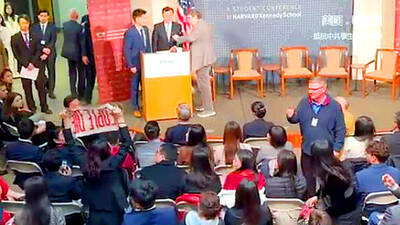
A group of Taiwanese-American and Tibetan-American students at Harvard University on Saturday disrupted Chinese Ambassador to the US Xie Feng’s (謝鋒) speech at the school, accusing him of being responsible for numerous human rights violations. Four students — two Taiwanese Americans and two from Tibet — held up banners inside a conference hall where Xie was delivering a speech at the opening ceremony of the Harvard Kennedy School China Conference 2024. In a video clip provided by the Coalition of Students Resisting the CCP (Chinese Communist Party), Taiwanese-American Cosette Wu (吳亭樺) and Tibetan-American Tsering Yangchen are seen holding banners that together read:

UNAWARE: Many people sit for long hours every day and eat unhealthy foods, putting them at greater risk of developing one of the ‘three highs,’ an expert said More than 30 percent of adults aged 40 or older who underwent a government-funded health exam were unaware they had at least one of the “three highs” — high blood pressure, high blood lipids or high blood sugar, the Health Promotion Administration (HPA) said yesterday. Among adults aged 40 or older who said they did not have any of the “three highs” before taking the health exam, more than 30 percent were found to have at least one of them, Adult Preventive Health Examination Service data from 2022 showed. People with long-term medical conditions such as hypertension or diabetes usually do not
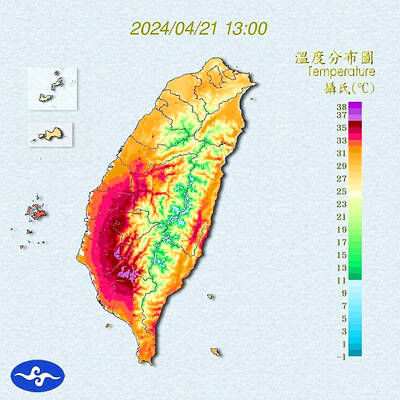
Heat advisories were in effect for nine administrative regions yesterday afternoon as warm southwesterly winds pushed temperatures above 38°C in parts of southern Taiwan, the Central Weather Administration (CWA) said. As of 3:30pm yesterday, Tainan’s Yujing District (玉井) had recorded the day’s highest temperature of 39.7°C, though the measurement will not be included in Taiwan’s official heat records since Yujing is an automatic rather than manually operated weather station, the CWA said. Highs recorded in other areas were 38.7°C in Kaohsiung’s Neimen District (內門), 38.2°C in Chiayi City and 38.1°C in Pingtung’s Sandimen Township (三地門), CWA data showed. The spell of scorching
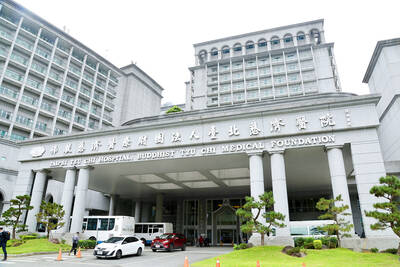
POLICE INVESTIGATING: A man said he quit his job as a nurse at Taipei Tzu Chi Hospital as he had been ‘disgusted’ by the behavior of his colleagues A man yesterday morning wrote online that he had witnessed nurses taking photographs and touching anesthetized patients inappropriately in Taipei Tzu Chi Hospital’s operating theaters. The man surnamed Huang (黃) wrote on the Professional Technology Temple bulletin board that during his six-month stint as a nurse at the hospital, he had seen nurses taking pictures of patients, including of their private parts, after they were anesthetized. Some nurses had also touched patients inappropriately and children were among those photographed, he said. Huang said this “disgusted” him “so much” that “he felt the need to reveal these unethical acts in the operating theater


 RSS
RSS