


The opposition-initiated motion to recall President Chen Shui-bian (
"The recall campaign has drifted away from its original aim and become an ideological confrontation between pan-blue and pan-green supporters," said Wang Yeh-li (王業立), a political science professor at Tunghai University. "Leaders of the two camps should be held culpable for causing political and social unrest."
Wang criticized Chinese Nationalist Party (KMT) Chairman Ma Ying-jeou (

PHOTO: CHAN CHAO-YANG, TAIPEI TIMES
Ma said earlier this month that Chen would "die a horrible death" if he didn't step down immediately, and urged the president to voluntarily resign instead of waiting to be recalled.
Ma later admitted that his remarks were improper, but argued that he had simply been angry about Chen's lack of sincerity in responding to the scandals involving his family members.
Ma's comments irked pan-green supporters, who allegedly called in to pirate radio stations down south encouraging others to end Ma's life.
Wang also questioned whether Chen was inciting ethnic friction to take some of the heat off himself.
Wang said that Ma, instead of effectively and responsibly responding to the recent spate of corruption scandals plaguing the administration, had succumbed to pressure from his supporters and People First Party Chairman James Soong (
The pan-blue camp claimed that what mattered was the process rather than the end result, realizing that the recall bid was doomed to fail because of the high legal threshold.
The pan-green alliance, on the other hand, criticized the pan-blue camp for pursuing a political agenda and decided to play it cool by boycotting the opposition's plan.
The last two legislative hearings organized by pan-blue lawmakers turned out to be a rehash of TV political talk shows with the absence of guests.
Apart from the political wrestling in the legislature, both camps have mobilized their supporters to stage large-scale protests around the nation.
Commenting on the political strife, Wang said that the public has gradually lost interest in the pan-blue camp's plan, which was originally designed to exhibit the corrupt side of the administration.
"The pan-green camp's counter strategy to play it cool proved efficient, although there is still room for discussion in terms of the president's decision to skip the issuance of a rebuttal to the recall motion," he said. "To respond to the recall motion is not only his legal right but also his constitutional duty."
No matter what justifications the pan-blue alliance made to vindicate their recall motion, Wang said that Chen was duty bound to offer a statement and let the legislature and public judge it.
Ivor Yang (楊奕華), a professor of law at Soochow University, however, expressed a different opinion.
The law does not specify whether the person being recalled must respond. In other words, the president can choose whether to respond to the recall proposal.

Former president Ma Ying-jeou’s (馬英九) mention of Taiwan’s official name during a meeting with Chinese President Xi Jinping (習近平) on Wednesday was likely a deliberate political play, academics said. “As I see it, it was intentional,” National Chengchi University Graduate Institute of East Asian Studies professor Wang Hsin-hsien (王信賢) said of Ma’s initial use of the “Republic of China” (ROC) to refer to the wider concept of “the Chinese nation.” Ma quickly corrected himself, and his office later described his use of the two similar-sounding yet politically distinct terms as “purely a gaffe.” Given Ma was reading from a script, the supposed slipup
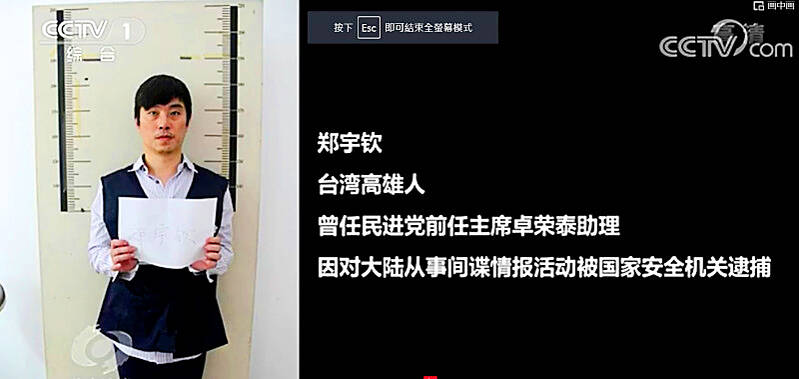
Former Czech Republic-based Taiwanese researcher Cheng Yu-chin (鄭宇欽) has been sentenced to seven years in prison on espionage-related charges, China’s Ministry of State Security announced yesterday. China said Cheng was a spy for Taiwan who “masqueraded as a professor” and that he was previously an assistant to former Cabinet secretary-general Cho Jung-tai (卓榮泰). President-elect William Lai (賴清德) on Wednesday last week announced Cho would be his premier when Lai is inaugurated next month. Today is China’s “National Security Education Day.” The Chinese ministry yesterday released a video online showing arrests over the past 10 years of people alleged to be
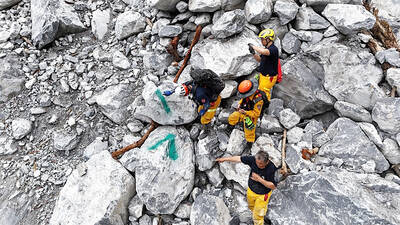
The bodies of two individuals were recovered and three additional bodies were discovered on the Shakadang Trail (砂卡礑) in Taroko National Park, eight days after the devastating earthquake in Hualien County, search-and-rescue personnel said. The rescuers reported that they retrieved the bodies of a man and a girl, suspected to be the father and daughter from the Yu (游) family, 500m from the entrance of the trail on Wednesday. The rescue team added that despite the discovery of the two bodies on Friday last week, they had been unable to retrieve them until Wednesday due to the heavy equipment needed to lift
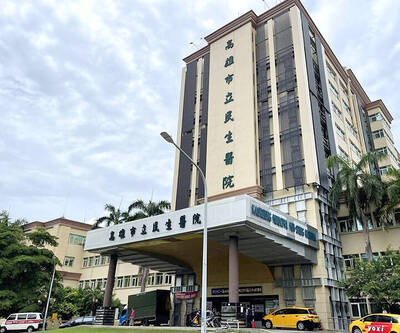
MIX-UP: Kaohsiung Municipal Min-Sheng Hospital director Yen Chia-chi was suspended from his duties after surgeons operated on the wrong patient last week The Kaohsiung Department of Health yesterday fined Kaohsiung Municipal Min-Sheng Hospital NT$500,0000 for misidentifying two patients and consequently causing one of them to undergo the wrong surgery last week. The hospital’s director Yen Chia-chi (顏家祺) was suspended from his duties. The surgeon who was scheduled to operate on the patient was given a major demerit and is subject to subsequent disciplinary actions. Demerits were given to the anesthesiologist, the nurse in the operation room, the nurse in the ward and the worker who helped transfer the patient from the ward to the operation room for having failed to verify the patient’s identity. Meanwhile, the


 RSS
RSS