


President Chen Shui-bian's (
"Power brings with it responsibility. All Cabinet and [Democratic Progressive Party (DPP)] members must from now on be ready to take up their responsibilities," she said. "It is the president's `blue ocean' strategy to delegate power to the Cabinet and party members."
The "Blue Ocean Strategy" is the subject of a book written by W. Chan Kim and Renee Mauborgne. Kim and Mauborgne argue that cutthroat competition results in nothing but a bloody, red ocean of rivals fighting over a shrinking profit pool.
The authors advocate the idea of "winning by not competing," or achieving lasting success not by battling competitors, but by creating "blue oceans": untapped sectors ripe for growth.
Kim and Mauborgne claim that strategic moves of this nature -- which they call "value innovation" -- create powerful leaps in value that often render rivals obsolete for more than a decade.
Lu made the remarks after addressing an international conference on medical equipment in Taipei. She was responding to the announcement that Chen made late on Wednesday night.
Chen said he would relinquish party responsibilities and focus solely on doing his job as the president, leaving it to ranking Cabinet and DPP members to make their own calls on other matters.
In other words, all Cabinet-related matters, including nominations of Cabinet personnel, would from now on be in the hands of Premier Su Tseng-chang (
Chen will also no longer participate in the DPP's internal affairs, nor campaign on behalf of party members running for public office.
Chen's decision has received mixed reactions from party members and opposition parties.
Some have criticized the move as a political gamble undertaken to divert public attention away from a recent spate of scandals plaguing the president's family and close aides.
Others have interpreted Chen's decision as a strategic attempt to address his flagging popularity.
When asked how she defines her own position in the wake of the announcement, Lu said that while Chen remained the head of state, she was "still the vice president until 2008."
Lu also dismissed a report in yesterday's Chinese-language China Times newspaper, which claimed that Chen was unhappy about her secretly organizing a meeting with opposition parties.
Lu said she had informed Chen about her actions and that he was not unhappy about them.
Meanwhile, Presidential Office Secretary-General Mark Chen (
He confirmed that there would soon be a personnel reshuffle, but refused to disclose any details.
On Wednesday, executive member of the Taipei Society Hong Yu-hung (
The four in question are Deputy Presidential Secretary-General Ma Yung-cheng (馬永成), Minister of Education Tu Cheng-sheng (杜正勝), Minister of Finance Joseph Lyu (呂桔誠) and Minister of Transportation and Communications Kuo Yao-chi (郭瑤琪).
The Ministry of Foreign Affairs said yesterday that despite being part of the Executive Yuan, it would continue to take directives from the president.
The Constitution does not specify that it is the president's duty to set foreign policies, but the National Security Council Organization Law (
Such policies cover the areas of defense, foreign affairs, cross-strait and major national disasters.
During a visit by the premier to the legislature yesterday, Legislative Speaker Wang Jin-pyng (王金平) said: "I would like to congratulate [the premier] on obtaining real administrative power. I believe that [Su] can now put his skills to good use and play a decisive role in politics."
Su was low-key in response, saying the president had given the Cabinet greater responsibilities.
"[The president's announcement] made it clear how sincere he is to push reform and meet the public's expectations," Su said.
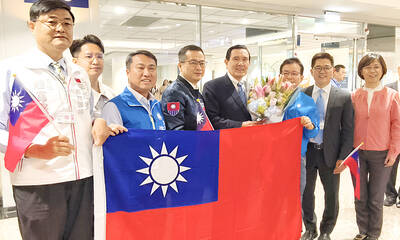
Former president Ma Ying-jeou’s (馬英九) mention of Taiwan’s official name during a meeting with Chinese President Xi Jinping (習近平) on Wednesday was likely a deliberate political play, academics said. “As I see it, it was intentional,” National Chengchi University Graduate Institute of East Asian Studies professor Wang Hsin-hsien (王信賢) said of Ma’s initial use of the “Republic of China” (ROC) to refer to the wider concept of “the Chinese nation.” Ma quickly corrected himself, and his office later described his use of the two similar-sounding yet politically distinct terms as “purely a gaffe.” Given Ma was reading from a script, the supposed slipup
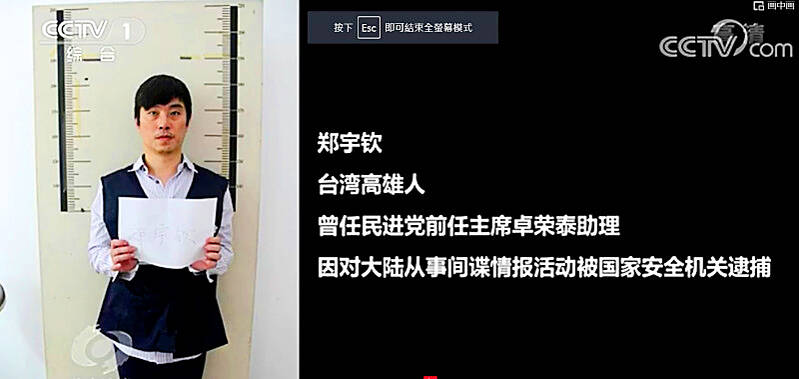
Former Czech Republic-based Taiwanese researcher Cheng Yu-chin (鄭宇欽) has been sentenced to seven years in prison on espionage-related charges, China’s Ministry of State Security announced yesterday. China said Cheng was a spy for Taiwan who “masqueraded as a professor” and that he was previously an assistant to former Cabinet secretary-general Cho Jung-tai (卓榮泰). President-elect William Lai (賴清德) on Wednesday last week announced Cho would be his premier when Lai is inaugurated next month. Today is China’s “National Security Education Day.” The Chinese ministry yesterday released a video online showing arrests over the past 10 years of people alleged to be
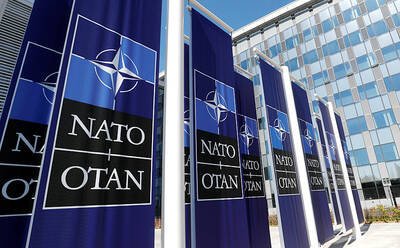
THE HAWAII FACTOR: While a 1965 opinion said an attack on Hawaii would not trigger Article 5, the text of the treaty suggests the state is covered, the report says NATO could be drawn into a conflict in the Taiwan Strait if Chinese forces attacked the US mainland or Hawaii, a NATO Defense College report published on Monday says. The report, written by James Lee, an assistant research fellow at Academia Sinica’s Institute of European and American Studies, states that under certain conditions a Taiwan contingency could trigger Article 5 of NATO, under which an attack against any member of the alliance is considered an attack against all members, necessitating a response. Article 6 of the North Atlantic Treaty specifies that an armed attack in the territory of any member in Europe,
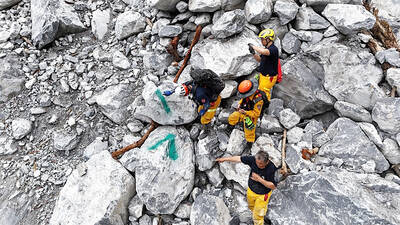
The bodies of two individuals were recovered and three additional bodies were discovered on the Shakadang Trail (砂卡礑) in Taroko National Park, eight days after the devastating earthquake in Hualien County, search-and-rescue personnel said. The rescuers reported that they retrieved the bodies of a man and a girl, suspected to be the father and daughter from the Yu (游) family, 500m from the entrance of the trail on Wednesday. The rescue team added that despite the discovery of the two bodies on Friday last week, they had been unable to retrieve them until Wednesday due to the heavy equipment needed to lift


 RSS
RSS